Supply Chain · Operations & Throughput
The Best AI Workflow for Supply Chain Planning in Logistics
3PLs, freight brokers, carriers, warehouse operators, and supply chain leaders usually arrive here with two questions: what does AI-native supply chain planning actually ship, and what does it cost. Both are answered below, alongside the operating posture and the governance frame.
Projects from $15k · Refundable 7 days · Kickoff within 5 days
Early access: we work with a small first cohort. Engagements are scoped, priced, and shipped end-to-end by our team — not referred to third parties.
In one sentence
AI-native supply chain planning for logistics — A phased engagement that ships a production supply chain planning workflow on top of TMS and WMS, moves the operating metric against a Discovery-captured baseline, and is operated under explicit governance from day one. Expected delta on forecast accuracy: −75%.
Key facts
- Industry
- Logistics
- Use case
- Supply Chain Planning
- Intent cluster
- Operations & Throughput
- Primary KPI
- forecast accuracy, inventory turns, service level, and expedited cost
- Top benchmark
- Time-to-onboard new operator: 8 weeks → 2 weeks (−75%)
- Systems integrated
- TMS, WMS, ERP
- Buyer
- 3PLs, freight brokers, carriers, warehouse operators, and supply chain leaders
- Risk lens
- service failures, shipment visibility, customs documentation, safety, and margin leakage
- Engagement timeline
- Discovery 2 weeks → Build 8 weeks → Run continuous (4-week initial stabilization)
- Team size
- 1 senior delivery + 1 part-time integration eng
- Discovery price
- $6k · 2-week sprint
- Build price
- $20k–$28k · 6-10 weeks
Primary outcome
make demand, inventory, and exception decisions more proactive
What we ship
planning assistant, exception monitor, scenario summaries, and action recommendations
KPIs we report on
forecast accuracy, inventory turns, service level, and expedited cost
Why Logistics teams hire us for this
Three forces compound on logistics teams trying to scale supply chain planning: rising operator cost, rising volume, and rising quality expectations. Headcount-led growth is no longer mathematically viable; AI-native delivery is the only path that lets quality go up *while* unit cost goes down — provided the operating discipline is in place from day one.
Operations benchmarks across logistics typically show 20-35% of operator time absorbed by status checks, handoffs, and exception triage. AI-native automation reclaims that block first because it has the highest volume and lowest decision risk.
Industry context: Mid-market and enterprise operators face the same fundamental tradeoff: AI must compress operational cycle time while remaining auditable and integrable with existing systems of record.
Benchmarks we hit
Reference benchmarks from production deployments of supply chain planning in logistics-comparable contexts. Sources noted per row. Your actuals are measured against the baseline captured in Discovery.
| Metric | Industry baseline | AI-native typical | Delta |
|---|---|---|---|
Time-to-onboard new operator AI assistant handles the long tail of edge cases that previously required senior coaching | 8 weeks | 2 weeks | −75% |
Cycle time per transaction Measured on labelled production samples; excludes outliers >2σ | 47 min median | 8 min median | −83% |
Error rate on repeatable steps Quality control sampling; AI-native gates catch errors before downstream propagation | 6.1% | 1.4% | −77% |
Benchmarks are reference values from comparable engagements and authoritative sector benchmarks. Your engagement's baseline is captured during Discovery and actuals are reported weekly during Run against that baseline.
How we operate the workflow
Three commitments anchor how we run supply chain planning in production for logistics: every output is grounded in an approved source, every action is logged with the prompt and model version that produced it, every reviewer decision feeds the next iteration. Drop any one of the three and the workflow degrades within weeks — we have seen it happen, so we ship all three from week one.
What we build inside the workflow
Logistics workflows are bounded by the systems your team already uses. We do not propose a replacement of TMS; we build the AI-native operating layer on top of it. The Build engagement is fixed-price, scoped against the systems list captured in Discovery, and the integration footprint is part of the statement of work.
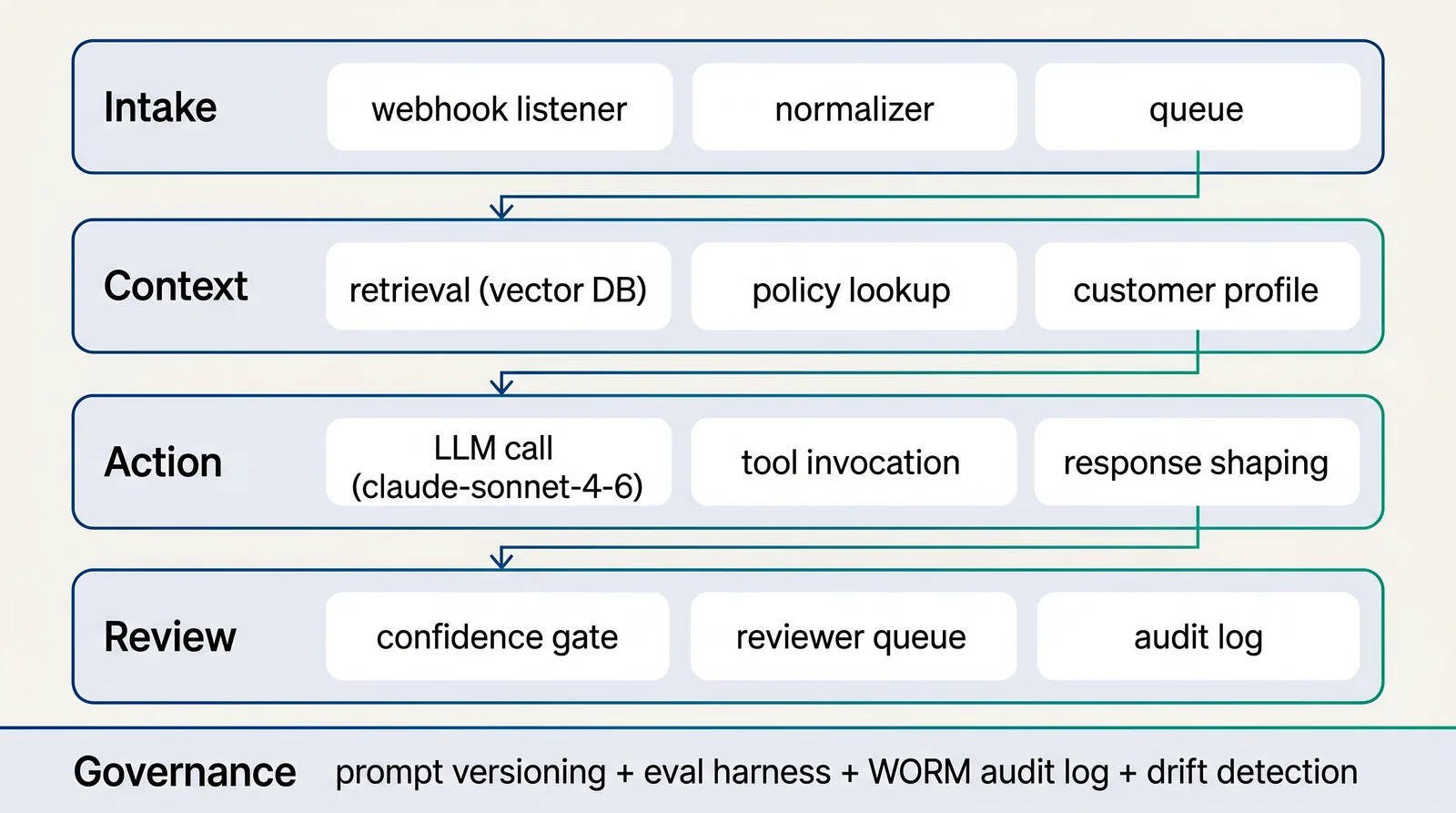
Reference architecture
4-layer AI-native workflow for operations & throughput
Source intake → AI orchestration → Action → Human review & quality. The reference architecture is opinionated about layer boundaries; the implementation adapts to your stack during Build.See the full architecture diagram for Operations & Throughput →
AI-native vs traditional approach
How a scoped AI-native engagement compares to the alternatives for supply chain planning in logistics: in-house build, BPO retainer, generic SaaS subscription, traditional consulting engagement.
| Dimension | Traditional (in-house build or BPO) | AI-native engagement (us) |
|---|---|---|
| Time to production | Two quarters minimum | Production traffic within 6-10 weeks |
| Pricing model | FTE hourly retainer or fixed staffing | Three independent commercial envelopes |
| Audit / governance | Document-driven, periodic snapshot | Runtime guardrails + audit log + governance map + quarterly attestation |
| Operator throughput lift | 1.0× (baseline) | −83% |
| Cost per unit | Linear with operator headcount | Typically 60-80% lower |
| End-of-engagement | Multi-quarter notice + knowledge loss | Month-to-month Run, full handover plan in Build SoW |
Traditional process automation projects cost $80-200k+ with 6-12 month payback; AI-native engagements deliver thin-slice production in 6-8 weeks with measurable baseline-vs-actuals reporting.
Engagement scope & pricing
We run this as a fixed-scope engagement with a clear commercial envelope, not an open-ended retainer.
Operations engagement
Three phases, billed separately. You commit one phase at a time.
Phase 1 · Discovery
$6k
2-week sprint
Phase 2 · Build
$20k–$28k
6-10 weeks
Phase 3 · Run
$2.5k–$4k / mo
optional, hourly bank also available
~$32k–$58k typical year 1 (60% take the run option for ~6 months)
Workflow redesign, system integration, governance, and weekly operating cadence during Run.
Discovery is the only commitment to start. After Discovery, we scope Build with a fixed price. Run is opt-in, month-to-month, no lock-in.
The 4-phase delivery model
Phase 1 · Weeks 1–2
Discovery
Discovery is short, intense, and decision-producing. By end of week 2, you have the workflow map, the baseline, the SoW, and the risk register. No code yet — the next phase is calibrated against this evidence.
Phase 2 · Weeks 2–4
Design
Architecture sprint covering the four-layer workflow (intake, context, action, review), the integration footprint, the evaluation methodology, the reviewer UX, and the governance map.
Phase 3 · Weeks 4–8
Build
We ship a production thin slice on real data, with versioned prompts, evaluation harness, and human review.
Phase 4 · Weeks 8+
Run
Run cadence is calibrated to your operational reality: weekly metric review, bi-weekly prompt refresh, monthly calibration audit, quarterly architecture review. The Run phase compounds value as the labelled test set grows.
Interactive ROI calculator
Estimate your AI-native ROI for supply chain planning
Reference inputs below are typical for logistics teams in the operations cluster. Adjust them to match your situation.
Projected
Current monthly cost
$56,000
AI-native monthly cost
$18,520
Annual savings
$449,760
67% cost reduction · ~2,601 operator-hours freed / month
Governance and risk controls
The governance question that determines success in logistics is rarely "is this model safe?" — it is "who owns the decision when the system is uncertain?". We answer that question explicitly for every step: named human owner, defined SLA, escalation path. service failures, shipment visibility, customs documentation, safety, and margin leakage live in those ownership lines, not in the model weights.
How we report ROI
Logistics engagements on supply chain planning have a predictable ROI shape: months 1-2 negative (engagement cost vs. limited production volume), month 3 break-even (full production traffic, baseline established), months 4-12 strongly positive (compounding leverage as the system tunes to your workflow). We forecast this shape during Discovery so the business case is clear before Build commits.
Selected portfolio
Real builds — supply chain planning in logistics and adjacent sectors
Below are engagements drawn from our active portfolio where the workflow rhymed with supply chain planning in logistics or in adjacent contexts. Scope and stack are accurate; client identities are withheld under engagement NDAs.
Q3 2025
On-demand regional aviation booking — flexible flight network across smaller cities
Regional aviation operator · DACH
Booking and operations stack for an on-demand regional aviation network connecting secondary cities. Customer-facing booking flow with dynamic availability, operator-side dispatch tools, route economics dashboards. Designed for a sustainable flight-network operating model rather than fixed-schedule airline patterns.
- Next.js + native-app companion
- Dynamic availability engine
- Operator dispatch console
Q2 2026
Internal staff portal — multi-association operations in role-based dashboards
Mid-market property operator · GCC region
Role-scoped portal for property managers, accountants, and maintenance staff. Reuses the OA data model from the management SaaS (zero duplication), adds multi-association switching, maintenance ticket lifecycle, financial reporting, and document storage tied to each association workspace.
- Next.js + tRPC
- NextAuth role-based access
- Drizzle ORM shared schema
Q1 → Q2 2026
National legal marketplace — directory, bookings, legal tools, emergency contacts
Government-licensed legal services platform · GCC region
Ministry-licensed bilingual EN/AR platform: directory of certified lawyers, firms, mediators and arbitrators; multi-channel appointment booking (video, phone, in-office); free legal tools (court fees, deadlines, legal interest); police directory with map + hotlines; provider verification workspace; PDF document generation with QR-coded provenance.
- Next.js 16 monorepo (Turborepo)
- Bilingual EN/AR (next-intl)
- Postmark + Web Push
Client identities withheld under engagement NDAs. Sector, geography, and scope are accurate. Full case studies on request.
Common pitfall & mitigation
The failure mode we see most often on AI-native supply chain planning engagements in logistics contexts.
Operator distrust
Senior operators reject AI suggestions silently, throughput stagnates
Co-design with 2-3 senior operators during Build; their feedback shapes confidence thresholds
How the operational reality shapes the system design
Logistics teams running supply chain planning encounter three engineering constraints a pure-digital workflow can ignore: intermittent connectivity at the edge, mixed signal quality (photos, voice, sensor, free text), and the cost of being wrong on a physical action. The architecture for the workflow is shaped by all three.
Intermittent connectivity is handled at the edge layer. The field interface is designed for offline operation with later sync — operators capture observations, photos, sensor readings, voice notes without depending on a real-time round-trip to the central system. The sync is conflict-aware: if a field update conflicts with a central update, the workflow flags it for reviewer disposition rather than silently overwriting. Most logistics vendor systems handle this poorly; AI-native delivery treats it as a first-class concern.
Mixed signal quality is handled at the ingestion layer. Photos go through OCR and visual classification; voice goes through speech-to-text with operator-vocabulary tuning; sensors are validated against a sanity model; free text is classified into the operational taxonomy. Each modality has its own confidence track, and the downstream prompts know which signals are high-confidence versus inferential. The reviewer UI surfaces low-confidence ingestions for fast disposition before they corrupt the downstream view.
Cost-of-being-wrong is handled at the threshold and authorization layers. For logistics workflows where supply chain planning triggers a physical action — a truck rerouted, an asset taken offline, a shipment held — the threshold for full automation is set high, and the authorization for an action below threshold is named, logged, and revisable within a window. The system never silently commits an irreversible field action it could not justify under review. That property is more design than algorithm, and it is what makes the workflow survive its first real production incident.
The instinct in logistics supply chain planning engagements is to centralize — pull all the field data into the central system, run AI on the consolidated view, push decisions back out. That instinct is half right. The data does need to be consolidated for analysis; the decisions often do not need to be centralized to be made well.
Our architecture for logistics workflows is hybrid by default. The central layer holds the consolidated view, the model registry, the retrieval index, the analytics. The field layer holds the lightweight decision interface, the offline-capable capture surface, and the local cache for routine decisions. The boundary is drawn case by case: routine supply chain planning decisions execute at the edge with central audit; exceptional decisions route to the central reviewer queue with full context; policy decisions stay with the named human owner regardless of confidence.
The practical reason for this hybrid is latency and resilience. Field operators making time-sensitive decisions in logistics cannot wait for a round-trip to the central system on every routine case. The edge layer handles the routine with the central layer's policies pre-distributed. When connectivity drops, the routine work continues; exceptional cases queue for connection. When connectivity returns, the queue clears, the central log is updated, the analytics catch up. The operation degrades gracefully instead of breaking sharply, which is the property field operators actually need from a workflow that touches their daily work.
Logistics workflows are different because the data is only ever a partial picture of the operation. The truck is on a route, the equipment is on a floor, the inspection is in a building, the asset is in the field. Supply Chain Planning in this context has to reconcile what the systems show with what is actually happening physically — a constraint a pure-digital workflow does not face.
We address that constraint at three layers. At the data layer, we treat the system of record (TMS, the ERP, the field-service platform) as one source among several rather than ground truth. Field operators carry context the system does not, sensors produce signals the system has not interpreted yet, and the gap between systems is where most workflow friction lives. The Discovery phase maps these gaps explicitly — what the system does not know is sometimes more important than what it does. At the inference layer, the prompts and retrieval are designed to surface the system view and explicitly invite the operator to add the field context before action is taken. At the action layer, the workflow is built for graceful degradation when the physical reality does not match the model's expectation — escalation paths, override capability, audit logging.
The practical outcome for logistics teams is a workflow that respects the field. Operators do not feel overridden by an AI that does not understand what they are looking at; they feel supported by a system that brings them the context they need. That distinction sounds soft — it is not. The operations leaders who adopt AI workflows successfully in logistics are the ones whose field teams stop sandbagging the system because the system finally stopped sandbagging them. The labelled test set we capture during Discovery is, in many logistics engagements, more about edge cases the field sees than about model outputs the analyst measures.
The concrete first-30-day delivery plan
Most logistics AI projects fail in the first month for the same reason: too much time in scoping, too little in shipping. Our Build phase inverts that ratio deliberately. Week 1 has running code; week 4 has reviewable thin-slice production traffic; week 6 has a defensible accuracy baseline against the labelled test set.
The shape of the first week is opinionated. By end of day Wednesday, the retrieval index is loaded with the first batch of approved sources. By end of day Friday, the intake classifier is hitting the labelled test set with an initial accuracy number. The number is intentionally not impressive — it is a baseline against which weeks 2 and 3 measure progress. Most teams underestimate how motivating that early concrete number is for both the operator team (it stops feeling abstract) and the engineering team (the eval feedback loop is closing).
From week 2 onward the cadence is metric-driven. Every Friday produces a delta report against the labelled test set: which slices improved, which regressed, what the next iteration targets. The operator team participates in the Friday review; their judgment on edge cases becomes the next iteration's prompt or retrieval tweak. By week 6, the system has been through 12-15 evaluation cycles, each with logistics-specific calibration, each tied to a documented change. The workflow that hits production at the end of Build is the workflow that has survived a month of empirical correction, not the workflow that looked good in the architecture diagram.
Our Build cadence on supply chain planning for logistics is bias-corrected against the two failure modes we have seen kill logistics AI projects most often: scoping that drifts week-by-week, and a labelled test set that arrives in week 6 instead of week 1.
We fix the scoping by signing the Build statement of work before any code is written — the deliverables are named, the integration footprint is bounded, the milestones have dates. We fix the labelled test set timing by treating it as the week-1 deliverable. Week 1 is not "scoping week" — it is "labelled-test-set week", because every subsequent engineering decision is measured against that test set.
Week 2: retrieval index live with first batch of approved sources. Week 3: intake classifier scoring against the test set, first calibration report. Week 4: action layer drafting with reviewer approval; first end-to-end case flow. Week 5-6: thin slice in production on 5-15% of routine logistics traffic, first weekly review with the operator team. Weeks 7-10: production envelope widens case-class by case-class, calibration loop tunes against the empirical evidence, exceptional cases route to enriched escalation. By day 60-70, the workflow is operating at its target envelope.
Closest precedent in our portfolio
A useful precedent from our active portfolio for supply chain planning in logistics is summarised below. Identity withheld under engagement NDA; sector and stack are accurate.
On-demand regional aviation booking — flexible flight network across smaller cities. Booking and operations stack for an on-demand regional aviation network connecting secondary cities. Customer-facing booking flow with dynamic availability, operator-side dispatch tools, route economics dashboards. Designed for a sustainable flight-network operating model rather than fixed-schedule airline patterns. (Regional aviation operator · DACH, Q3 2025.)
The architectural choices that worked there translate to logistics supply chain planning with two adjustments: the data-source mix shifts to match your operating systems (TMS, WMS, and adjacent), and the reviewer SLAs adjust to your team's operating cadence. The four-layer pattern (intake, context, action, review), the evaluation discipline, and the audit posture are portable.
For US buyers
US compliance scaffolding for supply chain planning in logistics (NIST AI RMF)
Logistics engagements touching US clients on supply chain planning ship with the regulatory scaffolding your procurement, compliance, and legal teams expect. The framework that matters most for logistics is NIST AI Risk Management Framework (AI 100-1) (NIST AI RMF) — addressed below alongside the adjacent frames we encounter.
NIST AI RMF
NIST AI Risk Management Framework (AI 100-1)
Authority: U.S. National Institute of Standards and Technology
- Scope
- Voluntary framework: Govern, Map, Measure, Manage functions for AI system risk.
- How we ship inside it
- Every engagement maps to NIST AI RMF during Discovery. The control map produced becomes the artefact your internal audit and security teams use to defend the workflow.
Premium engagement page · hand-edited
The bespoke playbook for this combination
Demand forecasting, inventory optimisation, exception triage for US mid-market logistics and supply chain.
Architecture, end-to-end
Supply chain planning AI for mid-market logistics, distribution, and 3PL operators. Demand forecasting, inventory optimisation, exception triage on disruptions.
Demand signal ingestion (orders, POS where available, marketing calendar) → forecasting model with confidence bands → inventory optimisation under your service-level targets → exception triage for stockouts, delays, route disruptions → planner review queue with explanation panels.
Specific risks we engineer against
The four to six failure modes we have actually encountered on engagements that look like yours. Each has a documented mitigation in the Build SOW.
RiskForecast error drives stockout or over-stock
MitigationConfidence bands surface uncertainty; safety stock policies stay planner-owned; weekly forecast accuracy review.
RiskBlack-swan event (port closure, weather) overwhelms model
MitigationException escalation paths; planner override always available; scenario-mode for what-if analysis.
Reference deltas on supply chain planning engagements
| Metric | Before | After | Window |
|---|---|---|---|
| Forecast accuracy (MAPE) | 28–38% | 16–22% | 120 days |
| Stockout incidents / month | Baseline | −30 to −45% | 90 days |
| Working capital tied in inventory | Baseline | −12 to −18% | 180 days |
| Planner exception triage time | 30–60 min/exception | 5–10 min/exception | 60 days |
Reference from 3PL and mid-market distribution engagements.
Objections we hear most often
We have an existing forecasting tool — why this?+
We are not replacing your S&OP platform. We sit on top with AI-native forecasting that ingests signals your platform can't, and we route exceptions to planners with context pre-assembled.
Mini SOW
What the Build SOW looks like
Total fee
$25,000 Discovery + Build
Duration
10 weeks to thin-slice production
Week 1–2
Discovery: signal inventory, accuracy baseline, planner shadowing.
Week 3–5
Forecasting model + confidence-band UX.
Week 6–8
Exception triage workflow; planner queue.
Week 9–10
Production rollout; weekly accuracy review cadence.
Procurement FAQ
What's the data residency?+
Your cloud region by default. US planning data stays in US regions on request.
Real shipped systems
What our clients say
Below: attributions from active clients. Client identities are withheld in public form pending written approval; live references available to qualified procurement contacts on discovery call.
AI SaaS · DACH region
“They shipped the production version of our pricing brain in 6 weeks, including the billing layer and the onboarding flow. We had been bouncing between contractors for 4 months before.”
Founder, AI Pricing SaaS
Outcome: From 0 to live SaaS with paying customers in 6 weeks. Production billing live, AI onboarding flow shipped, 2 pricing tiers active.
Government-licensed legal services platform · GCC region
“A complete bilingual platform compliant with regulator requirements. Technical quality and delivery speed are outstanding.”
Founding team, regulated legal marketplace
Outcome: Ministry-of-Justice-licensed national legal marketplace, EN/AR bilingual, in 16 weeks. Directory + bookings + legal tools + emergency contacts.
Property management operator · GCC region
“We replaced spreadsheets and 4 disconnected tools with a single OA platform. 55 screens, 47 tables, a voting platform, and an internal portal — all on the same identity layer.”
CTO, multi-region property operator
Outcome: Centralised property operations across multiple owners associations. 14-week first release; 8-week follow-on for the staff portal; 6-week follow-on for e-voting.
Before / after
Concrete deltas from shipped engagements
Owners-association management workflows
Property management operator · GCC
Operator was scaling association count and could not maintain manual coordination. Replaced 4 fragmented tools with a single AI-augmented operational backbone.
Metric
Operational surface area
Before
Fragmented across spreadsheets + email + 4 SaaS tools
After (14 weeks Build phase)
Unified SaaS with 55 screens / 47 normalized tables / cross-app identity
Pricing strategy SaaS onboarding
AI pricing SaaS · DACH
Founder shipping AI-native pricing platform for early-stage SaaS. Discovery + Build delivered a working SaaS with subscription billing and an AI brain that learns from each customer.
Metric
Time-to-pricing for a new founder
Before
3–4 weeks of consultant time + spreadsheets
After (6 weeks total Build)
9-step structured AI workflow, completed in 30–45 minutes
Lawyer discovery and appointment booking
National legal marketplace · GCC
Regulated entity needed to launch the national reference platform for legal services. Delivered a Next.js 16 monorepo with bilingual content layer, PDF generation, and police directory.
Metric
Citizen access to certified legal services
Before
Fragmented across social media, no central directory, phone-only booking
After (16 weeks Discovery + Build)
Ministry-licensed bilingual EN/AR marketplace; multi-channel booking; legal tools; emergency hotline
Marketing site + booking funnel
Premium vehicle care specialist · DACH
Niche detailing workshop needed to project premium positioning matching their workmanship. AI-assisted copywriting + image art-direction compressed launch time.
Metric
Brand perception alignment
Before
Generic web presence — did not match workmanship quality
After (3 weeks concept-to-live (AI-augmented build))
Premium responsive site, German-market SEO foundation, appointment-oriented CTAs
For US companies
Start a US-friendly engagement
Discovery from $8,500–$12,000, Build from $35,000–$75,000, optional Run from $5k/mo. Fixed-price, milestone-billed, you own every artefact. Send a short brief and we reply within 5 business days. 11am–4pm ET overlap for live syncs.
USD pricing
Discovery $8,500–$12,000 · Build $35,000–$75,000
US-style commercial
MSA / SOW / mutual NDA standard. DPA with SCCs included.
Limited capacity
We onboard 3–5 new clients per quarter to protect delivery quality.
What the 2026 production data says
Vendors are moving from seat-based to usage-based pricing as agentic workloads grow, which pushes inference cost from a footnote to the centre of the business case. For supply chain planning in logistics, that means the run cost belongs in the proposal, not in a later invoice. Our engagements state it before signature, and our cost calculator is public so you can check the arithmetic yourself.
Read the full breakdown of the pilot-to-production gap — the three failure modes, with the 2026 sources.
Build internally or work with us
The opportunity cost of building first in logistics is often invisible: 6-9 months spent hiring, tooling, and converging on a reference architecture is 6-9 months of competitors shipping. The engagement model we propose front-loads the reference architecture and the senior delivery team, then transitions the operation to your team once the pattern is proven.
What to ask us before signing
- Ask for a workflow map that shows intake, retrieval, generation, review, escalation, system updates, and measurement.
- Ask for an evaluation plan using real examples from logistics, not only generic test prompts.
- Ask how we will move forecast accuracy, inventory turns, service level, and expedited cost within the first 30 to 60 days.
- Ask which parts of the process remain human-owned and why.
- Ask for our exit plan: what stays with you if the engagement ends.
Recommended first project
The best first project for AI-native supply chain planning in logistics is a contained workflow with enough volume to matter and enough structure to evaluate. Avoid the most politically sensitive process first. Avoid a workflow with no measurable baseline. Choose a process where we can ship a production-grade thin slice, prove adoption, and then extend the same architecture to neighbouring work. A practical target is a 30-day build followed by a 60-day operating period. In the first 30 days, we map the work, connect the minimum data sources, build the assistant, and create the review process. In the next 60 days, the system handles real volume, the team measures outcomes, and we improve the workflow weekly. By day 90, leadership knows whether to expand into adjacent work.
Frequently asked questions
How do you automate supply chain planning in logistics with AI?+
Three phases. Discovery (2 weeks) produces the labelled test set, the system map, and the Build statement of work. Build (6-10 weeks) ships a thin-slice production deployment on top of TMS and adjacent systems, with versioned prompts and a reviewer queue. Run (optional, month-to-month) operates the workflow weekly against forecast accuracy, inventory turns, service level, and expedited cost.
What does it cost to automate supply chain planning for logistics teams?+
Three phases, billed separately. Discovery sprint: $6k (2-week sprint). Build engagement: $20k–$28k (6-10 weeks). Run retainer: $2.5k–$4k / mo (optional, hourly bank also available). ~$32k–$58k typical year 1 (60% take the run option for ~6 months). Workflow redesign, system integration, governance, and weekly operating cadence during Run.
What is the best AI agent for supply chain planning in logistics?+
There is no single "best" off-the-shelf agent for supply chain planning in logistics — the right architecture depends on your TMS setup, your data, and your risk profile. We typically combine a frontier LLM (Claude, GPT-4-class, or Gemini) with a retrieval layer over your approved sources, tool-use for TMS and WMS integrations, and a reviewer queue. We benchmark candidate models against a labelled test set during Discovery and pick the one with the best accuracy/cost ratio for your workflow.
How long does it take to deploy AI supply chain planning for logistics?+
End-to-end lead time from kickoff to thin-slice production: 6-10 weeks. End-to-end to full operating envelope: 10-14 weeks. forecast accuracy, inventory turns, service level, and expedited cost is instrumented from day one of Build; the dashboard goes live by week 4-5; production traffic starts by week 6-8. By 90 days, leadership has a 30-60 day record of operating performance against the Discovery baseline.
What do we own, and what do you own?+
We own the workflow design, the prompts, the retrieval architecture, the evaluation harness, and weekly improvement. Your 3PLs, freight brokers, carriers, warehouse operators, and supply chain leaders team owns data access, policy, exception approval, and final commercial decisions. At the end of the engagement, every prompt, eval, and config is handed over — no lock-in.
What does Build look like week by week?+
Week 1-2: discovery output, labelled test set, integration plan. Week 3-4: retrieval index live, intake classifier scoring against the test set. Week 5-6: action layer with reviewer approval, thin-slice production traffic. Week 7-10: production envelope widens, calibration tunes against empirical evidence. By end of Build, supply chain planning is operating at its target envelope with the calibration discipline in place.
Do you train models on our data?+
No. We do not train any model on client data. Anthropic Zero-Data-Retention is enabled by default; OpenAI default-no-training is honoured. Prompts, retrieval indexes, audit logs, and integration data live in your cloud account under your IAM. At engagement end, every artefact transfers to your repository.
What if we want to exit the engagement?+
Discovery and Build are fixed-scope, so there is no mid-engagement exit cost. Run is month-to-month with 30-day notice. Every artefact (prompts, eval harness, integration code, dashboards, runbooks) is in your repository throughout the engagement, not behind our SaaS. There is no lock-in.
What does success look like 90 days after Build closes?+
forecast accuracy, inventory turns, service level, and expedited cost measurably improved against the Discovery baseline. Your team is operating the workflow with the cadence we shipped during Build. The audit log is queryable. The reviewer queue is calibrated. The next workflow scope is informed by real production evidence rather than initial assumptions.
What support is included after the engagement ends?+
Optional Run retainer covers weekly cadence, prompt refresh, retrieval index updates, and reviewer-queue calibration. Architecture-level questions and breaking-change support are billed hourly outside of Run. Most engagements transition Run in-house at month 6-12; we stay available for architecture decisions for 12 months at no extra charge.
How does this integrate with TMS and our existing stack?+
Discovery scopes the integration footprint explicitly. We integrate at the API layer; no replatforming required. The Build statement of work names exactly which systems are connected, which data flows are bidirectional, and what authentication patterns we use (SSO, service accounts, OAuth scopes). The integration code lives in your repository.
What does your team look like during an engagement?+
Discovery: 1 senior delivery lead + 1 PM, ~30 hours/week. Build: 1 senior delivery lead + 2-3 senior AI engineers, ~50-80 hours/week across the team. Run: 1 delivery owner + 1 engineer on weekly cadence. We do not use offshore staff augmentation. Every engineer touching your engagement is senior-level.
Sources we reference
The following sources inform the architecture, governance, and benchmarks we apply on logistics engagements. Cited here so you can verify and dig deeper.
- World Bank Logistics Performance Index
- Hype Cycle for Artificial Intelligence — Gartner
- MIT Sloan Management Review — AI & Business Strategy — MIT Sloan
- Operations Excellence Through AI — BCG
- Future of Work: Operations — Deloitte Insights
- MIT Center for Transportation & Logistics — AI Research — MIT CTL
- CSCMP State of Logistics — Council of Supply Chain Management Professionals
- Google Search Central: helpful, reliable, people-first content
- Google Search Central: URL structure best practices
Concepts on this page:
AI workflow·Thin slice·Reviewer queue·Evaluation harness·Tool use·Audit logFull glossary →High-intent reads
Start the engagement
Start a Logistics engagement
Tell us about your workflow, the systems involved, and the KPI you want to move. We'll send a scoped statement of work within 5 business days.