AI workflow automation services
AI Workflow Automation Services: We Build It, Deploy It, Run It
An AI workflow automation company for mid-market and enterprise teams. We design, build, and operate governed, production AI workflows across sales, marketing, and back-office — not no-code glue. Fixed pricing. Weekly KPI reporting. Governed from day one.
Projects from $15k · Refundable 7 days · Kickoff within 5 days
In one sentence
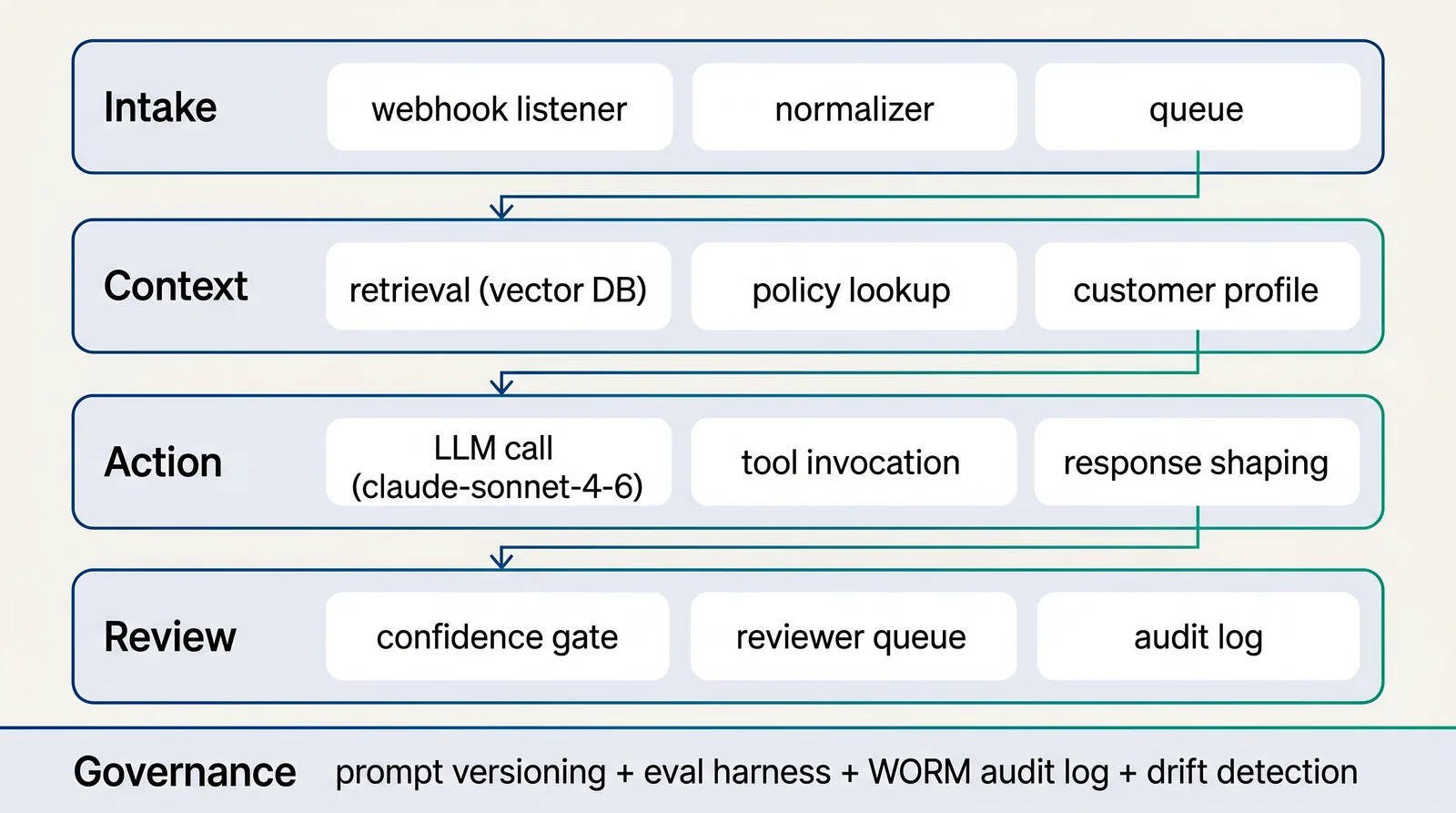
AI workflow automation as a service is a phased engagement (Discovery 2-3 weeks → Build 6-10 weeks → Run continuous) in which we design, build, and operate a production AI workflow on your real data — moving a named KPI by 30-90% against your baseline and governed by versioned prompts, audit logs, and reviewer queues from day one. It is the services layer above the no-code tools, not another Zapier flow.
Key facts
- Engagement model
- Phased fixed-price
- Discovery
- $5-8k · 2-3 weeks
- Build
- $15-40k · 6-10 weeks
- Run
- $2-6k/mo · month-to-month, optional
- Time to production
- 6-10 weeks thin-slice
- Year-1 total
- $25-90k typical
- Verticals served
- Sales, Marketing, Back-Office
- Industries
- 42 covered (banking, healthcare, legal…)
- Governance
- Versioned prompts · audit logs · NIST AI RMF
Why a services partner, not a no-code automation agency
The phrase “ai workflow automation” is dominated by no-code SaaS (Zapier, Make, n8n, Gumloop) and the low-trust shops that resell them. That is the wrong tool for a workflow you have to defend in front of a regulator or a CFO. We do the other job: engineered services — production-grade, governed, built for regulated work — not no-code glue that breaks the moment an input changes and has no owner when it does.
Production, not a Zap that breaks
No-code agency: No-code agencies stitch Zapier / Make / n8n / Gumloop flows that silently fail when an input shape changes and have no owner when they break.
Us: We ship the workflow to your real production traffic with an eval harness, drift detection, and a reviewer queue — engineered to survive edge cases, not demo on cherry-picked inputs.
Audit logs on every inference
No-code agency: No-code glue gives you a run history, not an audit trail — you cannot show a regulator who decided what, on which sources, with which prompt version.
Us: Audit logs on every inference call, versioned prompts, and source allow-lists — reviewable by your risk officer before launch and retrievable if a decision is challenged.
NIST AI RMF for regulated work
No-code agency: Off-the-shelf automation tools ship no governance framework; compliance is left entirely to you.
Us: NIST AI RMF mapping for regulated workflows, quarterly attestation packs, and a risk lens defined in Discovery — the same posture behind our HIPAA-aligned / GDPR healthcare build.
Real reviewers, real judgment
No-code agency: No-code flows either auto-execute blindly or dump everything on a human — there is no confidence routing.
Us: Low-confidence cases route to named reviewers with SLAs; AI handles volume, humans handle judgment, exceptions, and policy.
Deciding whether to buy a tool or have a workflow built and run? Walk it through our AI build-vs-buy decision tool, then read the pillar guide on AI-native workflow automation.
How much does it cost to automate my business with AI?
For a mid-market company ($50M-$500M revenue), expect $5-8k for Discovery (the only commitment to start), then $15-40k for Build (fixed-price, 6-10 weeks to thin-slice production), then optional $2-6k/month Run with month-to-month exit. Total typical first-year investment for one workflow: $30k-$90k vs $250k-$1M for traditional consulting firms on the same scope.
What ROI should I expect from automating my business with AI?
On the workflows we've shipped to production, the cost-per-case drops 40-70% and case throughput per FTE rises 2-4×. For a typical mid-market customer-service workflow processing 5,000 cases/month at $8/case all-in, that's $400k+ annual savings against a $60k first-year engagement — sub-3-month payback when the workflow has real volume. Lower-volume workflows pay back in 6-9 months instead. Pre-commitment math is done in Discovery, with your numbers.
Which business workflows can you automate with AI?
Three verticals where AI business automation has the cleanest signal-to-noise on impact. Pick the one with the most pain and volume; we scope the first workflow in Discovery.
AI Sales Automation
Sales
Outbound prospecting, lead qualification, CRM enrichment, meeting scheduling, and pipeline reporting.
- →Sales Prospecting (signal-driven outbound at 14-22 SQLs/week per SDR)
- →Lead Qualification (CRM auto-scoring with reviewer escalation on edge cases)
- →Revenue Operations (pipeline forecasting + AI-drafted ops reports)
Outbound throughput typically +3-5×, cost per qualified meeting -75%
AI Marketing Automation
Marketing
Content production, lifecycle orchestration, paid-media operations, and landing-page production at scale.
- →Content Marketing (briefs → drafts → SME review → publish)
- →Lifecycle Marketing (segment-aware email + in-product flows)
- →SEO Landing Pages (programmatic with quality gates)
- →Paid Media Operations (creative iteration + bid management)
Content velocity 3-8× with reviewer-approved quality bar
AI Back-Office Automation
Back-Office
Operations, finance, HR, compliance, and customer service workflows where AI handles volume and humans handle judgment.
- →Customer Service Automation (intent classification + grounded responses)
- →Document Processing (extraction + validation + downstream system updates)
- →Compliance Operations (alert triage + reviewer queues + attestations)
- →Finance Back Office (reconciliation, invoice processing, exception routing)
Cycle time -70 to -90%, error rate -60 to -80%, audit-ready logs
How long does it take to automate my business with AI?
Three phases, billed separately. You commit one phase at a time. Discovery is the only commitment to start.
Phase 1 · Discovery
2-3 weeks · $5-8k
We map the current workflow, capture the KPI baseline, document system access requirements, identify the risk lens, and write a scoped Statement of Work for Build with a fixed price. Output: a 25-page Discovery report + 8-page Build SoW.
Phase 2 · Build
6-10 weeks · $15-40k
We build six tangible artefacts: workflow map (current and target), labelled test set (200-1000 cases), prompt and retrieval repository (versioned), integration layer (against your systems), reviewer queue (with SLAs), operating dashboard (KPIs, drift detection). Thin-slice ships to production traffic by week 6.
Phase 3 · Run (optional)
$2-6k/month · month-to-month
Weekly KPI report against Discovery baseline. Prompt refresh against new edge cases. Retrieval index updates. Reviewer-queue calibration. Quarterly attestation pack for risk officers. By month 6, your team takes over Run if desired — every artefact is handed over.
What does an AI automation in production actually look like?
Most AI engagements stop at the prototype that works on cherry-picked inputs. Ours ship to production traffic with KPIs, SLAs, and governance you can defend in front of a CFO, a risk officer, or an auditor.
What 'production' means here
Real data, real reviewers, real KPIs. Not a sandbox demo on cherry-picked inputs. The thin slice ships to production traffic by week 6 of Build and runs continuously after that.
SLAs we commit to
Reviewer-queue throughput <24h average. Workflow uptime >99.5%. Quarterly attestation packs delivered in <5 days from quarter-end. Documented in the Build SoW.
Governance shipped on day one
Versioned prompts, audit logs on every inference call, source allow-lists, NIST AI RMF mapping for regulated workflows. Reviewable by your risk officer before production launch.
KPI accountability
Baseline captured in Discovery. Actuals reported weekly during Run. No 'pilot in perpetuity' — by day 90 leadership has the data to expand or stop.
Real builds, not no-code demos
The difference between a services partner and a no-code shop shows up in what actually runs in production. Two examples we built and operate:
Healthcare technology · Medical imaging
Cloud PACS + AI imaging platform, run 24/7 under Swiss hosting
A zero-footprint, HIPAA-aligned / 100% GDPR DICOM exchange with AI-assisted reporting, engineered to a 6-24 hour report turnaround SLA with 24/7 availability — built and operated as an exclusive technology partner, not a no-code flow.
HIPAA-aligned · 100% GDPR · 6-24h SLA · 24/7
Read the case study →Real estate · Property operations
Owners-association operations backbone — 55+ screens, 47 tables
A full operational SaaS replacing spreadsheets and email threads: 55+ management screens, 47 normalized tables with a full audit history, and role-based access enforced server-side — shipped to production inside a regulated GCC market.
55+ screens · 47 tables · full audit trail
Read the case study →For regulated workflows — banking onboarding, KYC/AML triage, compliance reporting — we bring the same governed, audit-logged posture: see how we approach AI workflow automation for banking and the broader AI automation consulting practice.
Which industries have we already automated AI workflows for?
42 industries covered, each with its own engagement template, benchmarks, and risk lens. A sample of the high-volume ones:
What else do buyers ask before automating their business with AI?
What are AI workflow automation services?+
AI workflow automation services are a delivered engagement — not a tool subscription — where a partner designs, builds, and operates a production AI workflow on your behalf. Our model is Discovery → Build → Run: we scope and baseline the workflow, build it against your real systems with an eval harness and reviewer queue, then run it with weekly KPI reporting. You get a governed, owned workflow, not a Zapier flow you have to maintain yourself.
How are AI workflow automation services different from tools like Zapier or n8n?+
Zapier, Make, n8n, and Gumloop are no-code tools: you (or a low-cost agency) chain pre-defined integrations that break when an input changes and carry no governance. AI workflow automation services are the delivery layer above that — we redesign the workflow around AI, ship it to production traffic, and add the things no-code glue lacks: audit logs on every inference call, versioned prompts, source allow-lists, NIST AI RMF mapping for regulated work, and named reviewers with SLAs. The wedge is production-grade and governed versus no-code-glue.
How much do AI workflow automation services cost?+
Phased fixed-price. Discovery: $5-8k for 2-3 weeks. Build: $15-40k for 6-10 weeks depending on integration depth and risk lens. Run: $2-6k/month, optional, month-to-month. Total year-1 typically $25-90k for a focused workflow — far below traditional consulting builds for an equivalent production system, and the right comparison to a low-trust no-code agency is governance and production-readiness, not just price.
What is AI business automation?+
AI business automation is the use of AI as the operating layer of a business workflow — intake, classification, retrieval, drafting, decisioning — with humans handling judgment, exceptions, and policy. It is distinct from RPA (rule-based) and from 'AI features' (a chat button bolted onto an existing process). The workflow itself is redesigned around AI.
How much does AI business automation cost?+
Phased fixed-price. Discovery: $5-8k for 2-3 weeks. Build: $15-40k for 6-10 weeks depending on integration depth and risk lens. Run: $2-6k/month, optional, month-to-month. Total year-1 typically $25-90k for a focused workflow — orders of magnitude below traditional consulting builds for an equivalent production system.
How long does an AI business automation project take to deploy?+
Thin-slice production deployment in 6-10 weeks from Discovery start: 2.5 weeks Discovery (scope, baseline, systems, risk model), then 6-10 weeks Build (architecture, eval harness, reviewer queue, KPI dashboard, thin-slice shipped to production traffic). Optional Run phase runs continuously after that with weekly KPI reporting.
What business processes can be automated with AI in 2026?+
Any high-volume, structured-but-messy workflow with a measurable outcome. The best candidates: customer service (intent + grounded answers), document processing (extraction + validation), sales prospecting (signal-driven outbound), compliance triage (alert routing + evidence assembly), executive reporting (data → narrative), claims/case processing (intake → decision support). The wrong candidates: politically charged decisions with no measurable baseline, or workflows with insufficient volume to justify the build.
How is AI business automation different from RPA or workflow automation tools?+
RPA executes rule-based scripts on structured data — it breaks when the input shape changes. Workflow tools (Zapier, n8n) chain pre-defined integrations — they don't reason. AI business automation handles unstructured input, adapts to exceptions, and makes context-aware decisions while routing low-confidence cases to humans. It is the operating layer above the integration layer, not a substitute for it.
Do we own the AI workflow at the end of the engagement, or are we locked in?+
You own everything: prompts, evaluation harness, code, configs, runbook, operating playbook. Run is month-to-month with no notice period. Most clients keep us on Run for 6-12 months while their team learns the operating model, then take it in-house. The Build SoW includes a full handover plan; the engagement is designed to survive our absence.
What systems do you integrate with?+
Anything with an API or a database we're allowed to touch. In practice: CRMs (Salesforce, HubSpot), ticketing (Zendesk, Intercom), ERPs and finance systems, document stores, email, data warehouses, and internal databases. Integration depth is the main thing that moves Build between $15k and $40k, so system access is documented in the 2-3 week Discovery before we quote. What we avoid: screen-scraping a UI that has no API — that's the brittle RPA pattern we exist to replace.
Do you train AI models on our data?+
No. Workflows run on model APIs under no-training terms, or inside your own cloud (Bedrock, Vertex) where governance requires it. Your data is used to run your workflow and to build your labelled test set of 200-1000 cases — which you own — not to improve anyone's model. Data handling, access, and retention are scoped in Discovery before anything moves, and every inference call is audit-logged so you can show a regulator exactly what touched what.
Which workflows do you refuse to automate?+
Final decisions a model shouldn't make alone: hiring and firing calls, credit denial, medical judgment — anything where a wrong answer harms a person and no reviewer is in the loop. We design AI to handle volume and route those calls to named humans, or we don't build it. We also decline workflows under a few hundred cases a month (the build won't pay back) and workflows with no measurable baseline — if Discovery can't baseline it, we can't prove it works, and we won't pretend.
Popular with buyers
Start here
Start with a 2.5-week Discovery
$5-8k, fixed price, 2-3 weeks. Output: a scoped Statement of Work for Build with a fixed price and a documented baseline. The only commitment to start.