Professional Services · Revenue & Growth
How to Automate Lead Qualification in Legal Services (Step-by-Step)
law firms, legal operations teams, in-house counsel, and compliance leaders usually arrive here with two questions: what does AI-native lead qualification actually ship, and what does it cost. Both are answered below, alongside the operating posture and the governance frame.
Projects from $15k · Refundable 7 days · Kickoff within 5 days
Early access: we work with a small first cohort. Engagements are scoped, priced, and shipped end-to-end by our team — not referred to third parties.
In one sentence
AI-native lead qualification for legal services — Production lead qualification for legal services delivered in vertical slices, each gated by the labelled test set captured during Discovery, each handing operational ownership progressively to your team. Expected delta on speed to lead: −77%.
Key facts
- Industry
- Legal Services
- Use case
- Lead Qualification
- Intent cluster
- Revenue & Growth
- Primary KPI
- speed to lead, MQL to SQL conversion, sales acceptance rate, and wasted meeting reduction
- Top benchmark
- Cost per qualified meeting: $420 → $95 (−77%)
- Systems integrated
- DMS, CLM, e-discovery
- Buyer
- law firms, legal operations teams, in-house counsel, and compliance leaders
- Risk lens
- privilege, confidentiality, unauthorized practice, citation accuracy, and client duty
- Engagement timeline
- Discovery 3 weeks → Build 8 weeks → Run continuous (regulated industry)
- Team size
- 2 senior delivery + 1 part-time reviewer trainer
- Discovery price
- $5k · 2-week sprint
- Build price
- $15k–$22k · 6-8 weeks
Primary outcome
separate serious buyers from noise faster
What we ship
AI qualification assistant, scoring rubric, routing rules, and CRM governance
KPIs we report on
speed to lead, MQL to SQL conversion, sales acceptance rate, and wasted meeting reduction
Why Legal Services teams hire us for this
Three things have changed for legal services teams trying to scale lead qualification between 2023 and 2026: model quality on real workflows is no longer the bottleneck, vendor-prompt-engineering as a service has saturated, and the work that compounds is operational integration. Our engagement model is built around that third axis — the model and prompt choice are commodity decisions, the operational layer is where defensible advantage lives.
Recent industry benchmarks (Gartner, Salesforce Research) show legal services revenue teams spend 60-70% of their week on non-selling activities. AI-native delivery targets that non-selling block first.
Industry context: Mid-market and enterprise operators face the same fundamental tradeoff: AI must compress operational cycle time while remaining auditable and integrable with existing systems of record.
Benchmarks we hit
Reference benchmarks from production deployments of lead qualification in legal services-comparable contexts. Sources noted per row. Your actuals are measured against the baseline captured in Discovery.
| Metric | Industry baseline | AI-native typical | Delta |
|---|---|---|---|
Cost per qualified meeting Includes AI infra cost, SDR time, and overhead allocation | $420 | $95 | −77% |
Lead-to-meeting cycle time Median across Salesforce-reporting B2B teams; AI-native compression validated on first thin-slice deployment | 11.4 days | 2.8 days | −75% |
Outbound reply rate Industry baseline from Gartner B2B Sales Pulse; AI-native lift from per-prospect context injection | 1.2% | 4.1% | +3.4× |
Benchmarks are reference values from comparable engagements and authoritative sector benchmarks. Your engagement's baseline is captured during Discovery and actuals are reported weekly during Run against that baseline.
How we operate the workflow
Three commitments anchor how we run lead qualification in production for legal services: every output is grounded in an approved source, every action is logged with the prompt and model version that produced it, every reviewer decision feeds the next iteration. Drop any one of the three and the workflow degrades within weeks — we have seen it happen, so we ship all three from week one.
What we build inside the workflow
A strong implementation starts with a clear inventory of the current work. For Legal Services, that means understanding how data moves through DMS, CLM, e-discovery, billing, matter management, who owns each decision, and where handoffs slow the team down. We document current cycle time, error rates, quality review steps, rework, and the volume of requests or records flowing through the process. The automation layer will scores inbound demand, summarizes context, checks fit, asks missing questions, and routes leads to the right owner.
Reference architecture
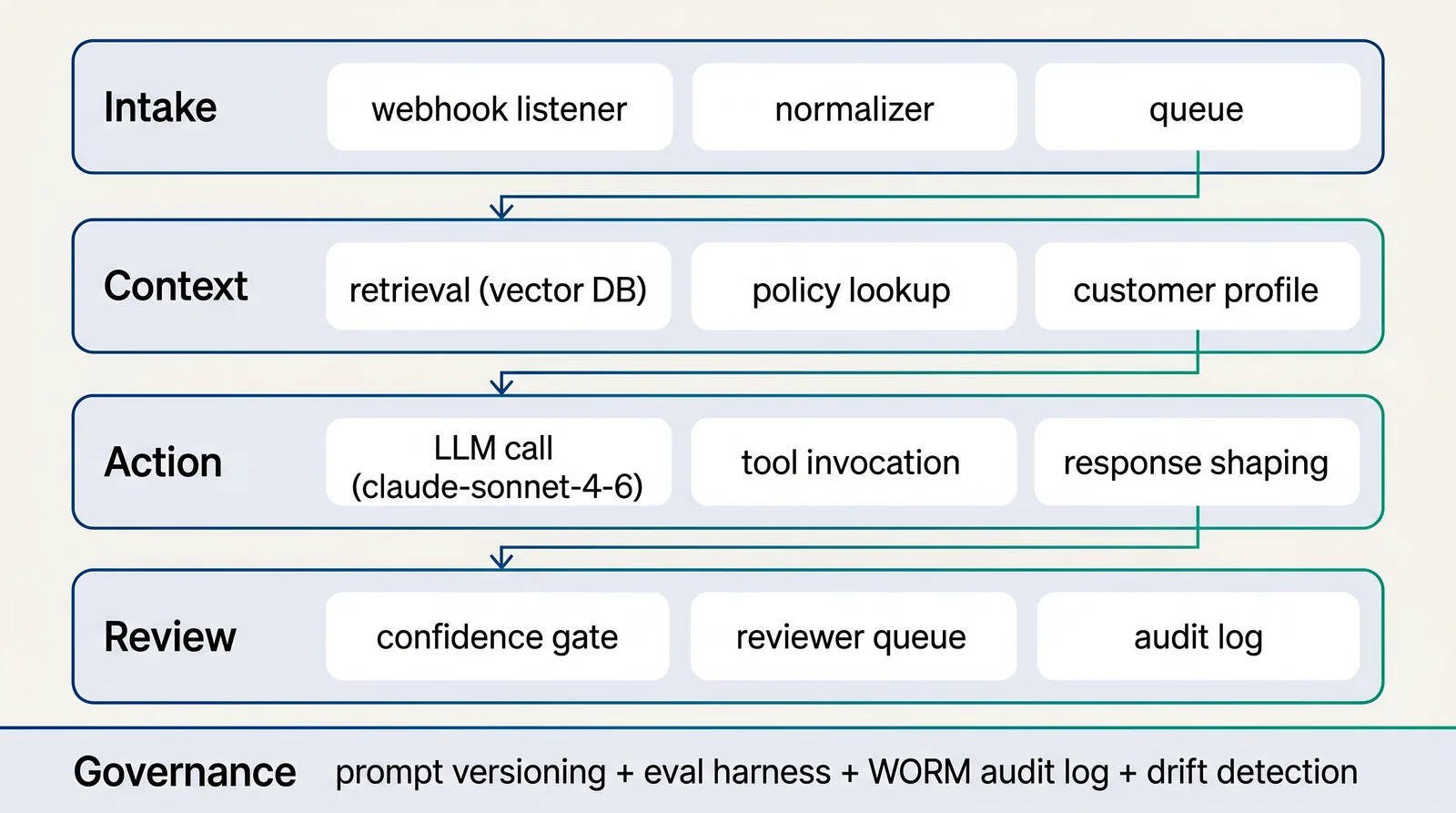
4-layer AI-native workflow for revenue & growth
Intake → context → action → review. The loop is closed: every reviewer decision feeds the next iteration of the prompt and the retrieval index. Without the closed loop, accuracy degrades silently over months.See the full architecture diagram for Revenue & Growth →
AI-native vs traditional approach
How a scoped AI-native engagement compares to the alternatives for lead qualification in legal services: in-house build, BPO retainer, generic SaaS subscription, traditional consulting engagement.
| Dimension | Traditional (in-house build or BPO) | AI-native engagement (us) |
|---|---|---|
| Time to production | Two quarters minimum | Production traffic within 6-10 weeks |
| Pricing model | FTE hourly retainer or fixed staffing | Three independent commercial envelopes |
| Audit / governance | Document-driven, periodic snapshot | Runtime guardrails + audit log + governance map + quarterly attestation |
| Operator throughput lift | 1.0× (baseline) | −75% |
| Cost per unit | Linear with operator headcount | Typically 60-80% lower |
| End-of-engagement | Multi-quarter notice + knowledge loss | Month-to-month Run, full handover plan in Build SoW |
Traditional process automation projects cost $80-200k+ with 6-12 month payback; AI-native engagements deliver thin-slice production in 6-8 weeks with measurable baseline-vs-actuals reporting.
Engagement scope & pricing
We run this as a fixed-scope engagement with a clear commercial envelope, not an open-ended retainer.
Revenue engagement
Three phases, billed separately. You commit one phase at a time.
Phase 1 · Discovery
$5k
2-week sprint
Phase 2 · Build
$15k–$22k
6-8 weeks
Phase 3 · Run
$2k–$3k / mo
optional, hourly bank also available
~$25k–$45k typical year 1 (60% take the run option for ~6 months)
Outbound, growth, or revenue-ops workflow, integration with your CRM, weekly operating review during Run.
Two-week Discovery, then your decision. Build is fixed-price against the Discovery output. Run, if you opt in, is month-to-month with a documented exit path.
The 4-phase delivery model
Phase 1 · Weeks 1–2
Discovery
Discovery is short, intense, and decision-producing. By end of week 2, you have the workflow map, the baseline, the SoW, and the risk register. No code yet — the next phase is calibrated against this evidence.
Phase 2 · Weeks 2–4
Design
Two weeks of design produces the technical artefacts Build executes against: the workflow blueprint, the data-access plan, the prompt strategy, the review-queue UX, the audit-log shape, the dashboard wireframes.
Phase 3 · Weeks 4–8
Build
Vertical-slice delivery against the labelled test set. Each slice ships to production, gated by eval criteria. By end of Build, the workflow is operating on real traffic with the calibration discipline established.
Phase 4 · Weeks 8+
Run
Run is where AI accuracy stops being a one-time evaluation result and becomes a sustained operating metric. We run the weekly cadence; your team takes ownership progressively over the first quarter.
Interactive ROI calculator
Estimate your AI-native ROI for lead qualification
Reference inputs below are typical for legal services teams in the revenue cluster. Adjust them to match your situation.
Projected
Current monthly cost
$24,000
AI-native monthly cost
$7,920
Annual savings
$192,960
67% cost reduction · ~468 operator-hours freed / month
Governance and risk controls
The hardest governance question in AI-native delivery is not "how do we audit?" — it is "what cases do we route to humans?". For legal services workflows touching privilege, confidentiality, unauthorized practice, citation accuracy, and client duty, we set explicit confidence thresholds during Build, validate them against the labelled test set, and recalibrate weekly during Run. Reviewers see only the cases that need them, with the supporting evidence pre-assembled.
How we report ROI
ROI conversations on lead qualification usually start with "how much will it save?" and stall there. We reframe them around three measurable shifts: throughput per operator, time per case, and quality variance — all benchmarked against the Discovery baseline. Once those shifts are documented, the cost-per-transaction conversation answers itself.
Selected portfolio
Real builds — lead qualification in legal services and adjacent sectors
Below are engagements drawn from our active portfolio where the workflow rhymed with lead qualification in legal services or in adjacent contexts. Scope and stack are accurate; client identities are withheld under engagement NDAs.
Q1 → Q2 2026
National legal marketplace — directory, bookings, legal tools, emergency contacts
Government-licensed legal services platform · GCC region
Ministry-licensed bilingual EN/AR platform: directory of certified lawyers, firms, mediators and arbitrators; multi-channel appointment booking (video, phone, in-office); free legal tools (court fees, deadlines, legal interest); police directory with map + hotlines; provider verification workspace; PDF document generation with QR-coded provenance.
- Next.js 16 monorepo (Turborepo)
- Bilingual EN/AR (next-intl)
- Postmark + Web Push
Q3 2025
Property marketplace — buy, rent, list across apartments, villas, commercial
Regional real-estate marketplace · GCC region
National real-estate marketplace covering apartments, villas, and commercial property: listing management for agencies and owners, search and filter optimised for local buyer intent, SEO foundation built for long-tail property queries, lead capture per listing with routing to the listing agent.
- Next.js + dynamic SEO routes
- Listing CMS
- Lead routing engine
Q1 2026
Premium bilingual corporate site + internal CRM
Multi-vertical consulting group · Europe
Corporate marketing site with animated bento-grid editorial, bilingual content architecture, and an internal CRM behind the scenes for lead handling. Designed to project a premium positioning aligned with enterprise buyers while keeping marketing-team ownership of the content layer.
- Next.js + animated bento grids
- Bilingual content layer
- Internal CRM integration
Client identities withheld under engagement NDAs. Sector, geography, and scope are accurate. Full case studies on request.
Common pitfall & mitigation
The failure mode we see most often on AI-native lead qualification engagements in legal services contexts.
Attribution loss
AI-generated touches blur the funnel; nobody knows what really worked
UTM convention + touch-level logging from day 1; weekly cohort analysis in the Run review
How the regulatory frame shapes the architecture
The single regulatory question that makes or breaks legal services lead qualification engagements is "who is accountable for an automated decision". Our answer, baked into the architecture: there is always a named human owner per decision class, with the role visible in the reviewer interface, the audit log, and the governance map. Full automation does not mean no accountability — it means the named accountable human approved the policy that authorized the automation, and can revoke that authorization at any time without re-architecting the system.
Compliance officers in legal services have seen enough "AI governance frameworks" to recognize when one is theatre. The questions they actually ask are concrete: where does the training or retrieval data come from, who curates it, how do model updates get validated, what happens when the model disagrees with the policy, and how is the operator team trained to override.
We answer each of those concretely in the Build phase. Retrieval data is curated by a named subject-matter expert from your team during Discovery, with a documented refresh cadence and an approval workflow for new sources. Model updates are gated by the evaluation harness: a new candidate model has to beat the incumbent on the labelled test set across multiple metric slices before it is promoted, and the comparison is logged. Policy disagreements surface as escalations, not silent overrides — when the model recommends an action that conflicts with a policy clause, the reviewer queue captures both, the operator decides, and the decision feeds the next iteration of the prompt. Operator training is a deliverable, not an afterthought: we ship the reviewer playbook, the calibration sessions, and the first month of paired-review with your team during the transition out of Build.
The net effect for legal services leadership on lead qualification is a workflow that holds together under the three audiences that matter — internal audit, compliance, supervisor — without requiring three different versions of the story. The dashboard is the story. The audit log is the evidence. The control map is the framework. All three are live, all three are queryable, and all three are designed for the regulated reality your team operates in.
The concrete first-30-day delivery plan
Our Build cadence on lead qualification for legal services is bias-corrected against the two failure modes we have seen kill legal services AI projects most often: scoping that drifts week-by-week, and a labelled test set that arrives in week 6 instead of week 1.
We fix the scoping by signing the Build statement of work before any code is written — the deliverables are named, the integration footprint is bounded, the milestones have dates. We fix the labelled test set timing by treating it as the week-1 deliverable. Week 1 is not "scoping week" — it is "labelled-test-set week", because every subsequent engineering decision is measured against that test set.
Week 2: retrieval index live with first batch of approved sources. Week 3: intake classifier scoring against the test set, first calibration report. Week 4: action layer drafting with reviewer approval; first end-to-end case flow. Week 5-6: thin slice in production on 5-15% of routine legal services traffic, first weekly review with the operator team. Weeks 7-10: production envelope widens case-class by case-class, calibration loop tunes against the empirical evidence, exceptional cases route to enriched escalation. By day 60-70, the workflow is operating at its target envelope.
Most legal services AI projects fail in the first month for the same reason: too much time in scoping, too little in shipping. Our Build phase inverts that ratio deliberately. Week 1 has running code; week 4 has reviewable thin-slice production traffic; week 6 has a defensible accuracy baseline against the labelled test set.
The shape of the first week is opinionated. By end of day Wednesday, the retrieval index is loaded with the first batch of approved sources. By end of day Friday, the intake classifier is hitting the labelled test set with an initial accuracy number. The number is intentionally not impressive — it is a baseline against which weeks 2 and 3 measure progress. Most teams underestimate how motivating that early concrete number is for both the operator team (it stops feeling abstract) and the engineering team (the eval feedback loop is closing).
From week 2 onward the cadence is metric-driven. Every Friday produces a delta report against the labelled test set: which slices improved, which regressed, what the next iteration targets. The operator team participates in the Friday review; their judgment on edge cases becomes the next iteration's prompt or retrieval tweak. By week 6, the system has been through 12-15 evaluation cycles, each with legal services-specific calibration, each tied to a documented change. The workflow that hits production at the end of Build is the workflow that has survived a month of empirical correction, not the workflow that looked good in the architecture diagram.
Closest precedent in our portfolio
The engagement that most closely rhymes with lead qualification in legal services is summarised below. Identity withheld under engagement NDA; sector and stack are accurate.
National legal marketplace — directory, bookings, legal tools, emergency contacts. Ministry-licensed bilingual EN/AR platform: directory of certified lawyers, firms, mediators and arbitrators; multi-channel appointment booking (video, phone, in-office); free legal tools (court fees, deadlines, legal interest); police directory with map + hotlines; provider verification workspace; PDF document generation with QR-coded provenance. (Government-licensed legal services platform · GCC region, Q1 → Q2 2026.)
The architectural choices that worked there translate to legal services lead qualification with two adjustments: the data-source mix shifts to match your operating systems (DMS, CLM, and adjacent), and the reviewer SLAs adjust to your team's operating cadence. The four-layer pattern (intake, context, action, review), the evaluation discipline, and the audit posture are portable.
For US buyers
US compliance scaffolding for lead qualification in legal services (NIST AI RMF)
Legal Services engagements touching US clients on lead qualification ship with the regulatory scaffolding your procurement, compliance, and legal teams expect. The framework that matters most for legal services is NIST AI Risk Management Framework (AI 100-1) (NIST AI RMF) — addressed below alongside the adjacent frames we encounter.
NIST AI RMF
NIST AI Risk Management Framework (AI 100-1)
Authority: U.S. National Institute of Standards and Technology
- Scope
- Voluntary framework: Govern, Map, Measure, Manage functions for AI system risk.
- How we ship inside it
- Every engagement maps to NIST AI RMF during Discovery. The control map produced becomes the artefact your internal audit and security teams use to defend the workflow.
For US companies
Start a US-friendly engagement
Discovery from $8,500–$12,000, Build from $35,000–$75,000, optional Run from $5k/mo. Fixed-price, milestone-billed, you own every artefact. Send a short brief and we reply within 5 business days. 11am–4pm ET overlap for live syncs.
USD pricing
Discovery $8,500–$12,000 · Build $35,000–$75,000
US-style commercial
MSA / SOW / mutual NDA standard. DPA with SCCs included.
Limited capacity
We onboard 3–5 new clients per quarter to protect delivery quality.
What the 2026 production data says
Vendors are moving from seat-based to usage-based pricing as agentic workloads grow, which pushes inference cost from a footnote to the centre of the business case. For lead qualification in legal services, that means the run cost belongs in the proposal, not in a later invoice. Our engagements state it before signature, and our cost calculator is public so you can check the arithmetic yourself.
Read the full breakdown of the pilot-to-production gap — the three failure modes, with the 2026 sources.
Build internally or work with us
The opportunity cost of building first in legal services is often invisible: 6-9 months spent hiring, tooling, and converging on a reference architecture is 6-9 months of competitors shipping. The engagement model we propose front-loads the reference architecture and the senior delivery team, then transitions the operation to your team once the pattern is proven.
What to ask us before signing
- Ask for a workflow map that shows intake, retrieval, generation, review, escalation, system updates, and measurement.
- Ask for an evaluation plan using real examples from legal services, not only generic test prompts.
- Ask how we will move speed to lead, MQL to SQL conversion, sales acceptance rate, and wasted meeting reduction within the first 30 to 60 days.
- Ask which parts of the process remain human-owned and why.
- Ask for our exit plan: what stays with you if the engagement ends.
Recommended first project
If you can pick only one wedge, pick the lead qualification subflow that is currently absorbing the most senior-operator time on cases that are mostly routine but require context the system does not surface today. That subflow has the highest immediate ROI and the cleanest path to a labelled test set. We have shipped this pattern across enough legal services engagements to know which subflows compound and which stall. The Discovery sprint identifies the wedge concretely. The Build phase ships it as a thin slice within 6-8 weeks. The Run phase compounds value as the labelled test set grows, the prompt library tunes to your category, and the reviewer team calibrates against real traffic. The 90-day milestone is a defensible empirical track record on which to scope the next engagement.
Frequently asked questions
How do you automate lead qualification in legal services with AI?+
Three phases. Discovery (2 weeks) produces the labelled test set, the system map, and the Build statement of work. Build (6-10 weeks) ships a thin-slice production deployment on top of DMS and adjacent systems, with versioned prompts and a reviewer queue. Run (optional, month-to-month) operates the workflow weekly against speed to lead, MQL to SQL conversion, sales acceptance rate, and wasted meeting reduction.
What does it cost to automate lead qualification for legal services teams?+
Three phases, billed separately. Discovery sprint: $5k (2-week sprint). Build engagement: $15k–$22k (6-8 weeks). Run retainer: $2k–$3k / mo (optional, hourly bank also available). ~$25k–$45k typical year 1 (60% take the run option for ~6 months). Outbound, growth, or revenue-ops workflow, integration with your CRM, weekly operating review during Run.
What is the best AI agent for lead qualification in legal services?+
There is no single "best" off-the-shelf agent for lead qualification in legal services — the right architecture depends on your DMS setup, your data, and your risk profile. We typically combine a frontier LLM (Claude, GPT-4-class, or Gemini) with a retrieval layer over your approved sources, tool-use for DMS and CLM integrations, and a reviewer queue. We benchmark candidate models against a labelled test set during Discovery and pick the one with the best accuracy/cost ratio for your workflow.
How long does it take to deploy AI lead qualification for legal services?+
End-to-end lead time from kickoff to thin-slice production: 6-10 weeks. End-to-end to full operating envelope: 10-14 weeks. speed to lead, MQL to SQL conversion, sales acceptance rate, and wasted meeting reduction is instrumented from day one of Build; the dashboard goes live by week 4-5; production traffic starts by week 6-8. By 90 days, leadership has a 30-60 day record of operating performance against the Discovery baseline.
What do we own, and what do you own?+
We own the workflow design, the prompts, the retrieval architecture, the evaluation harness, and weekly improvement. Your law firms, legal operations teams, in-house counsel, and compliance leaders team owns data access, policy, exception approval, and final commercial decisions. At the end of the engagement, every prompt, eval, and config is handed over — no lock-in.
What's the revenue ROI shape for lead qualification in legal services?+
speed to lead, MQL to SQL conversion, sales acceptance rate, and wasted meeting reduction is the bridge metric to matter cycle time, realization rate, review throughput, and client response time. The first 30 days are negative (engagement cost vs. limited production volume); month 3 typically hits break-even; months 4-12 are strongly positive as the labelled test set grows and the prompt library tunes to your category.
Do you train models on our data?+
No. We do not train any model on client data. Anthropic Zero-Data-Retention is enabled by default; OpenAI default-no-training is honoured. Prompts, retrieval indexes, audit logs, and integration data live in your cloud account under your IAM. At engagement end, every artefact transfers to your repository.
What if we want to exit the engagement?+
Discovery and Build are fixed-scope, so there is no mid-engagement exit cost. Run is month-to-month with 30-day notice. Every artefact (prompts, eval harness, integration code, dashboards, runbooks) is in your repository throughout the engagement, not behind our SaaS. There is no lock-in.
What does success look like 90 days after Build closes?+
speed to lead, MQL to SQL conversion, sales acceptance rate, and wasted meeting reduction measurably improved against the Discovery baseline. Your team is operating the workflow with the cadence we shipped during Build. The audit log is queryable. The reviewer queue is calibrated. The next workflow scope is informed by real production evidence rather than initial assumptions.
What support is included after the engagement ends?+
Optional Run retainer covers weekly cadence, prompt refresh, retrieval index updates, and reviewer-queue calibration. Architecture-level questions and breaking-change support are billed hourly outside of Run. Most engagements transition Run in-house at month 6-12; we stay available for architecture decisions for 12 months at no extra charge.
How does this integrate with DMS and our existing stack?+
Discovery scopes the integration footprint explicitly. We integrate at the API layer; no replatforming required. The Build statement of work names exactly which systems are connected, which data flows are bidirectional, and what authentication patterns we use (SSO, service accounts, OAuth scopes). The integration code lives in your repository.
What does your team look like during an engagement?+
Discovery: 1 senior delivery lead + 1 PM, ~30 hours/week. Build: 1 senior delivery lead + 2-3 senior AI engineers, ~50-80 hours/week across the team. Run: 1 delivery owner + 1 engineer on weekly cadence. We do not use offshore staff augmentation. Every engineer touching your engagement is senior-level.
Sources we reference
The following sources inform the architecture, governance, and benchmarks we apply on legal services engagements. Cited here so you can verify and dig deeper.
- American Bar Association AI Resources
- MIT Sloan Management Review — AI & Business Strategy — MIT Sloan
- AI Adoption Statistics — U.S. Bureau of Labor Statistics
- B2B Sales Pulse Survey — Gartner for Sales
- State of Sales Report — Salesforce Research
- Google Search Central: helpful, reliable, people-first content
- Google Search Central: URL structure best practices
High-intent reads
Start the engagement
Start a Legal Services engagement
Tell us about your workflow, the systems involved, and the KPI you want to move. We'll send a scoped statement of work within 5 business days.