Technology · Revenue & Growth
Deploy an AI Agent for Revenue Operations in SaaS
An engagement page for SaaS founders, revenue leaders, customer success teams, and product marketers considering AI-native revenue operations. We cover what we ship, how we operate it, what it costs, what controls travel with it, and how we report against the metrics your team already tracks.
Projects from $15k · Refundable 7 days · Kickoff within 5 days
Early access: we work with a small first cohort. Engagements are scoped, priced, and shipped end-to-end by our team — not referred to third parties.
In one sentence
AI-native revenue operations for SaaS — A scoped engagement that turns revenue operations from a manual or partially-automated process into an instrumented production workflow on top of CRM, with the audit log and reviewer queue as first-class deliverables. Expected delta on forecast accuracy: +3×.
Key facts
- Industry
- SaaS
- Use case
- Revenue Operations
- Intent cluster
- Revenue & Growth
- Primary KPI
- forecast accuracy, CRM completeness, stage conversion, and sales productivity
- Top benchmark
- SDR throughput (qualified meetings / week): 4–6 → 14–22 (+3×)
- Systems integrated
- CRM, product analytics, support platforms
- Buyer
- SaaS founders, revenue leaders, customer success teams, and product marketers
- Risk lens
- customer data handling, hallucinated support, security claims, and lifecycle communication quality
- Engagement timeline
- Discovery 2 weeks → Build 9 weeks → Run continuous (integration-heavy)
- Team size
- 1 senior delivery + 1 part-time domain SME
- Discovery price
- $5k · 2-week sprint
- Build price
- $15k–$22k · 6-8 weeks
Primary outcome
make revenue data cleaner, faster, and easier to act on
What we ship
CRM hygiene workflows, forecasting assistant, pipeline inspection, and operating cadence
KPIs we report on
forecast accuracy, CRM completeness, stage conversion, and sales productivity
Why SaaS teams hire us for this
SaaS buyers we talk to share a common frustration: too many AI vendor demos, too few production deployments that survive a quarterly review. AI-native revenue operations is the answer to that gap — every engagement we ship is designed to pass a CFO's challenge, a risk officer's review, and an operator's daily use, simultaneously.
Across SaaS sales orgs we have benchmarked, the conversion floor from MQL to SQL hovers around 12-18% — most of the leakage happens at first-touch quality. That is the layer AI-native systems compress fastest.
Industry context: SaaS metrics live on NDR (net dollar retention), magic number, and CAC payback. AI-native delivery into PLG funnels needs to respect SOC 2 + ISO 27001 controls and integrate cleanly with Stripe + HubSpot + Segment.
Benchmarks we hit
Reference benchmarks from production deployments of revenue operations in SaaS-comparable contexts. Sources noted per row. Your actuals are measured against the baseline captured in Discovery.
| Metric | Industry baseline | AI-native typical | Delta |
|---|---|---|---|
SDR throughput (qualified meetings / week) Same SDR headcount, AI handles research + first-touch drafting | 4–6 | 14–22 | +3× |
CRM data quality (account completeness) Forrester B2B Insights: human-only CRM hygiene typically degrades within 6 months | 42% | 87% | +45 pts |
Pipeline conversion (SQL → opportunity) Lift attributed to better intent scoring + faster handoff from AI to AE | 18% | 27% | +50% |
Benchmarks are reference values from comparable engagements and authoritative sector benchmarks. Your engagement's baseline is captured during Discovery and actuals are reported weekly during Run against that baseline.
How we operate the workflow
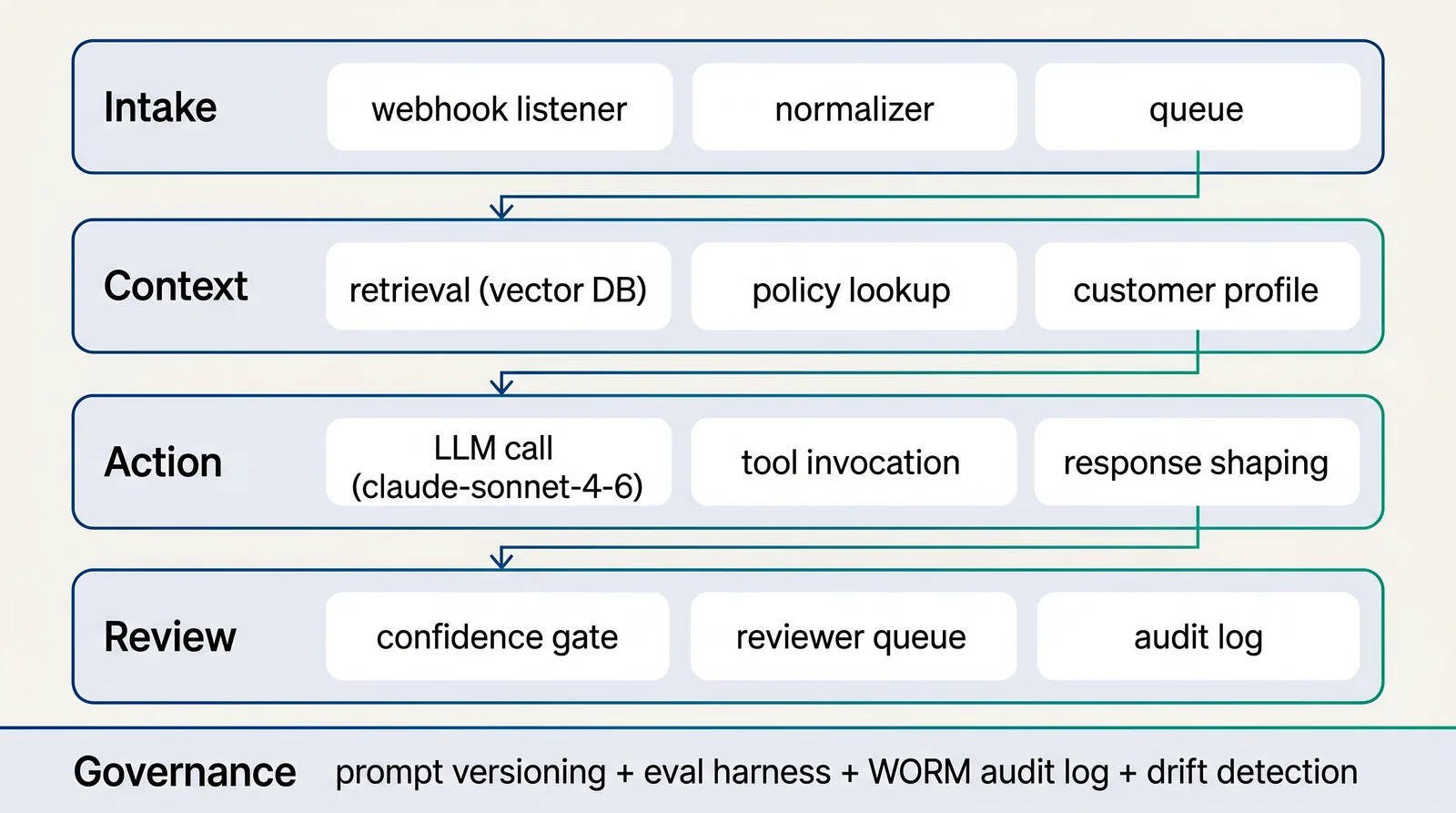
We treat the workflow as a system with five distinct layers: intake (classify and tag what comes in), context (retrieve approved sources), action (draft, route, decide), review (humans on low-confidence and high-impact cases), and learning (every reviewer action improves the next iteration). For revenue operations in SaaS, the layers are scoped during Discovery and built sequentially during Build.
What we build inside the workflow
The Build engagement ships three production layers. The intake layer classifies every request, record, or signal into a measurable taxonomy. The context layer retrieves approved source material — policy, customer history, prior cases, operational notes. The action layer detects missing fields, summarizes pipeline risk, suggests next steps, and standardizes handoffs. Each layer is wrapped with review queues, confidence scoring, audit logs, and dashboards before any production traffic.
Reference architecture
4-layer AI-native workflow for revenue & growth
The architecture is designed for substitution: any single layer (model, retrieval store, reviewer UI, action client) can be swapped without rewriting the others. That is the property that lets revenue operations survive 12+ months of provider and pricing change.See the full architecture diagram for Revenue & Growth →
AI-native vs traditional approach
The honest comparison for SaaS founders, revenue leaders, customer success teams, and product marketers on revenue operations: where AI-native delivery genuinely wins, where it is comparable, and where the traditional approach still makes sense.
| Dimension | Traditional (in-house build or BPO) | AI-native engagement (us) |
|---|---|---|
| Time-to-first-traffic | Multi-quarter program | 8-week thin-slice ship target |
| Commercial structure | Monthly retainer with FTE assumptions | Discovery, Build, Run priced independently |
| Control surface | Manual audit cycles | Versioned artefacts, signed audit log, named owners per control |
| Throughput-per-FTE | 1.0× (baseline) | +45 pts |
| Unit economics | Unchanged from baseline | 60-80% lower on routine cases |
| Termination clause | Multi-quarter notice; documentation gaps | Month-to-month Run; handover plan in Build SoW |
Manual onboarding costs $180-340 per new customer in CS time; AI-native onboarding brings it to $35-80 with reviewer queue on enterprise tier.
Engagement scope & pricing
SaaS engagements run as fixed-scope phases with named deliverables, not as hourly retainers. Each phase is independently committable.
Revenue engagement
Phased delivery, separate billing. Commit only to what you can defend against the prior phase's output.
Phase 1 · Discovery
$5k
2-week sprint
Phase 2 · Build
$15k–$22k
6-8 weeks
Phase 3 · Run
$2k–$3k / mo
optional, hourly bank also available
~$25k–$45k typical year 1 (60% take the run option for ~6 months)
Outbound, growth, or revenue-ops workflow, integration with your CRM, weekly operating review during Run.
The only thing you commit to today is the Discovery sprint. The Build SoW is produced inside Discovery and you decide whether to proceed. Run is optional.
The 4-phase delivery model
Phase 1 · Weeks 1–2
Discovery
Discovery is short, intense, and decision-producing. By end of week 2, you have the workflow map, the baseline, the SoW, and the risk register. No code yet — the next phase is calibrated against this evidence.
Phase 2 · Weeks 2–4
Design
We translate the Discovery findings into an architecture: which data sources, which prompts, which review queues, which controls, which dashboards. The Build phase ships against this design.
Phase 3 · Weeks 4–8
Build
6-10 week sprint that ships the thin-slice production workflow on top of your existing systems. Eval harness gating every prompt change. Reviewer queue staffed. Audit log queryable. Dashboard live.
Phase 4 · Weeks 8+
Run
Monthly month-to-month Run cadence: Monday metric review, Wednesday prompt and retrieval refresh, Friday calibration audit. The cadence is the deliverable; the prompts are the artefacts that change between cadence cycles.
Interactive ROI calculator
Estimate your AI-native ROI for revenue operations
Reference inputs below are typical for saas teams in the revenue cluster. Adjust them to match your situation.
Projected
Current monthly cost
$24,000
AI-native monthly cost
$7,920
Annual savings
$192,960
67% cost reduction · ~468 operator-hours freed / month
Governance and risk controls
AI-native workflows need a risk model that fits the sector. In SaaS, the central concerns are customer data handling, hallucinated support, security claims, and lifecycle communication quality. We ship five controls on every engagement: every answer or recommendation is grounded in approved sources; the system keeps a record of inputs, outputs, model versions, and reviewers; low-confidence or high-impact cases route to humans; quality is measured with a labelled test set of real examples; your team owns the final policy and escalation rules.
How we report ROI
ROI on revenue operations compounds through four channels: labor leverage (same team, more volume), quality consistency (fewer missed steps, less rework), cycle-time compression (decisions and handoffs happen faster), and learning speed (every case improves the taxonomy and playbook). In SaaS, that shows up in ARR, activation, churn, expansion revenue, support cost, and pipeline velocity.
Selected portfolio
Real builds — revenue operations in SaaS and adjacent sectors
Below are engagements drawn from our active portfolio where the workflow rhymed with revenue operations in SaaS or in adjacent contexts. Scope and stack are accurate; client identities are withheld under engagement NDAs.
Q1 2026
AI pricing system for startup founders — 9-step foundation + personalised AI brain
Founder-led pricing-strategy AI SaaS · DACH
First AI-powered pricing platform for startup founders. Structured 9-step pricing-foundation flow (product, customers, competition, costs, boundaries, model, strategy), personalised AI brain that learns from each business over time, two subscription tiers with money-back guarantee. Built end-to-end including billing, AI orchestration, and onboarding.
- Next.js + TypeScript
- Multi-LLM orchestration
- Subscription billing
Q2 2026
Digital brand refresh + integrated recruitment platform for an IT consulting firm
Enterprise IT consulting boutique · Europe
Repositioning + redesign for a pure-staffing IT consulting house serving CIO buyers. Editorial architecture tightened around three expertise pillars (IT & SAP, cloud, cybersecurity), premium art direction, conversion-oriented UX, marketing-team-owned Sanity CMS, and an integrated recruitment funnel for senior consultant sourcing.
- Next.js + Framer Motion
- Sanity CMS (marketing-owned)
- Recruitment funnel
Q3 2025
On-demand regional aviation booking — flexible flight network across smaller cities
Regional aviation operator · DACH
Booking and operations stack for an on-demand regional aviation network connecting secondary cities. Customer-facing booking flow with dynamic availability, operator-side dispatch tools, route economics dashboards. Designed for a sustainable flight-network operating model rather than fixed-schedule airline patterns.
- Next.js + native-app companion
- Dynamic availability engine
- Operator dispatch console
Client identities withheld under engagement NDAs. Sector, geography, and scope are accurate. Full case studies on request.
Common pitfall & mitigation
The failure mode we see most often on AI-native revenue operations engagements in SaaS contexts.
Attribution loss
AI-generated touches blur the funnel; nobody knows what really worked
UTM convention + touch-level logging from day 1; weekly cohort analysis in the Run review
Why digital-native teams hit a different ceiling on this
Observability for AI workflows in SaaS is in an earlier maturity stage than observability for the rest of your stack. Most APM tools treat model calls as opaque external requests; most logging frameworks struggle with the variable-length, high-cardinality nature of prompt and retrieval payloads. We bring opinionated patterns — structured prompt logging, retrieval trace capture, confidence-band telemetry, drift detection — and integrate them with your existing observability stack (Datadog, Honeycomb, your in-house OpenTelemetry rig). The result is a workflow that is debuggable at the same operational rigor as your other services.
How we ship the thin slice on this workflow
If you have ever shipped a non-trivial production system you know the first 30 days are make-or-break. For revenue operations in SaaS, the make-or-break decisions are: what does the labelled test set look like, what is in scope for the integration against CRM, where does the automation boundary sit, and how is the reviewer queue UX going to feel to your operator team. We answer all four in the first two weeks.
Labelled test set: 200 cases minimum by end of week 2, signed off by the engagement sponsor, covering routine, exceptional, ambiguous, and adversarial. Integration scope: documented and bounded by end of week 1, with the data-access plan reviewed by your engineering team. Automation boundary: drawn deliberately in week 2 — full automation lane, drafted-with-review lane, reserved-to-human lane — with confidence thresholds calibrated against the test set. Reviewer UX: prototyped in week 2 with two of your senior operators in the loop, iterated through week 3.
From day 30, the Build sprint shifts to widening the envelope. The decisions made in the first month are the ones that shape the next 12 months of operating the workflow — which is why we resist the temptation to skip ahead to the model layer before the test set and the reviewer UX have been earned.
For SaaS engagements on revenue operations, the first 30 days are not about building features — they are about producing the labelled test set that will govern every subsequent decision. The test set is the most valuable artefact of the engagement, because it is what makes "did this change make the workflow better?" a measurable question instead of an opinion.
We spend week 1 on test-set capture. The operator team picks 200-400 representative cases spanning routine, exceptional, ambiguous, and adversarial. Each case has the expected outcome, the expected reasoning, and the source citations a reviewer would want to see. The test set is reviewed for coverage gaps, signed off by the engagement sponsor, and version-controlled alongside the prompts.
From week 2, every prompt change, retrieval-index update, and threshold calibration is gated by the eval harness running against this test set. Improvements that beat the incumbent across enough metric slices get promoted; changes that look impressive on one slice but regress on another are flagged for review. By the end of Build, the test set has grown to 600-1000 cases, the workflow has been through 15-25 eval cycles, and SaaS leadership has empirical evidence that the system performs on their data, not on a vendor's demo.
This is the practice most SaaS AI projects skip because it looks like overhead in the first three weeks. It is the practice that determines whether the workflow survives the third quarter of Run, which is why we treat it as the foundation of Build rather than an afterthought.
Pattern reference from a prior engagement
A comparable engagement worth knowing about for revenue operations in SaaS is summarised below. Identity withheld under engagement NDA; sector and stack are accurate.
AI pricing system for startup founders — 9-step foundation + personalised AI brain. First AI-powered pricing platform for startup founders. Structured 9-step pricing-foundation flow (product, customers, competition, costs, boundaries, model, strategy), personalised AI brain that learns from each business over time, two subscription tiers with money-back guarantee. Built end-to-end including billing, AI orchestration, and onboarding. (Founder-led pricing-strategy AI SaaS · DACH, Q1 2026.)
The architectural choices that worked there translate to SaaS revenue operations with two adjustments: the data-source mix shifts to match your operating systems (CRM, product analytics, and adjacent), and the reviewer SLAs adjust to your team's operating cadence. The four-layer pattern (intake, context, action, review), the evaluation discipline, and the audit posture are portable.
For US buyers
US compliance scaffolding for revenue operations in SaaS (CCPA / CPRA, NIST AI RMF)
SaaS engagements touching US clients on revenue operations ship with the regulatory scaffolding your procurement, compliance, and legal teams expect. The framework that matters most for SaaS is California Consumer Privacy Act / California Privacy Rights Act (CCPA / CPRA) — addressed below alongside the adjacent frames we encounter.
CCPA / CPRA
California Consumer Privacy Act / California Privacy Rights Act
Authority: California Privacy Protection Agency (CPPA)
- Scope
- California resident data rights (access, deletion, opt-out of sale/sharing), sensitive personal information, automated decision-making opt-out (proposed regs).
- How we ship inside it
- California-touching engagements ship with consumer-rights workflows: access request handling, deletion within 45 days, opt-out signals (GPC) honored at the retrieval layer. Automated-decision-making disclosures align with proposed CPPA regulations.
NIST AI RMF
NIST AI Risk Management Framework (AI 100-1)
Authority: U.S. National Institute of Standards and Technology
- Scope
- Voluntary framework: Govern, Map, Measure, Manage functions for AI system risk.
- How we ship inside it
- Every engagement maps to NIST AI RMF during Discovery. The control map produced becomes the artefact your internal audit and security teams use to defend the workflow.
Premium engagement page · hand-edited
The bespoke playbook for this combination
Pipeline hygiene, SDR augmentation, account intelligence — built on top of Salesforce / HubSpot.
Architecture, end-to-end
An AI-native RevOps layer that sits between your CRM and your revenue team: ingests account signals, drafts research and outreach, surfaces stalled-pipeline patterns, and routes high-confidence next-actions to a reviewer queue.
Four layers ship in Build. (1) Intake: account-event stream from Salesforce/HubSpot + product usage from Segment/Mixpanel + intent signals from G2/Bombora. (2) Context: per-account retrieval index with recent activity, decision-maker map, prior touches, customer-success signals. (3) Action: Claude-class model generates account research briefs, drafts outbound sequences, flags accounts at risk of stalling. (4) Review: SDR + RevOps queue with one-click approve / iterate / escalate; every action logs back to CRM with provenance.
Specific risks we engineer against
The four to six failure modes we have actually encountered on engagements that look like yours. Each has a documented mitigation in the Build SOW.
RiskAI-generated outreach feels generic and hurts brand
MitigationVoice playbook in version control, brand-tone evaluation in eval harness, sampling 5% of outputs weekly during Run.
RiskCRM data quality is poor and feeds garbage to the AI
MitigationDiscovery includes a CRM hygiene audit; Build phase 1 is normalisation + dedup before any model touches the data.
RiskSales team rejects the workflow and goes back to manual
MitigationWe embed a senior SDR/AE during Build to co-design the reviewer UX; adoption metric tracked weekly during Run with calibration.
RiskVolume of outbound spikes and damages domain reputation
MitigationDomain warm-up plan, per-day volume caps, deliverability monitoring integrated into the operating dashboard.
Typical 90-day delta on Salesforce-tracked metrics
| Metric | Before | After | Window |
|---|---|---|---|
| SDR meetings booked / month / rep | 8–12 | 18–28 | 60 days |
| Account research time / opportunity | 45–90 min | 5–10 min | 30 days |
| Stalled-pipeline win-back rate | 8–12% | 18–26% | 90 days |
| SDR ramp time | 3–4 months | 5–7 weeks | first new SDR cohort |
Numbers are reference ranges from comparable engagements. Your engagement baseline is captured in Discovery and reported weekly during Run.
Objections we hear most often
We already have Outreach and ChatGPT — what's different?+
Outreach is a sequence delivery platform. ChatGPT is a generic LLM. We sit between them with operating discipline: versioned prompts, evaluation harness against your labelled test set, voice playbook in version control, reviewer queue calibrated to your team. The result is consistent quality at scale, not impressive demos.
Will this replace our SDR team?+
No. It compresses the routine prep work (account research, draft outreach, list scoring) so SDRs spend their time on the calls and the relationship-building. Throughput per SDR goes up; headcount typically stays flat for the first 2 quarters.
What about our CRM data privacy?+
The retrieval index lives in your cloud account. Prompts are processed by Anthropic with Zero-Data-Retention. No customer data is used for training. Per-rep IAM enforced through your SSO.
Mini SOW
What the Build SOW looks like
Total fee
$26,500 Discovery + Build
Duration
10 weeks to thin-slice production
Week 1–2
Discovery: CRM hygiene audit, labelled test set (200 accounts), Build SOW with named integrations.
Week 3–4
Retrieval index live; account-research drafts going through SDR review queue.
Week 5–6
Outbound sequence generation live; deliverability monitoring instrumented.
Week 7–8
Stalled-pipeline detection + win-back workflow deployed.
Week 9–10
Full team rollout; dashboard live; first weekly review report.
Procurement FAQ
Does this touch our customer PII?+
Yes — account data and contacts. Processed under DPA with SCCs. Data stays in your CRM region.
What's the exit path?+
Prompt repository, eval harness, dashboard code, integration code, runbook — all in your repo. At engagement end, we deprovision in 30 days.
Do you train on our data?+
No. Anthropic ZDR enabled. Workflow data is not used for any cross-client improvement.
Real shipped systems
What our clients say
Below: attributions from active clients. Client identities are withheld in public form pending written approval; live references available to qualified procurement contacts on discovery call.
AI SaaS · DACH region
“They shipped the production version of our pricing brain in 6 weeks, including the billing layer and the onboarding flow. We had been bouncing between contractors for 4 months before.”
Founder, AI Pricing SaaS
Outcome: From 0 to live SaaS with paying customers in 6 weeks. Production billing live, AI onboarding flow shipped, 2 pricing tiers active.
Government-licensed legal services platform · GCC region
“A complete bilingual platform compliant with regulator requirements. Technical quality and delivery speed are outstanding.”
Founding team, regulated legal marketplace
Outcome: Ministry-of-Justice-licensed national legal marketplace, EN/AR bilingual, in 16 weeks. Directory + bookings + legal tools + emergency contacts.
Property management operator · GCC region
“We replaced spreadsheets and 4 disconnected tools with a single OA platform. 55 screens, 47 tables, a voting platform, and an internal portal — all on the same identity layer.”
CTO, multi-region property operator
Outcome: Centralised property operations across multiple owners associations. 14-week first release; 8-week follow-on for the staff portal; 6-week follow-on for e-voting.
Before / after
Concrete deltas from shipped engagements
Owners-association management workflows
Property management operator · GCC
Operator was scaling association count and could not maintain manual coordination. Replaced 4 fragmented tools with a single AI-augmented operational backbone.
Metric
Operational surface area
Before
Fragmented across spreadsheets + email + 4 SaaS tools
After (14 weeks Build phase)
Unified SaaS with 55 screens / 47 normalized tables / cross-app identity
Pricing strategy SaaS onboarding
AI pricing SaaS · DACH
Founder shipping AI-native pricing platform for early-stage SaaS. Discovery + Build delivered a working SaaS with subscription billing and an AI brain that learns from each customer.
Metric
Time-to-pricing for a new founder
Before
3–4 weeks of consultant time + spreadsheets
After (6 weeks total Build)
9-step structured AI workflow, completed in 30–45 minutes
Lawyer discovery and appointment booking
National legal marketplace · GCC
Regulated entity needed to launch the national reference platform for legal services. Delivered a Next.js 16 monorepo with bilingual content layer, PDF generation, and police directory.
Metric
Citizen access to certified legal services
Before
Fragmented across social media, no central directory, phone-only booking
After (16 weeks Discovery + Build)
Ministry-licensed bilingual EN/AR marketplace; multi-channel booking; legal tools; emergency hotline
Marketing site + booking funnel
Premium vehicle care specialist · DACH
Niche detailing workshop needed to project premium positioning matching their workmanship. AI-assisted copywriting + image art-direction compressed launch time.
Metric
Brand perception alignment
Before
Generic web presence — did not match workmanship quality
After (3 weeks concept-to-live (AI-augmented build))
Premium responsive site, German-market SEO foundation, appointment-oriented CTAs
For US companies
Start a US-friendly engagement
Discovery from $8,500–$12,000, Build from $35,000–$75,000, optional Run from $5k/mo. Fixed-price, milestone-billed, you own every artefact. Send a short brief and we reply within 5 business days. 11am–4pm ET overlap for live syncs.
USD pricing
Discovery $8,500–$12,000 · Build $35,000–$75,000
US-style commercial
MSA / SOW / mutual NDA standard. DPA with SCCs included.
Limited capacity
We onboard 3–5 new clients per quarter to protect delivery quality.
What the 2026 production data says
MIT's State of AI in Business work found that 95% of generative AI pilots produced no measurable P&L impact. That statistic is usually read as a verdict on the technology; it is closer to a verdict on scoping. In SaaS, a revenue operations pilot that was never attached to an owned metric cannot show impact, however well it performs. We require the metric and its owner before the engagement starts.
Read the full breakdown of the pilot-to-production gap — the three failure modes, with the 2026 sources.
Build internally or work with us
The build-vs-buy decision in SaaS usually comes down to four constraints: do you have AI engineering capacity, do you have ops capacity to govern it, do you have time-to-value pressure, and do you have a reference architecture to copy. We bring all four to an engagement. If you have two or fewer, working with us is faster and cheaper than building.
What to ask us before signing
- Ask for the labelled test set methodology — how many cases, what the coverage gaps are, who signs them off.
- Ask where the prompt library and retrieval index will live (your cloud or ours) and what happens to them at the end of Run.
- Ask how we calibrate confidence thresholds and how often they are revisited against the SaaS reality.
- Ask for the audit log architecture — what is logged, how long it is retained, who can query it.
- Ask how a senior operator on your team becomes the first reviewer and what onboarding we ship to support them.
Recommended first project
Our recommendation for a first revenue operations engagement in SaaS is to pick the slice of the workflow that satisfies four criteria: there is a measurable baseline, the work is genuinely repetitive, the failure mode is reversible within a reasonable window, and a senior operator on your team can be the first reviewer. Those four criteria filter out the engagements that look impressive in a slide and fail in week three. The 90-day target is "thin slice in production with a defended baseline". By day 30, the system processes a small share of real traffic with full reviewer oversight. By day 60, the share has widened and the calibration is data-driven. By day 90, the operating cadence is your team's, the dashboard reflects empirical performance, and the case for the next workflow writes itself.
Frequently asked questions
How do you automate revenue operations in SaaS with AI?+
For SaaS, the build is biased toward operational durability over demo-grade polish. We instrument every case end-to-end (intake → context → action → review), gate every prompt change behind an evaluation harness, and integrate against CRM + product analytics. The workflow goes to production in 6-10 weeks and operates against forecast accuracy, CRM completeness, stage conversion, and sales productivity.
What does it cost to automate revenue operations for SaaS teams?+
Phased pricing — you commit to one phase at a time. Discovery is $5k for 2-week sprint. Build, scoped from Discovery, runs $15k–$22k over 6-8 weeks. Run is opt-in at $2k–$3k / mo per optional, hourly bank also available. ~$25k–$45k typical year 1 (60% take the run option for ~6 months)
What is the best AI agent for revenue operations in SaaS?+
The model is rarely the most consequential choice on revenue operations in SaaS. What matters more: the retrieval shape against your approved sources, the confidence-threshold calibration against the labelled test set, the reviewer queue UX, and the audit log architecture. We benchmark frontier models (Claude, GPT-4-class, Gemini) against your data and select for the accuracy/cost/latency profile that fits your operational reality — not a generic leaderboard.
How long does it take to deploy AI revenue operations for SaaS?+
Production traffic on revenue operations for SaaS typically starts at week 6-8 of Build, after the labelled test set, the eval harness, the reviewer queue, and the audit log are all in place. The first quarter of Run is paired operation — your team takes the dashboard, we stay on the architecture decisions. By the end of the first Run quarter, your team is operating the workflow with the cadence we ship as part of Build.
What do we own, and what do you own?+
The ownership boundary is documented in the Build statement of work. Our side: workflow architecture, prompt library, retrieval shape, evaluation harness, reviewer-queue design, audit log architecture, weekly operating cadence. Your side: data access, source curation by your subject-matter experts, policy interpretation, exception approval, final commercial decisions. Every artefact is yours at the end of Run.
What's the revenue ROI shape for revenue operations in SaaS?+
forecast accuracy, CRM completeness, stage conversion, and sales productivity is the bridge metric to ARR, activation, churn, expansion revenue, support cost, and pipeline velocity. The first 30 days are negative (engagement cost vs. limited production volume); month 3 typically hits break-even; months 4-12 are strongly positive as the labelled test set grows and the prompt library tunes to your category.
Do you train models on our data?+
No. We do not train any model on client data. Anthropic Zero-Data-Retention is enabled by default; OpenAI default-no-training is honoured. Prompts, retrieval indexes, audit logs, and integration data live in your cloud account under your IAM. At engagement end, every artefact transfers to your repository.
What if we want to exit the engagement?+
Discovery and Build are fixed-scope, so there is no mid-engagement exit cost. Run is month-to-month with 30-day notice. Every artefact (prompts, eval harness, integration code, dashboards, runbooks) is in your repository throughout the engagement, not behind our SaaS. There is no lock-in.
What does success look like 90 days after Build closes?+
forecast accuracy, CRM completeness, stage conversion, and sales productivity measurably improved against the Discovery baseline. Your team is operating the workflow with the cadence we shipped during Build. The audit log is queryable. The reviewer queue is calibrated. The next workflow scope is informed by real production evidence rather than initial assumptions.
What support is included after the engagement ends?+
Optional Run retainer covers weekly cadence, prompt refresh, retrieval index updates, and reviewer-queue calibration. Architecture-level questions and breaking-change support are billed hourly outside of Run. Most engagements transition Run in-house at month 6-12; we stay available for architecture decisions for 12 months at no extra charge.
How does this integrate with CRM and our existing stack?+
Discovery scopes the integration footprint explicitly. We integrate at the API layer; no replatforming required. The Build statement of work names exactly which systems are connected, which data flows are bidirectional, and what authentication patterns we use (SSO, service accounts, OAuth scopes). The integration code lives in your repository.
What does your team look like during an engagement?+
Discovery: 1 senior delivery lead + 1 PM, ~30 hours/week. Build: 1 senior delivery lead + 2-3 senior AI engineers, ~50-80 hours/week across the team. Run: 1 delivery owner + 1 engineer on weekly cadence. We do not use offshore staff augmentation. Every engineer touching your engagement is senior-level.
Sources we reference
The following sources inform the architecture, governance, and benchmarks we apply on SaaS engagements. Cited here so you can verify and dig deeper.
- NIST Secure Software Development Framework
- Worldwide AI and Generative AI Spending Guide — IDC
- Hype Cycle for Artificial Intelligence — Gartner
- B2B Buying Disconnect: Buying Decisions are Made Without Sellers — Forrester
- Generative AI Impact on Marketing & Sales — McKinsey
- Bessemer State of the Cloud — Bessemer Venture Partners
- ChartMogul SaaS Benchmarks — ChartMogul
- OpenView SaaS Benchmarks — OpenView Partners
- Google Search Central: helpful, reliable, people-first content
- Google Search Central: URL structure best practices
High-intent reads
Start the engagement
Start a SaaS engagement
Tell us about your workflow, the systems involved, and the KPI you want to move. We'll send a scoped statement of work within 5 business days.