Public Sector · Revenue & Growth
Productized SEO Landing Pages for Government Services
We design, build, and run AI-native seo landing pages for public agencies, civic service teams, procurement leaders, and digital government offices. This page describes the engagement: scope, pricing, timeline, controls, and the KPIs we commit to.
Projects from $15k · Refundable 7 days · Kickoff within 5 days
Early access: we work with a small first cohort. Engagements are scoped, priced, and shipped end-to-end by our team — not referred to third parties.
In one sentence
AI-native seo landing pages for government services — From Discovery baseline to production traffic in 8-12 weeks, with the operating model — eval harness, reviewer UI, audit log, calibration cadence — handed over as part of Build, not deferred to Run. Expected delta on indexed pages: +3.4×.
Key facts
- Industry
- Government Services
- Use case
- SEO Landing Pages
- Intent cluster
- Revenue & Growth
- Primary KPI
- indexed pages, impressions, qualified clicks, conversion rate, and internal link depth
- Top benchmark
- Outbound reply rate: 1.2% → 4.1% (+3.4×)
- Systems integrated
- case management, public portals, records systems
- Buyer
- public agencies, civic service teams, procurement leaders, and digital government offices
- Risk lens
- public accountability, accessibility, privacy, transparency, and records retention
- Engagement timeline
- Discovery 2 weeks → Build 9 weeks → Run continuous (integration-heavy)
- Team size
- 1 senior delivery + 1 part-time domain SME
- Discovery price
- $5k · 2-week sprint
- Build price
- $15k–$22k · 6-8 weeks
Primary outcome
capture long-tail demand with useful pages at scale
What we ship
programmatic SEO architecture, keyword map, page templates, and internal link graph
KPIs we report on
indexed pages, impressions, qualified clicks, conversion rate, and internal link depth
Why Government Services teams hire us for this
In government services, the workflows that benefit most from AI-native delivery share three traits: high volume, structured-but-messy input, and a measurable outcome. SEO Landing Pages fits all three. That is why we treat this combination as a first engagement — the wedge with the cleanest signal-to-noise on impact.
Recent industry benchmarks (Gartner, Salesforce Research) show government services revenue teams spend 60-70% of their week on non-selling activities. AI-native delivery targets that non-selling block first.
Industry context: Mid-market and enterprise operators face the same fundamental tradeoff: AI must compress operational cycle time while remaining auditable and integrable with existing systems of record.
Benchmarks we hit
Reference benchmarks from production deployments of seo landing pages in government services-comparable contexts. Sources noted per row. Your actuals are measured against the baseline captured in Discovery.
| Metric | Industry baseline | AI-native typical | Delta |
|---|---|---|---|
Outbound reply rate Industry baseline from Gartner B2B Sales Pulse; AI-native lift from per-prospect context injection | 1.2% | 4.1% | +3.4× |
SDR throughput (qualified meetings / week) Same SDR headcount, AI handles research + first-touch drafting | 4–6 | 14–22 | +3× |
CRM data quality (account completeness) Forrester B2B Insights: human-only CRM hygiene typically degrades within 6 months | 42% | 87% | +45 pts |
Benchmarks are reference values from comparable engagements and authoritative sector benchmarks. Your engagement's baseline is captured during Discovery and actuals are reported weekly during Run against that baseline.
How we operate the workflow
Run cadence on seo landing pages is calibrated to government services reality, not consultant fantasy. We do not promise daily prompt updates — we promise weekly. We do not promise instant model swaps — we promise quarterly evaluations against new candidates. The promise is operational reliability, not heroic effort, because heroic effort does not survive the third month.
What we build inside the workflow
Concretely for government services, we integrate with case management and public portals, build the retrieval and reasoning steps for seo landing pages, and instrument indexed pages, impressions, qualified clicks, conversion rate, and internal link depth. The Build deliverable is programmatic SEO architecture, keyword map, page templates, and internal link graph, paired with a runbook your team can operate without us.
Reference architecture
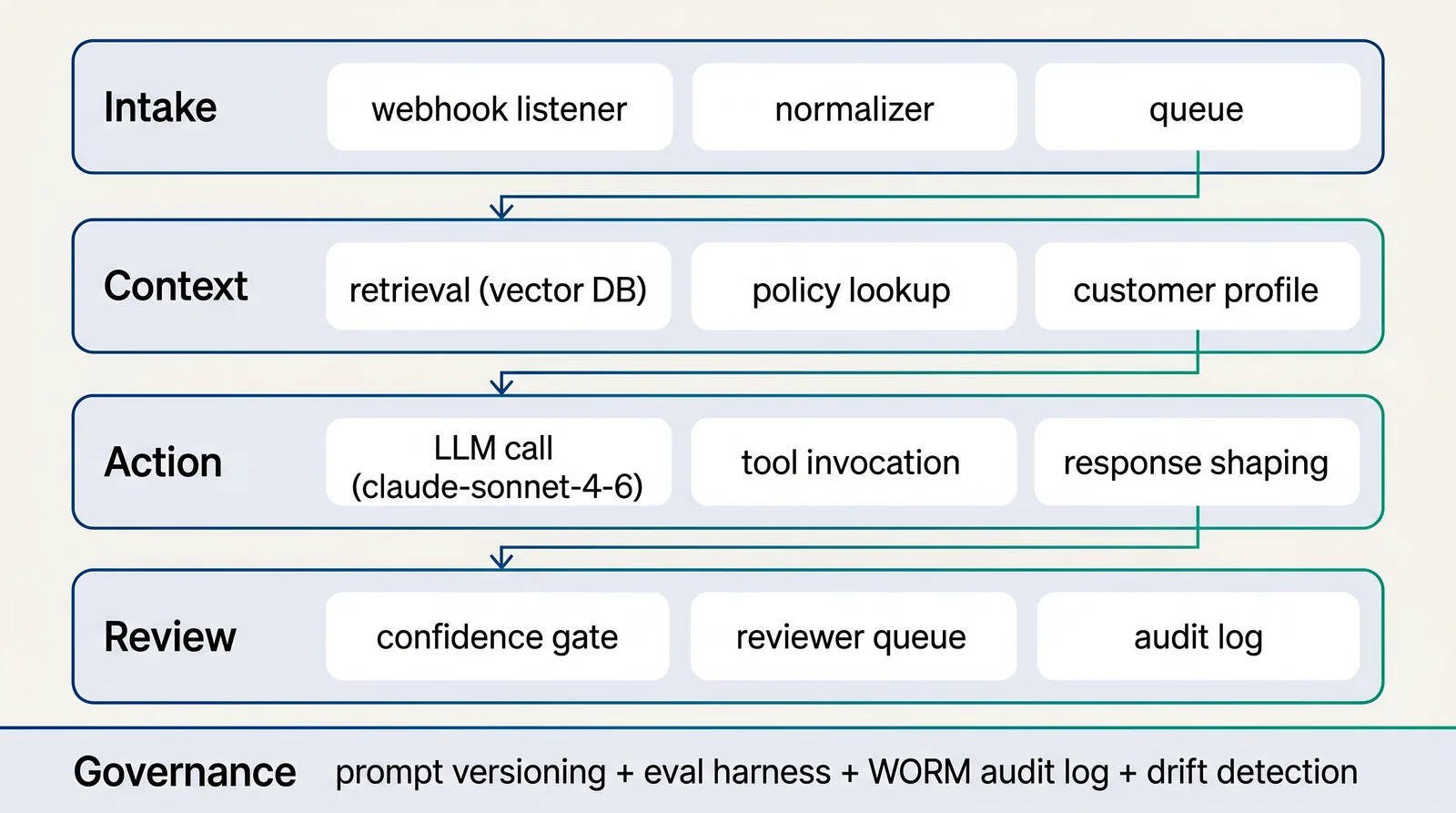
4-layer AI-native workflow for revenue & growth
The architecture is designed for substitution: any single layer (model, retrieval store, reviewer UI, action client) can be swapped without rewriting the others. That is the property that lets seo landing pages survive 12+ months of provider and pricing change.See the full architecture diagram for Revenue & Growth →
AI-native vs traditional approach
What changes between a traditional seo landing pages program in government services and an AI-native engagement is not the goal — it is the architecture, the operating cadence, and the exit posture. The table below makes the differences explicit.
| Dimension | Traditional (in-house build or BPO) | AI-native engagement (us) |
|---|---|---|
| Lead time to live deployment | 6-12 months | 6-10 weeks (thin slice) |
| Engagement billing | Time-and-materials or annual contract | Phased fixed-price (Discovery → Build → opt Run) |
| Audit posture | Manual logs, periodic review | Versioned prompts, audit logs, reviewer queues, attestations |
| Per-operator capacity | 1.0× (baseline) | +3× |
| Per-case cost | Industry baseline | Sub-dollar marginal cost on routine envelope |
| Exit path | Knowledge transfer takes 6+ months | Documented exit at every phase; artefacts in your repo |
Traditional process automation projects cost $80-200k+ with 6-12 month payback; AI-native engagements deliver thin-slice production in 6-8 weeks with measurable baseline-vs-actuals reporting.
Engagement scope & pricing
Three phases, three commercial envelopes. Discovery is the only commitment to start; Build and Run are scoped against the Discovery output.
Revenue engagement
Each phase is independently committable. Discovery is the only one you have to start with.
Phase 1 · Discovery
$5k
2-week sprint
Phase 2 · Build
$15k–$22k
6-8 weeks
Phase 3 · Run
$2k–$3k / mo
optional, hourly bank also available
~$25k–$45k typical year 1 (60% take the run option for ~6 months)
Outbound, growth, or revenue-ops workflow, integration with your CRM, weekly operating review during Run.
The only thing you commit to today is the Discovery sprint. The Build SoW is produced inside Discovery and you decide whether to proceed. Run is optional.
The 4-phase delivery model
Phase 1 · Weeks 1–2
Discovery
We sit with the operator team running the workflow today, watch a working day end-to-end, and produce the baseline that Build will be measured against. Two-week sprint, fixed price.
Phase 2 · Weeks 2–4
Design
Architecture sprint covering the four-layer workflow (intake, context, action, review), the integration footprint, the evaluation methodology, the reviewer UX, and the governance map.
Phase 3 · Weeks 4–8
Build
End of Build deliverables: the production workflow, the operating runbook, the eval pipeline as code, the reviewer interface, the audit log architecture, the dashboard with KPI tracking. All six are inspectable.
Phase 4 · Weeks 8+
Run
Monthly month-to-month Run cadence: Monday metric review, Wednesday prompt and retrieval refresh, Friday calibration audit. The cadence is the deliverable; the prompts are the artefacts that change between cadence cycles.
Interactive ROI calculator
Estimate your AI-native ROI for seo landing pages
Reference inputs below are typical for government services teams in the revenue cluster. Adjust them to match your situation.
Projected
Current monthly cost
$24,000
AI-native monthly cost
$7,920
Annual savings
$192,960
67% cost reduction · ~468 operator-hours freed / month
Governance and risk controls
For government services teams operating under public accountability, accessibility, privacy, transparency, and records retention, the governance stack we ship is opinionated: source allow-lists curated by your subject-matter expert, prompt versioning gated by your evaluation harness, reviewer queues staffed by your team, audit logs retained per your data policy. We bring the architecture; you bring the policy. The combination is what auditors recognize as defensible.
How we report ROI
The ROI metric that matters most for government services leadership on seo landing pages is not labor savings — it is opportunity capture. Faster indexed pages means more cases handled in the same window, more revenue, more compliance coverage, more customer trust. We measure both: the costs that drop and the throughput that scales.
Selected portfolio
Real builds — seo landing pages in government services and adjacent sectors
Below are engagements drawn from our active portfolio where the workflow rhymed with seo landing pages in government services or in adjacent contexts. Scope and stack are accurate; client identities are withheld under engagement NDAs.
Q1 → Q2 2026
National legal marketplace — directory, bookings, legal tools, emergency contacts
Government-licensed legal services platform · GCC region
Ministry-licensed bilingual EN/AR platform: directory of certified lawyers, firms, mediators and arbitrators; multi-channel appointment booking (video, phone, in-office); free legal tools (court fees, deadlines, legal interest); police directory with map + hotlines; provider verification workspace; PDF document generation with QR-coded provenance.
- Next.js 16 monorepo (Turborepo)
- Bilingual EN/AR (next-intl)
- Postmark + Web Push
Q1 2026
Premium marketing site for a specialist detailing workshop
Premium vehicle care specialist · DACH region
Marketing site for a premium vehicle detailing workshop: ceramic coating, paint protection film, detailing, smart repair. Luxury automotive visual direction, structured per-service catalog with proof points, German-market SEO foundation, appointment-oriented CTAs throughout the funnel.
- Next.js + custom design system
- Core Web Vitals first
- German-market SEO
Q3 2025
Specialist trades marketing site — roof, facade, renovation services
Construction trades specialist · France
Marketing site for a regional roofing and facade specialist: service architecture covering roof renovation, facade work, and installation services; quote-request workflow with regional catchment routing; SEO foundation built for local intent across nearby municipalities.
- Next.js + responsive
- Local SEO foundation
- Quote-request workflow
Client identities withheld under engagement NDAs. Sector, geography, and scope are accurate. Full case studies on request.
Common pitfall & mitigation
The failure mode we see most often on AI-native seo landing pages engagements in government services contexts.
CRM hygiene degrading after launch
AI writes to CRM faster than humans validate; data quality drops after week 6
Confidence-scored writes with auto-rollback below threshold + weekly data-quality dashboard
Regulatory landscape and how we ship inside it
The single regulatory question that makes or breaks government services seo landing pages engagements is "who is accountable for an automated decision". Our answer, baked into the architecture: there is always a named human owner per decision class, with the role visible in the reviewer interface, the audit log, and the governance map. Full automation does not mean no accountability — it means the named accountable human approved the policy that authorized the automation, and can revoke that authorization at any time without re-architecting the system.
Compliance officers in government services have seen enough "AI governance frameworks" to recognize when one is theatre. The questions they actually ask are concrete: where does the training or retrieval data come from, who curates it, how do model updates get validated, what happens when the model disagrees with the policy, and how is the operator team trained to override.
We answer each of those concretely in the Build phase. Retrieval data is curated by a named subject-matter expert from your team during Discovery, with a documented refresh cadence and an approval workflow for new sources. Model updates are gated by the evaluation harness: a new candidate model has to beat the incumbent on the labelled test set across multiple metric slices before it is promoted, and the comparison is logged. Policy disagreements surface as escalations, not silent overrides — when the model recommends an action that conflicts with a policy clause, the reviewer queue captures both, the operator decides, and the decision feeds the next iteration of the prompt. Operator training is a deliverable, not an afterthought: we ship the reviewer playbook, the calibration sessions, and the first month of paired-review with your team during the transition out of Build.
The net effect for government services leadership on seo landing pages is a workflow that holds together under the three audiences that matter — internal audit, compliance, supervisor — without requiring three different versions of the story. The dashboard is the story. The audit log is the evidence. The control map is the framework. All three are live, all three are queryable, and all three are designed for the regulated reality your team operates in.
The tactical playbook for the first 30 days
Week 1 — Discovery handover and labelled test set capture. We sit with the operator team running seo landing pages today, watch a working day end to end, and capture 200+ real cases as the labelled test set. By Friday we have the workflow map, the system inventory (case management, public portals, and adjacent), the risk register, and the success metrics aligned with your KPI of indexed pages.
Week 2 — Architecture and integration scoping. We design the four-layer workflow (intake, context, action, review), confirm the retrieval shape, lock the prompt strategy direction, and produce the integration plan against case management. The output is the Build statement of work with a fixed price and a named deliverable per phase.
Week 3-4 — Build sprint 1: retrieval and intake. We stand up the retrieval index against your approved sources, build the intake classifier, instrument the audit log, and run the first eval cycle against the labelled test set. The thin slice is functional but not production-deployed.
Week 5-6 — Build sprint 2: action and review. We ship the action layer, build the reviewer queue UI, calibrate the confidence thresholds against the labelled test set, and onboard the first reviewer cohort. By end of week 6 the workflow is processing low-stakes production traffic with full audit logging.
The rest of the Build phase widens the production envelope case-by-case based on the reviewer feedback loop. By the end of Build, seo landing pages for government services is running on real traffic with the operating cadence already established.
The Build phase rhythm for seo landing pages in government services is engineered for the bottleneck most teams hit at the end of week 2: ambition outrunning evidence. We engineer for the opposite — evidence first, ambition calibrated to it.
Week 1 produces the discovery report, the labelled test set, the integration plan, the risk register, the success metrics. Week 2 stands up the retrieval index, the intake classifier, the eval harness, the audit log. Week 3 wires the action layer with reviewer approval, runs the first three eval cycles, produces the first calibration report. Week 4 ships the thin slice to a narrow production audience (5-10% of routine cases), instruments the operator feedback loop, and runs the first weekly review.
By day 30, the dashboard is live, the system is processing real government services cases, the operator team is engaging with the reviewer queue, the eval harness is gated on every change, and the next two weeks of Build are scoped from concrete evidence rather than initial assumptions. Days 31-45 widen the production envelope to 40-60% of routine cases. Days 46-60 absorb the remaining routine envelope and start handling the first tranche of exceptional cases. By the close of Build (day 60-70), the workflow is operating at its target envelope with the calibration discipline in place to handle drift, edge cases, and future model changes.
How this rhymes with a recent build
A comparable engagement worth knowing about for seo landing pages in government services is summarised below. Identity withheld under engagement NDA; sector and stack are accurate.
National legal marketplace — directory, bookings, legal tools, emergency contacts. Ministry-licensed bilingual EN/AR platform: directory of certified lawyers, firms, mediators and arbitrators; multi-channel appointment booking (video, phone, in-office); free legal tools (court fees, deadlines, legal interest); police directory with map + hotlines; provider verification workspace; PDF document generation with QR-coded provenance. (Government-licensed legal services platform · GCC region, Q1 → Q2 2026.)
The reason that engagement is a useful reference is not the surface match — it is the underlying decision structure. The same questions show up on seo landing pages for government services: where to draw the automation boundary, how to calibrate confidence thresholds against the labelled test set, what to put in the reviewer UI, how to instrument drift. The answers transfer; the implementation specifics adapt to your stack.
For US buyers
US compliance scaffolding for seo landing pages in government services (NIST AI RMF)
Government Services engagements touching US clients on seo landing pages ship with the regulatory scaffolding your procurement, compliance, and legal teams expect. The framework that matters most for government services is NIST AI Risk Management Framework (AI 100-1) (NIST AI RMF) — addressed below alongside the adjacent frames we encounter.
NIST AI RMF
NIST AI Risk Management Framework (AI 100-1)
Authority: U.S. National Institute of Standards and Technology
- Scope
- Voluntary framework: Govern, Map, Measure, Manage functions for AI system risk.
- How we ship inside it
- Every engagement maps to NIST AI RMF during Discovery. The control map produced becomes the artefact your internal audit and security teams use to defend the workflow.
For US companies
Start a US-friendly engagement
Discovery from $8,500–$12,000, Build from $35,000–$75,000, optional Run from $5k/mo. Fixed-price, milestone-billed, you own every artefact. Send a short brief and we reply within 5 business days. 11am–4pm ET overlap for live syncs.
USD pricing
Discovery $8,500–$12,000 · Build $35,000–$75,000
US-style commercial
MSA / SOW / mutual NDA standard. DPA with SCCs included.
Limited capacity
We onboard 3–5 new clients per quarter to protect delivery quality.
What the 2026 production data says
The 2026 surveys are blunt about what happens next: enterprises report adopting AI agents at close to four in five, while barely one in ten runs them in production. For seo landing pages in government services, the gap is rarely about model quality — it is inference cost discovered at production volume, a workflow nobody owns end to end, and failures quiet enough to go unnoticed for weeks. We scope against those three before we write code.
Read the full breakdown of the pilot-to-production gap — the three failure modes, with the 2026 sources.
Build internally or work with us
Some government services teams should build internally, especially when they already have strong product, data, security, and operations capacity. Most teams move faster with us because the bottleneck is not only engineering — it is translating messy operational work into a reliable AI-assisted workflow that people will actually use. After 6 to 12 months you can absorb the operating model internally or keep us as a managed execution partner.
What to ask us before signing
- Ask for a 30/60/90-day plan with named deliverables, not a vague phase description.
- Ask how we handle the long tail of edge cases the operator team has never encoded — escalation, calibration, capture.
- Ask for the model and provider strategy — single-model, multi-model, fallback paths, cost forecasting.
- Ask how the reviewer queue UX is designed and whether your operator team can shape it during Build.
- Ask for references from government services-adjacent engagements — sector, scope, and outcome dimensions.
Recommended first project
Our recommendation for a first seo landing pages engagement in government services is to pick the slice of the workflow that satisfies four criteria: there is a measurable baseline, the work is genuinely repetitive, the failure mode is reversible within a reasonable window, and a senior operator on your team can be the first reviewer. Those four criteria filter out the engagements that look impressive in a slide and fail in week three. The 90-day target is "thin slice in production with a defended baseline". By day 30, the system processes a small share of real traffic with full reviewer oversight. By day 60, the share has widened and the calibration is data-driven. By day 90, the operating cadence is your team's, the dashboard reflects empirical performance, and the case for the next workflow writes itself.
Frequently asked questions
How do you automate seo landing pages in government services with AI?+
We map the existing seo landing pages workflow inside government services, identify the high-volume, high-structure tasks, and build an AI agent that handles those tasks while routing low-confidence cases to a human reviewer. The build connects to your case management, public portals, records systems, runs against a labelled test set, and ships behind a reviewer queue before it sees production traffic. We then operate it, measure indexed pages, impressions, qualified clicks, conversion rate, and internal link depth, and improve it weekly.
What does it cost to automate seo landing pages for government services teams?+
~$25k–$45k typical year 1 (60% take the run option for ~6 months). The structure: $5k Discovery (2-week sprint) → $15k–$22k Build (6-8 weeks) → optional $2k–$3k / mo Run. Outbound, growth, or revenue-ops workflow, integration with your CRM, weekly operating review during Run.
What is the best AI agent for seo landing pages in government services?+
Model selection on seo landing pages for government services happens against five criteria: quality on your labelled test set, cost per inference at your projected volume, latency budget for the user-facing path, provider reliability over 12-18 months, contractual data-handling posture. We bring the comparative methodology from prior engagements and run it during Build; the winning model is the one that survives all five, not the one that wins the demo.
How long does it take to deploy AI seo landing pages for government services?+
A thin-slice deployment in 2-week sprint after Discovery, with real government services data and real reviewers. The full Build phase runs 6-8 weeks. By day 90, indexed pages, impressions, qualified clicks, conversion rate, and internal link depth is instrumented, the team has a baseline, and leadership has the data needed to decide on expansion into adjacent government services workflows.
What do we own, and what do you own?+
What we ship as code lives in your repository under your IAM. The prompts, the evaluation harness, the integration code, the reviewer UI, the infrastructure-as-code — all in your Git, not in our SaaS. We bring the engineering, the operating discipline, and the cadence; you bring the data, the policy, and the operator team. The handover is documented from day one of Build, not deferred to the end.
How do you measure revenue impact for seo landing pages in government services?+
We instrument indexed pages, impressions, qualified clicks, conversion rate, and internal link depth from day one, paired with sector-level metrics such as case backlog, response time, citizen satisfaction, and cost per service request. We report against baseline weekly during Run, and we publish a 90-day impact recap.
Do you train models on our data?+
No. We do not train any model on client data. Anthropic Zero-Data-Retention is enabled by default; OpenAI default-no-training is honoured. Prompts, retrieval indexes, audit logs, and integration data live in your cloud account under your IAM. At engagement end, every artefact transfers to your repository.
What if we want to exit the engagement?+
Discovery and Build are fixed-scope, so there is no mid-engagement exit cost. Run is month-to-month with 30-day notice. Every artefact (prompts, eval harness, integration code, dashboards, runbooks) is in your repository throughout the engagement, not behind our SaaS. There is no lock-in.
What does success look like 90 days after Build closes?+
indexed pages, impressions, qualified clicks, conversion rate, and internal link depth measurably improved against the Discovery baseline. Your team is operating the workflow with the cadence we shipped during Build. The audit log is queryable. The reviewer queue is calibrated. The next workflow scope is informed by real production evidence rather than initial assumptions.
What support is included after the engagement ends?+
Optional Run retainer covers weekly cadence, prompt refresh, retrieval index updates, and reviewer-queue calibration. Architecture-level questions and breaking-change support are billed hourly outside of Run. Most engagements transition Run in-house at month 6-12; we stay available for architecture decisions for 12 months at no extra charge.
How does this integrate with case management and our existing stack?+
Discovery scopes the integration footprint explicitly. We integrate at the API layer; no replatforming required. The Build statement of work names exactly which systems are connected, which data flows are bidirectional, and what authentication patterns we use (SSO, service accounts, OAuth scopes). The integration code lives in your repository.
What does your team look like during an engagement?+
Discovery: 1 senior delivery lead + 1 PM, ~30 hours/week. Build: 1 senior delivery lead + 2-3 senior AI engineers, ~50-80 hours/week across the team. Run: 1 delivery owner + 1 engineer on weekly cadence. We do not use offshore staff augmentation. Every engineer touching your engagement is senior-level.
Sources we reference
The following sources inform the architecture, governance, and benchmarks we apply on government services engagements. Cited here so you can verify and dig deeper.
- GSA Artificial Intelligence
- Hype Cycle for Artificial Intelligence — Gartner
- MIT Sloan Management Review — AI & Business Strategy — MIT Sloan
- B2B Sales Pulse Survey — Gartner for Sales
- State of Sales Report — Salesforce Research
- Google Search Central: helpful, reliable, people-first content
- Google Search Central: URL structure best practices
High-intent reads
Start the engagement
Start a Government Services engagement
Tell us about your workflow, the systems involved, and the KPI you want to move. We'll send a scoped statement of work within 5 business days.