Manufacturing and Mobility · Operations & Throughput
Automotive Document Processing: From Spreadsheets to AI-Native Production
We design, build, and run AI-native document processing for OEMs, dealer groups, mobility operators, parts distributors, and aftersales leaders. This page describes the engagement: scope, pricing, timeline, controls, and the KPIs we commit to.
Projects from $15k · Refundable 7 days · Kickoff within 5 days
Early access: we work with a small first cohort. Engagements are scoped, priced, and shipped end-to-end by our team — not referred to third parties.
In one sentence
AI-native document processing for automotive — A phased engagement that ships a production document processing workflow on top of DMS and CRM, moves the operating metric against a Discovery-captured baseline, and is operated under explicit governance from day one. Expected delta on documents per hour: −77%.
Key facts
- Industry
- Automotive
- Use case
- Document Processing
- Intent cluster
- Operations & Throughput
- Primary KPI
- documents per hour, extraction accuracy, exception rate, and processing cost
- Top benchmark
- Error rate on repeatable steps: 6.1% → 1.4% (−77%)
- Systems integrated
- DMS, CRM, ERP
- Buyer
- OEMs, dealer groups, mobility operators, parts distributors, and aftersales leaders
- Risk lens
- safety claims, financing compliance, customer data, warranty accuracy, and dealer coordination
- Engagement timeline
- Discovery 2 weeks → Build 6 weeks → Run continuous
- Team size
- 1 senior delivery + founder oversight
- Discovery price
- $6k · 2-week sprint
- Build price
- $20k–$28k · 6-10 weeks
Primary outcome
extract meaning from documents at scale
What we ship
document intake pipeline, extraction schema, validation workflow, and exception queue
KPIs we report on
documents per hour, extraction accuracy, exception rate, and processing cost
Why Automotive teams hire us for this
The instinct in automotive is to either build everything internally or sign a multi-year retainer with a consulting firm. Neither option is well-matched to the speed of model and tooling changes in 2026. A scoped, phased AI-native engagement on document processing lets you move fast on the build while keeping option value on what comes next.
Operations benchmarks across automotive typically show 20-35% of operator time absorbed by status checks, handoffs, and exception triage. AI-native automation reclaims that block first because it has the highest volume and lowest decision risk.
Industry context: Mid-market and enterprise operators face the same fundamental tradeoff: AI must compress operational cycle time while remaining auditable and integrable with existing systems of record.
Benchmarks we hit
Reference benchmarks from production deployments of document processing in automotive-comparable contexts. Sources noted per row. Your actuals are measured against the baseline captured in Discovery.
| Metric | Industry baseline | AI-native typical | Delta |
|---|---|---|---|
Error rate on repeatable steps Quality control sampling; AI-native gates catch errors before downstream propagation | 6.1% | 1.4% | −77% |
Operator throughput per FTE Same operator handles 3.7× the volume thanks to first-pass AI processing | 1.0× (baseline) | 3.7× | +270% |
Rework / case Includes manual re-entry, customer call-backs, and reviewer escalations | 21% | 4% | −81% |
Benchmarks are reference values from comparable engagements and authoritative sector benchmarks. Your engagement's baseline is captured during Discovery and actuals are reported weekly during Run against that baseline.
How we operate the workflow
Run cadence on document processing is calibrated to automotive reality, not consultant fantasy. We do not promise daily prompt updates — we promise weekly. We do not promise instant model swaps — we promise quarterly evaluations against new candidates. The promise is operational reliability, not heroic effort, because heroic effort does not survive the third month.
What we build inside the workflow
Automotive workflows are bounded by the systems your team already uses. We do not propose a replacement of DMS; we build the AI-native operating layer on top of it. The Build engagement is fixed-price, scoped against the systems list captured in Discovery, and the integration footprint is part of the statement of work.
Reference architecture
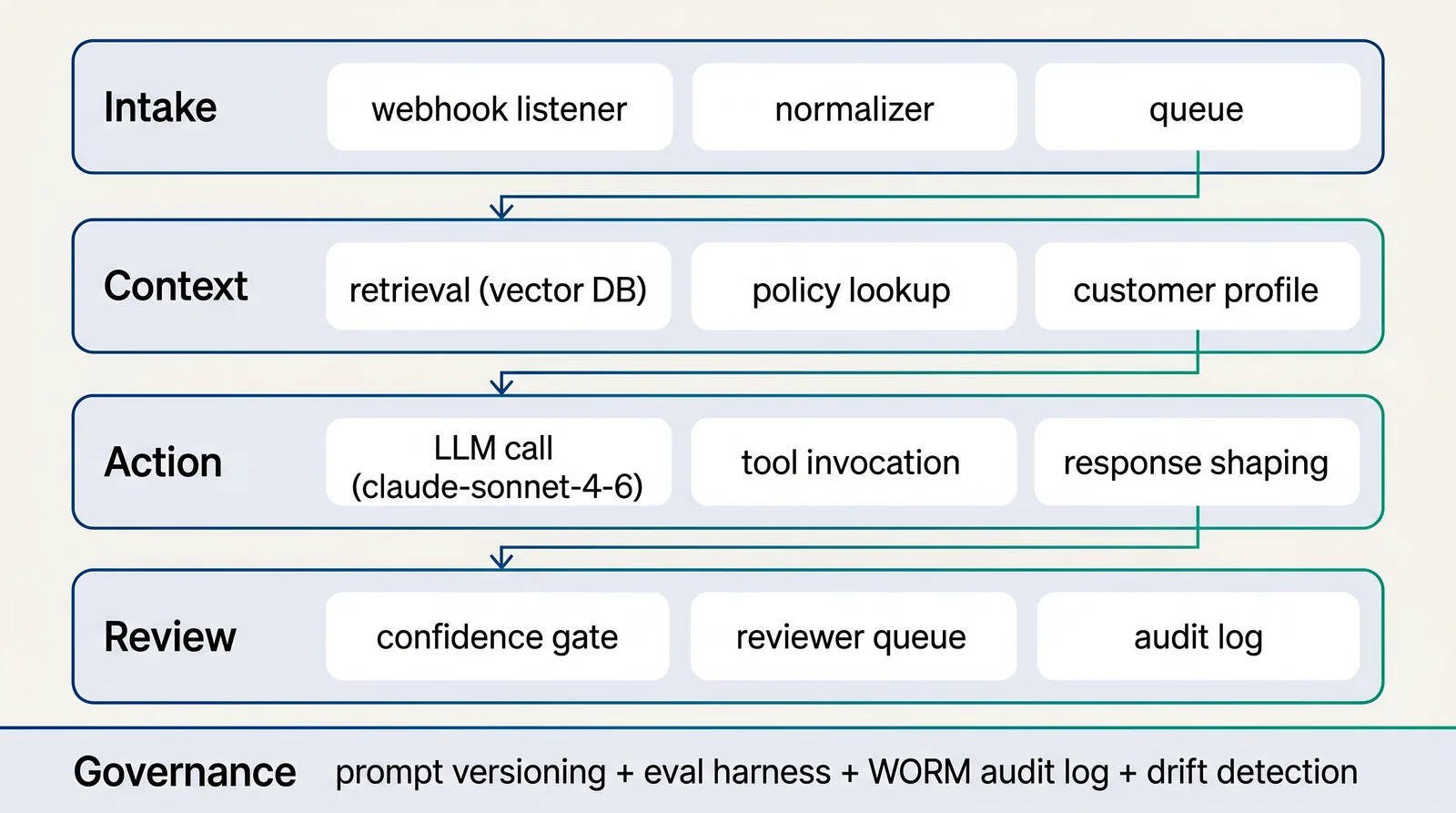
4-layer AI-native workflow for operations & throughput
The reference architecture treats prompts and retrieval as code: version-controlled, evaluated on every change, deployed through CI. That posture is what makes document processing legible to engineering audit twelve months in.See the full architecture diagram for Operations & Throughput →
AI-native vs traditional approach
What changes between a traditional document processing program in automotive and an AI-native engagement is not the goal — it is the architecture, the operating cadence, and the exit posture. The table below makes the differences explicit.
| Dimension | Traditional (in-house build or BPO) | AI-native engagement (us) |
|---|---|---|
| Time to production | Two quarters minimum | Production traffic within 6-10 weeks |
| Pricing model | FTE hourly retainer or fixed staffing | Three independent commercial envelopes |
| Audit / governance | Document-driven, periodic snapshot | Runtime guardrails + audit log + governance map + quarterly attestation |
| Operator throughput lift | 1.0× (baseline) | +270% |
| Cost per unit | Linear with operator headcount | Typically 60-80% lower |
| End-of-engagement | Multi-quarter notice + knowledge loss | Month-to-month Run, full handover plan in Build SoW |
Traditional process automation projects cost $80-200k+ with 6-12 month payback; AI-native engagements deliver thin-slice production in 6-8 weeks with measurable baseline-vs-actuals reporting.
Engagement scope & pricing
Three phases, three commercial envelopes. Discovery is the only commitment to start; Build and Run are scoped against the Discovery output.
Operations engagement
Each phase is independently committable. Discovery is the only one you have to start with.
Phase 1 · Discovery
$6k
2-week sprint
Phase 2 · Build
$20k–$28k
6-10 weeks
Phase 3 · Run
$2.5k–$4k / mo
optional, hourly bank also available
~$32k–$58k typical year 1 (60% take the run option for ~6 months)
Workflow redesign, system integration, governance, and weekly operating cadence during Run.
Discovery contains its own value (the workflow map, the baseline, the SoW). You can stop after Discovery and still own the artefacts. If you proceed, Build is fixed-scope and fixed-price.
The 4-phase delivery model
Phase 1 · Weeks 1–2
Discovery
We sit with the operator team running the workflow today, watch a working day end-to-end, and produce the baseline that Build will be measured against. Two-week sprint, fixed price.
Phase 2 · Weeks 2–4
Design
Design phase is where the irreversible architectural choices are made: layer boundaries, substitution interfaces, governance posture, evaluation methodology. We invest disproportionately here because corrections in Build are 10× more expensive.
Phase 3 · Weeks 4–8
Build
Build is paced by the evaluation harness: every prompt change must beat the incumbent on the labelled test set across enough metric slices to be promoted. The harness is what makes Build defensible.
Phase 4 · Weeks 8+
Run
Monthly month-to-month Run cadence: Monday metric review, Wednesday prompt and retrieval refresh, Friday calibration audit. The cadence is the deliverable; the prompts are the artefacts that change between cadence cycles.
Interactive ROI calculator
Estimate your AI-native ROI for document processing
Reference inputs below are typical for automotive teams in the operations cluster. Adjust them to match your situation.
Projected
Current monthly cost
$56,000
AI-native monthly cost
$18,520
Annual savings
$449,760
67% cost reduction · ~2,601 operator-hours freed / month
Governance and risk controls
Internal auditors and external regulators in automotive converge on the same three questions: data provenance, decision traceability, replayability. Our control stack answers all three from the same audit log — one source of truth, queryable, exportable, signed. No spreadsheet reconciliation, no after-the-fact narrative.
How we report ROI
The business case lives in operating metrics, not model benchmarks. For document processing, the metrics that matter are documents per hour, extraction accuracy, exception rate, and processing cost. For Automotive, leadership will also care about lead-to-sale conversion, service retention, inventory days, warranty cycle time, and parts fill rate. Every build decision we make connects to one of those metrics, and we publish a weekly performance review during the Run phase.
Selected portfolio
Real builds — document processing in automotive and adjacent sectors
Below are engagements drawn from our active portfolio where the workflow rhymed with document processing in automotive or in adjacent contexts. Scope and stack are accurate; client identities are withheld under engagement NDAs.
Q4 2025
Internal automation tool — workflow automation for consulting operations
Multi-vertical consulting group · Europe
Internal automation tool to streamline workflows, reduce manual administrative load, and improve operational efficiency across consulting and management processes. Integrates with existing systems rather than replacing them, automating handoffs and document flows that previously moved through email.
- Workflow automation engine
- Document-flow integration
- Operational dashboards
Q2 2026
Internal staff portal — multi-association operations in role-based dashboards
Mid-market property operator · GCC region
Role-scoped portal for property managers, accountants, and maintenance staff. Reuses the OA data model from the management SaaS (zero duplication), adds multi-association switching, maintenance ticket lifecycle, financial reporting, and document storage tied to each association workspace.
- Next.js + tRPC
- NextAuth role-based access
- Drizzle ORM shared schema
Q1 → Q2 2026
National legal marketplace — directory, bookings, legal tools, emergency contacts
Government-licensed legal services platform · GCC region
Ministry-licensed bilingual EN/AR platform: directory of certified lawyers, firms, mediators and arbitrators; multi-channel appointment booking (video, phone, in-office); free legal tools (court fees, deadlines, legal interest); police directory with map + hotlines; provider verification workspace; PDF document generation with QR-coded provenance.
- Next.js 16 monorepo (Turborepo)
- Bilingual EN/AR (next-intl)
- Postmark + Web Push
Client identities withheld under engagement NDAs. Sector, geography, and scope are accurate. Full case studies on request.
Common pitfall & mitigation
The failure mode we see most often on AI-native document processing engagements in automotive contexts.
Integration debt with legacy systems
ERP/SAP integration is treated as 'last step' and blocks production
Integration scoped during Discovery; mock-then-real pattern during Build
Bridging the data-physical gap in this category
Sensor and IoT signals across automotive environments arrive with three uncomfortable properties: they are noisy at the unit level, biased at the aggregate level, and missing during the windows where they would be most useful. Document Processing engagements that depend on these signals have to engineer for all three from week one.
We handle noise with multi-source validation — a single sensor reading triggers cross-checks against neighbouring sensors or operator confirmation before the workflow acts on it. We handle bias with a calibration loop tied to the labelled test set: known-state cases are checked against the model's interpretation, drift is detected and corrected. We handle missingness with explicit confidence bands — the workflow distinguishes "the answer is X" from "the answer would be X if the signal was reliable, which it currently is not". For automotive operators, the difference between those two is the difference between a tool that earns trust and a tool that erodes it.
Most failure modes in automotive document processing workflows trace back to the same architectural mistake: treating the central system of record as authoritative when the field reality has moved on. We design against that mistake explicitly. The system of record is one input; the operator's observation is another; the sensor or external signal is a third. The workflow reconciles them with a documented precedence rule per case class, and the reconciliation event is logged in a way that can be audited later.
What this looks like in practice for automotive on document processing: the operator sees a single decision interface that surfaces the three views, flags conflicts, and asks for the override or escalation that breaks the tie. The audit log captures the inputs, the decision, the reasoning, the operator. Six months later, if a regulator, an auditor, or an internal reviewer asks how a particular case was handled, the answer is queryable in one step.
For automotive workflows, AI-native delivery is not primarily about replacing human work — it is about closing the gap between the system view and the field view. document processing sits at that gap, which is why it is a high-leverage first engagement for this category.
The gap shows up in three predictable ways. First, the system of record (DMS and adjacent) reports a state that does not match what the field operator is looking at — the work order says complete, the asset is not actually back online; the inventory says in-stock, the bin is empty; the schedule says on-time, the truck is on a detour. Second, the field signal does not propagate to the system in time for the next decision — an issue spotted in the morning shift surfaces in the dashboard after the afternoon dispatch is already wrong. Third, the institutional knowledge of how the operation actually runs lives in operator heads, not in the system, and degrades every time a senior operator retires.
The AI-native workflow attacks each gap at its source. State reconciliation is handled by deliberate signal collection — sensors, photos, operator confirmations — wired through the workflow rather than left to manual update. Signal propagation is handled by the inference and routing layers — the morning observation becomes an updated forecast becomes a recalibrated dispatch before the next decision window. Knowledge capture is handled by the operator notes layer and the post-resolution review loop — every case becomes a labelled example, every senior operator's reasoning becomes structured training data, every retirement risk shrinks instead of growing.
The combined effect across a year of Run is a measurable closure of the gap. The dashboard finally reflects what the field is actually doing; the field finally has the context the system has been hoarding; the institutional knowledge stops being a single point of failure. That is what AI-native delivery looks like in automotive — operational, not theatrical.
The tactical playbook for the first 30 days
Most automotive AI projects fail in the first month for the same reason: too much time in scoping, too little in shipping. Our Build phase inverts that ratio deliberately. Week 1 has running code; week 4 has reviewable thin-slice production traffic; week 6 has a defensible accuracy baseline against the labelled test set.
The shape of the first week is opinionated. By end of day Wednesday, the retrieval index is loaded with the first batch of approved sources. By end of day Friday, the intake classifier is hitting the labelled test set with an initial accuracy number. The number is intentionally not impressive — it is a baseline against which weeks 2 and 3 measure progress. Most teams underestimate how motivating that early concrete number is for both the operator team (it stops feeling abstract) and the engineering team (the eval feedback loop is closing).
From week 2 onward the cadence is metric-driven. Every Friday produces a delta report against the labelled test set: which slices improved, which regressed, what the next iteration targets. The operator team participates in the Friday review; their judgment on edge cases becomes the next iteration's prompt or retrieval tweak. By week 6, the system has been through 12-15 evaluation cycles, each with automotive-specific calibration, each tied to a documented change. The workflow that hits production at the end of Build is the workflow that has survived a month of empirical correction, not the workflow that looked good in the architecture diagram.
Our Build cadence on document processing for automotive is bias-corrected against the two failure modes we have seen kill automotive AI projects most often: scoping that drifts week-by-week, and a labelled test set that arrives in week 6 instead of week 1.
We fix the scoping by signing the Build statement of work before any code is written — the deliverables are named, the integration footprint is bounded, the milestones have dates. We fix the labelled test set timing by treating it as the week-1 deliverable. Week 1 is not "scoping week" — it is "labelled-test-set week", because every subsequent engineering decision is measured against that test set.
Week 2: retrieval index live with first batch of approved sources. Week 3: intake classifier scoring against the test set, first calibration report. Week 4: action layer drafting with reviewer approval; first end-to-end case flow. Week 5-6: thin slice in production on 5-15% of routine automotive traffic, first weekly review with the operator team. Weeks 7-10: production envelope widens case-class by case-class, calibration loop tunes against the empirical evidence, exceptional cases route to enriched escalation. By day 60-70, the workflow is operating at its target envelope.
How this rhymes with a recent build
The recent build in our portfolio that maps cleanest to document processing in automotive is summarised below. Identity withheld under engagement NDA; sector and stack are accurate.
Internal staff portal — multi-association operations in role-based dashboards. Role-scoped portal for property managers, accountants, and maintenance staff. Reuses the OA data model from the management SaaS (zero duplication), adds multi-association switching, maintenance ticket lifecycle, financial reporting, and document storage tied to each association workspace. (Mid-market property operator · GCC region, Q2 2026.)
The reason that engagement is a useful reference is not the surface match — it is the underlying decision structure. The same questions show up on document processing for automotive: where to draw the automation boundary, how to calibrate confidence thresholds against the labelled test set, what to put in the reviewer UI, how to instrument drift. The answers transfer; the implementation specifics adapt to your stack.
For US buyers
US compliance scaffolding for document processing in automotive (NIST AI RMF)
Automotive engagements touching US clients on document processing ship with the regulatory scaffolding your procurement, compliance, and legal teams expect. The framework that matters most for automotive is NIST AI Risk Management Framework (AI 100-1) (NIST AI RMF) — addressed below alongside the adjacent frames we encounter.
NIST AI RMF
NIST AI Risk Management Framework (AI 100-1)
Authority: U.S. National Institute of Standards and Technology
- Scope
- Voluntary framework: Govern, Map, Measure, Manage functions for AI system risk.
- How we ship inside it
- Every engagement maps to NIST AI RMF during Discovery. The control map produced becomes the artefact your internal audit and security teams use to defend the workflow.
For US companies
Start a US-friendly engagement
Discovery from $8,500–$12,000, Build from $35,000–$75,000, optional Run from $5k/mo. Fixed-price, milestone-billed, you own every artefact. Send a short brief and we reply within 5 business days. 11am–4pm ET overlap for live syncs.
USD pricing
Discovery $8,500–$12,000 · Build $35,000–$75,000
US-style commercial
MSA / SOW / mutual NDA standard. DPA with SCCs included.
Limited capacity
We onboard 3–5 new clients per quarter to protect delivery quality.
What the 2026 production data says
The 2026 surveys are blunt about what happens next: enterprises report adopting AI agents at close to four in five, while barely one in ten runs them in production. For document processing in automotive, the gap is rarely about model quality — it is inference cost discovered at production volume, a workflow nobody owns end to end, and failures quiet enough to go unnoticed for weeks. We scope against those three before we write code.
Read the full breakdown of the pilot-to-production gap — the three failure modes, with the 2026 sources.
Build internally or work with us
Some automotive teams should build internally, especially when they already have strong product, data, security, and operations capacity. Most teams move faster with us because the bottleneck is not only engineering — it is translating messy operational work into a reliable AI-assisted workflow that people will actually use. After 6 to 12 months you can absorb the operating model internally or keep us as a managed execution partner.
What to ask us before signing
- Ask for a workflow map that shows intake, retrieval, generation, review, escalation, system updates, and measurement.
- Ask for an evaluation plan using real examples from automotive, not only generic test prompts.
- Ask how we will move documents per hour, extraction accuracy, exception rate, and processing cost within the first 30 to 60 days.
- Ask which parts of the process remain human-owned and why.
- Ask for our exit plan: what stays with you if the engagement ends.
Recommended first project
The first project we recommend for automotive on document processing is rarely the one leadership names in the initial conversation. The named project is usually the most politically visible — which is also the riskiest place to ship a first AI-native workflow. We typically recommend the adjacent subflow with the cleanest baseline, the smallest blast radius, and the most repetitive operator work. That first project produces three artefacts that the visible project needs: a labelled test set the operator team has signed off on, a reference architecture against DMS, and a credibility track record with the internal stakeholders who will be asked to support the second engagement. By the time we propose the second workflow — the visible one — the organisational gravity is on our side.
Frequently asked questions
How do you automate document processing in automotive with AI?+
Three phases. Discovery (2 weeks) produces the labelled test set, the system map, and the Build statement of work. Build (6-10 weeks) ships a thin-slice production deployment on top of DMS and adjacent systems, with versioned prompts and a reviewer queue. Run (optional, month-to-month) operates the workflow weekly against documents per hour, extraction accuracy, exception rate, and processing cost.
What does it cost to automate document processing for automotive teams?+
Three phases, billed separately. Discovery sprint: $6k (2-week sprint). Build engagement: $20k–$28k (6-10 weeks). Run retainer: $2.5k–$4k / mo (optional, hourly bank also available). ~$32k–$58k typical year 1 (60% take the run option for ~6 months). Workflow redesign, system integration, governance, and weekly operating cadence during Run.
What is the best AI agent for document processing in automotive?+
There is no single "best" off-the-shelf agent for document processing in automotive — the right architecture depends on your DMS setup, your data, and your risk profile. We typically combine a frontier LLM (Claude, GPT-4-class, or Gemini) with a retrieval layer over your approved sources, tool-use for DMS and CRM integrations, and a reviewer queue. We benchmark candidate models against a labelled test set during Discovery and pick the one with the best accuracy/cost ratio for your workflow.
How long does it take to deploy AI document processing for automotive?+
End-to-end lead time from kickoff to thin-slice production: 6-10 weeks. End-to-end to full operating envelope: 10-14 weeks. documents per hour, extraction accuracy, exception rate, and processing cost is instrumented from day one of Build; the dashboard goes live by week 4-5; production traffic starts by week 6-8. By 90 days, leadership has a 30-60 day record of operating performance against the Discovery baseline.
What do we own, and what do you own?+
We own the workflow design, the prompts, the retrieval architecture, the evaluation harness, and weekly improvement. Your OEMs, dealer groups, mobility operators, parts distributors, and aftersales leaders team owns data access, policy, exception approval, and final commercial decisions. At the end of the engagement, every prompt, eval, and config is handed over — no lock-in.
How fast does AI document processing get into production for automotive?+
We aim for a thin-slice in production by week 6, with real data, real edge cases, and real reviewers. documents per hour, extraction accuracy, exception rate, and processing cost is instrumented from day one, and we report against baseline weekly during Run.
Do you train models on our data?+
No. We do not train any model on client data. Anthropic Zero-Data-Retention is enabled by default; OpenAI default-no-training is honoured. Prompts, retrieval indexes, audit logs, and integration data live in your cloud account under your IAM. At engagement end, every artefact transfers to your repository.
What if we want to exit the engagement?+
Discovery and Build are fixed-scope, so there is no mid-engagement exit cost. Run is month-to-month with 30-day notice. Every artefact (prompts, eval harness, integration code, dashboards, runbooks) is in your repository throughout the engagement, not behind our SaaS. There is no lock-in.
What does success look like 90 days after Build closes?+
documents per hour, extraction accuracy, exception rate, and processing cost measurably improved against the Discovery baseline. Your team is operating the workflow with the cadence we shipped during Build. The audit log is queryable. The reviewer queue is calibrated. The next workflow scope is informed by real production evidence rather than initial assumptions.
What support is included after the engagement ends?+
Optional Run retainer covers weekly cadence, prompt refresh, retrieval index updates, and reviewer-queue calibration. Architecture-level questions and breaking-change support are billed hourly outside of Run. Most engagements transition Run in-house at month 6-12; we stay available for architecture decisions for 12 months at no extra charge.
How does this integrate with DMS and our existing stack?+
Discovery scopes the integration footprint explicitly. We integrate at the API layer; no replatforming required. The Build statement of work names exactly which systems are connected, which data flows are bidirectional, and what authentication patterns we use (SSO, service accounts, OAuth scopes). The integration code lives in your repository.
What does your team look like during an engagement?+
Discovery: 1 senior delivery lead + 1 PM, ~30 hours/week. Build: 1 senior delivery lead + 2-3 senior AI engineers, ~50-80 hours/week across the team. Run: 1 delivery owner + 1 engineer on weekly cadence. We do not use offshore staff augmentation. Every engineer touching your engagement is senior-level.
Sources we reference
The following sources inform the architecture, governance, and benchmarks we apply on automotive engagements. Cited here so you can verify and dig deeper.
- NHTSA Automated Vehicles
- AI Risk Management Framework (AI RMF 1.0) — NIST
- OECD AI Principles — OECD
- Lighthouse Network — Operations AI Adoption — World Economic Forum + McKinsey
- Operations Excellence Through AI — BCG
- Google Search Central: helpful, reliable, people-first content
- Google Search Central: URL structure best practices
Concepts on this page:
AI workflow·Thin slice·Reviewer queue·Evaluation harness·Tool use·Audit logFull glossary →High-intent reads
Start the engagement
Start a Automotive engagement
Tell us about your workflow, the systems involved, and the KPI you want to move. We'll send a scoped statement of work within 5 business days.