Production AI workflows
Pick the workflow. Prove it safely.
We build AI workflows for teams that need operational leverage without losing control: fixed scope, human review where it matters, audit logs on every run, and weekly reporting against the baseline.
Thin-slice first · Reviewer queue · Audit log · Fixed-scope Build
Track record
- 16
- production workflows shipped
- US · UAE · EU
- regions delivered in
- Week 7
- production guarantee or 50% back
- NIST AI RMF
- aligned governance + audit logs
Client names are withheld under NDA — we don't put logos we can't stand behind on the page. Founder-led delivery (ex-UBS, Paris Dauphine–PSL); anonymized case studies and a reference call are available in your Discovery.
Proof before scale
Thin-slice first
We ship one real path to production before expanding the workflow surface.
Human control
Reviewer queue
Low-confidence cases route to named reviewers with disposition tracking.
Audit posture
Every run logged
Prompt version, model, retrieval bundle, output, and reviewer decision are captured.
Commercial clarity
Fixed scope
Discovery, Build, and optional Run are priced as separate decisions.
Workflow families
Start from the operating pain, then choose the AI surface.
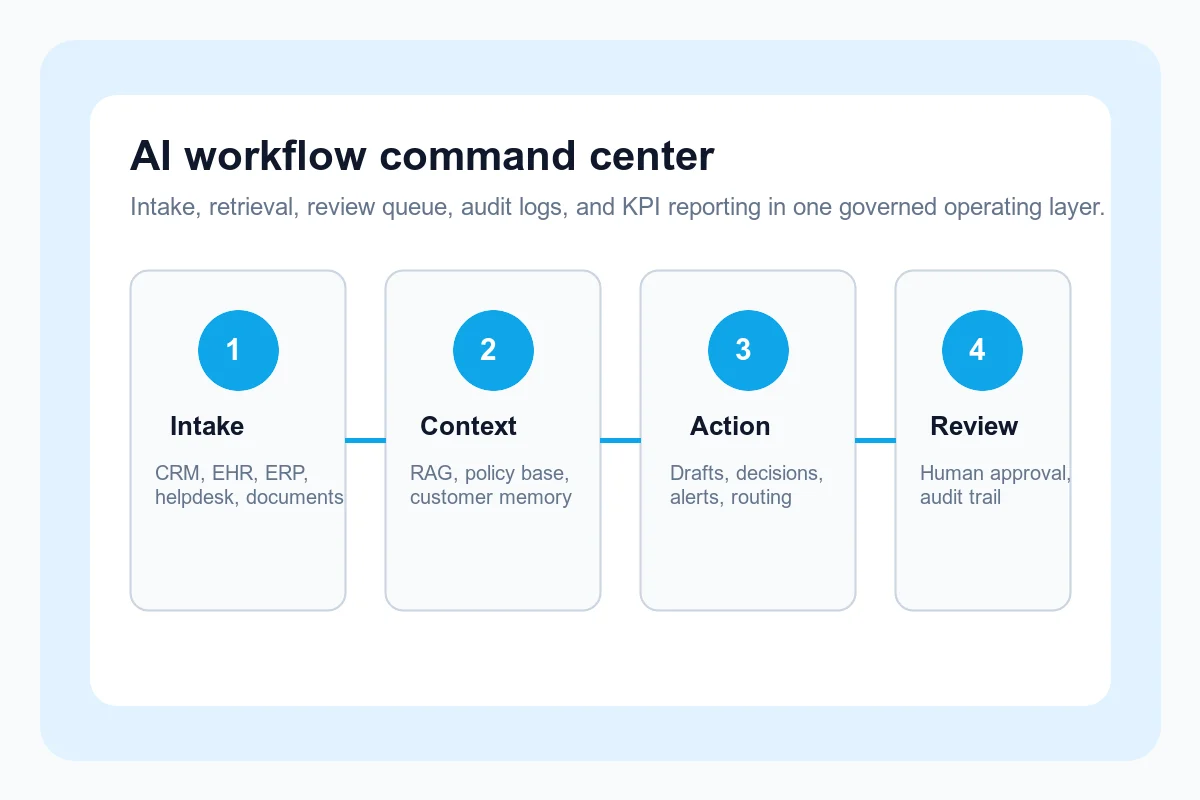
A good AI workflow is not a chatbot pasted onto a process. It is a controlled operating path with intake, context, action, review, audit evidence, and a KPI owner.
Sales, marketing, RevOps, pipeline quality
Revenue & Growth
Outbound, growth, and revenue-operations workflows shipped AI-native.
- Outbound research and personalization
- Lead qualification and CRM enrichment
- Campaign operations and reporting
More qualified activity without adding manual coordination around every account.
Back-office, finance, property ops, service delivery
Operations & Throughput
Back-office and throughput workflows redesigned around AI as the operating layer.
- Intake triage and case preparation
- Document-heavy operating workflows
- Internal portals and role-based dashboards
Higher throughput per operator with fewer handoffs, fewer missing fields, and visible SLAs.
Legal, quality, fraud, regulated review
Risk & Compliance
Governed, audit-ready AI workflows for regulated teams.
- Policy-grounded review queues
- Evidence bundle generation
- Audit-ready decision logging
Faster review cycles while preserving human accountability and evidence quality.
Support, onboarding, resident portals, customer ops
Customer Experience
Customer journey and support workflows where AI handles volume and humans handle trust.
- Self-serve customer intake
- Escalation-aware support automation
- Authenticated customer portals
Better first-response speed without hiding consequential edge cases from people.
Internal knowledge, analytics, product ops, enablement
Knowledge & Insight
Retrieval, evaluation, and decision-support systems built AI-native.
- Source-grounded retrieval
- Executive reporting workflows
- Decision-support dashboards
Answers, recommendations, and reports tied back to approved sources and fresh data.
Delivery model
The confidence model is built into the workflow.
The UX should make one thing obvious: AI is allowed to move fast only where the system can prove context, confidence, and accountability.
01
Map the work as it runs today
We sit with the operating team, capture the current path, the exception types, and the KPI baseline. No automation scope is accepted without a measurable before-state.
02
Design the control model
Each workflow gets thresholds, reviewer roles, source rules, audit fields, and escalation paths before production traffic touches the AI layer.
03
Ship a thin production path
The first release handles a narrow but real path end-to-end: intake, context, action, review, log, and KPI reporting.
04
Operate against the baseline
Run is weekly: KPI review, prompt changes through evals, reviewer calibration, retrieval refresh, and a decision on whether the next workflow is worth expanding.
Qualification
We only build workflows that can earn trust in production.
If a workflow cannot be measured, reviewed, or narrowed into a first production path, we do not turn it into a Build engagement. That constraint is a trust signal, not a sales obstacle.
- A named business owner can explain the workflow and approve exceptions.
- The workflow has enough repeat volume to justify instrumentation.
- Approved sources and system access can be defined during Discovery.
- The first release can be narrowed to one path with measurable impact.
- There is a human fallback for low-confidence or consequential decisions.
- The expected KPI can be measured before and after launch.
Proof
Built workflows beat claimed capability.
These are not abstract AI use cases. They are shipped operating surfaces with data models, portals, audit paths, and business users.
Real estate · Property operations
Owners-association management SaaS — properties, accounting, residents, governance in one platform
A fragmented property-operations process became a unified SaaS surface with normalized data, finance workflows, resident services, and audit history.
Operational surface
55+ management screens in one SaaS
Data architecture
47 normalized tables, full audit history
Resident experience
Community portal for residents and owners
Real estate · Governance & e-voting
Authenticated remote voting for owners-association resolutions — AGM democracy as software
A physical AGM voting process became authenticated remote voting with per-unit eligibility, real-time tallying, and a defensible vote trail.
Participation surface
Remote authenticated voting from any device
Compliance posture
Real-time tally with full per-vote audit log
Reach
Global owner base voting on the same resolutions
Legal services · National marketplace
Bilingual legal services marketplace — directory, appointments, legal tools, emergency contacts
A fragmented legal-services market became a bilingual, regulator-aligned platform for discovery, booking, tools, emergency contacts, and provider workflows.
Market coverage
Single ministry-licensed national marketplace
Language reach
Full EN/AR bilingual, prerendered both languages
Service breadth
Directory + booking + legal tools + emergency
Professional services · IT consulting
Digital brand refresh + integrated recruitment platform for an enterprise IT consulting firm
A generic consulting site became a sharper commercial and recruitment surface with distinct expertise tracks, CMS control, and inbound funnels.
Positioning
CIO-grade premium positioning, three distinct tracks
Talent sourcing
Integrated recruitment platform with application flow
Editorial control
Marketing-team-owned CMS via Sanity
Questions buyers ask
What makes a workflow ready for AI automation?
A workflow is ready when it has repeat volume, clear input data, identifiable exceptions, a measurable KPI, and a human owner who can approve edge cases. If those are missing, Discovery starts by defining them before any build scope is accepted.
Do you fully automate the workflow?
Not by default. We automate high-confidence paths, draft or prepare medium-confidence paths for review, and route low-confidence or consequential cases to humans. The autonomy level is a workflow design decision, not a blanket promise.
How do you prevent demo-grade AI from reaching production?
Every production workflow ships with a labelled test set, reviewer queue, audit log, versioned prompts, source rules, and weekly KPI reporting. Prompt changes are evaluated before release instead of edited directly in production.
Where should a company start?
Start with the workflow that has high volume, visible pain, available data, and a clear owner. The first release should be narrow enough to launch in weeks, but important enough that KPI movement matters.
First decision
Bring one workflow, one KPI, and the systems it touches.
The configurator turns that into a scope, delivery path, and next step. If the workflow is not ready, the useful output is a narrower Discovery rather than an overpromised Build.