Travel and Hospitality · Revenue & Growth
Win More Travel Agencies Deals with AI-Native SEO Landing Pages
For travel agency owners, tour operators, corporate travel managers, and concierge teams ready to move seo landing pages from manual operation to instrumented AI-native delivery. Below: the workflow we ship, the operating model that keeps it improving, the governance posture, and the commercial envelope.
Projects from $15k · Refundable 7 days · Kickoff within 5 days
Early access: we work with a small first cohort. Engagements are scoped, priced, and shipped end-to-end by our team — not referred to third parties.
In one sentence
AI-native seo landing pages for travel agencies — An AI-native seo landing pages workflow built against your existing GDS stack, calibrated against a labelled test set of real travel agencies cases, and operated against the KPIs your CFO recognises. Expected delta on indexed pages: +45 pts.
Key facts
- Industry
- Travel Agencies
- Use case
- SEO Landing Pages
- Intent cluster
- Revenue & Growth
- Primary KPI
- indexed pages, impressions, qualified clicks, conversion rate, and internal link depth
- Top benchmark
- CRM data quality (account completeness): 42% → 87% (+45 pts)
- Systems integrated
- GDS, CRM, booking engines
- Buyer
- travel agency owners, tour operators, corporate travel managers, and concierge teams
- Risk lens
- incorrect itineraries, supplier terms, refunds, traveler duty of care, and customer data handling
- Engagement timeline
- Discovery 2 weeks → Build 6 weeks → Run continuous
- Team size
- 1 senior delivery + founder oversight
- Discovery price
- $5k · 2-week sprint
- Build price
- $15k–$22k · 6-8 weeks
Primary outcome
capture long-tail demand with useful pages at scale
What we ship
programmatic SEO architecture, keyword map, page templates, and internal link graph
KPIs we report on
indexed pages, impressions, qualified clicks, conversion rate, and internal link depth
Why Travel Agencies teams hire us for this
What gets travel agencies teams to "yes" on AI-native seo landing pages is rarely the model itself — it is seeing a workflow that respects the way decisions are actually made on their team today. We start every Discovery with a workflow walk-through: who owns intake, who owns the judgment call, who owns the escalation, who carries the policy in their head. The build is shaped around that map, not against a generic reference architecture pulled from a deck.
Recent industry benchmarks (Gartner, Salesforce Research) show travel agencies revenue teams spend 60-70% of their week on non-selling activities. AI-native delivery targets that non-selling block first.
Industry context: Travel agencies juggle 15-30 supplier integrations (GDS + DMC + insurance + payment), high quote-to-book leakage (~25%), and increasingly demanding consumer cancellation behavior (10-15% post-booking changes).
Benchmarks we hit
Reference benchmarks from production deployments of seo landing pages in travel agencies-comparable contexts. Sources noted per row. Your actuals are measured against the baseline captured in Discovery.
| Metric | Industry baseline | AI-native typical | Delta |
|---|---|---|---|
CRM data quality (account completeness) Forrester B2B Insights: human-only CRM hygiene typically degrades within 6 months | 42% | 87% | +45 pts |
Pipeline conversion (SQL → opportunity) Lift attributed to better intent scoring + faster handoff from AI to AE | 18% | 27% | +50% |
Cost per qualified meeting Includes AI infra cost, SDR time, and overhead allocation | $420 | $95 | −77% |
Benchmarks are reference values from comparable engagements and authoritative sector benchmarks. Your engagement's baseline is captured during Discovery and actuals are reported weekly during Run against that baseline.
How we operate the workflow
When travel agencies leaders ask how we run seo landing pages differently from a typical consulting engagement, the honest answer is: we never stop running it. The Build phase produces the workflow, but the operating model — weekly reviews, edge-case folding, calibration drift detection — is what compounds value. Without it, AI accuracy degrades silently within months.
What we build inside the workflow
What you can stand on at the end of Build is six artefacts: a documented workflow map (current state and target), the labelled test set as the empirical foundation, the prompt repository under version control, the integration code against GDS, the reviewer interface with calibration tooling, the operating dashboard with KPI tracking. Each artefact has a named owner, a refresh cadence, and a retention policy. The artefacts are inspectable by your auditor, your CTO, and the next senior hire you make.
Reference architecture
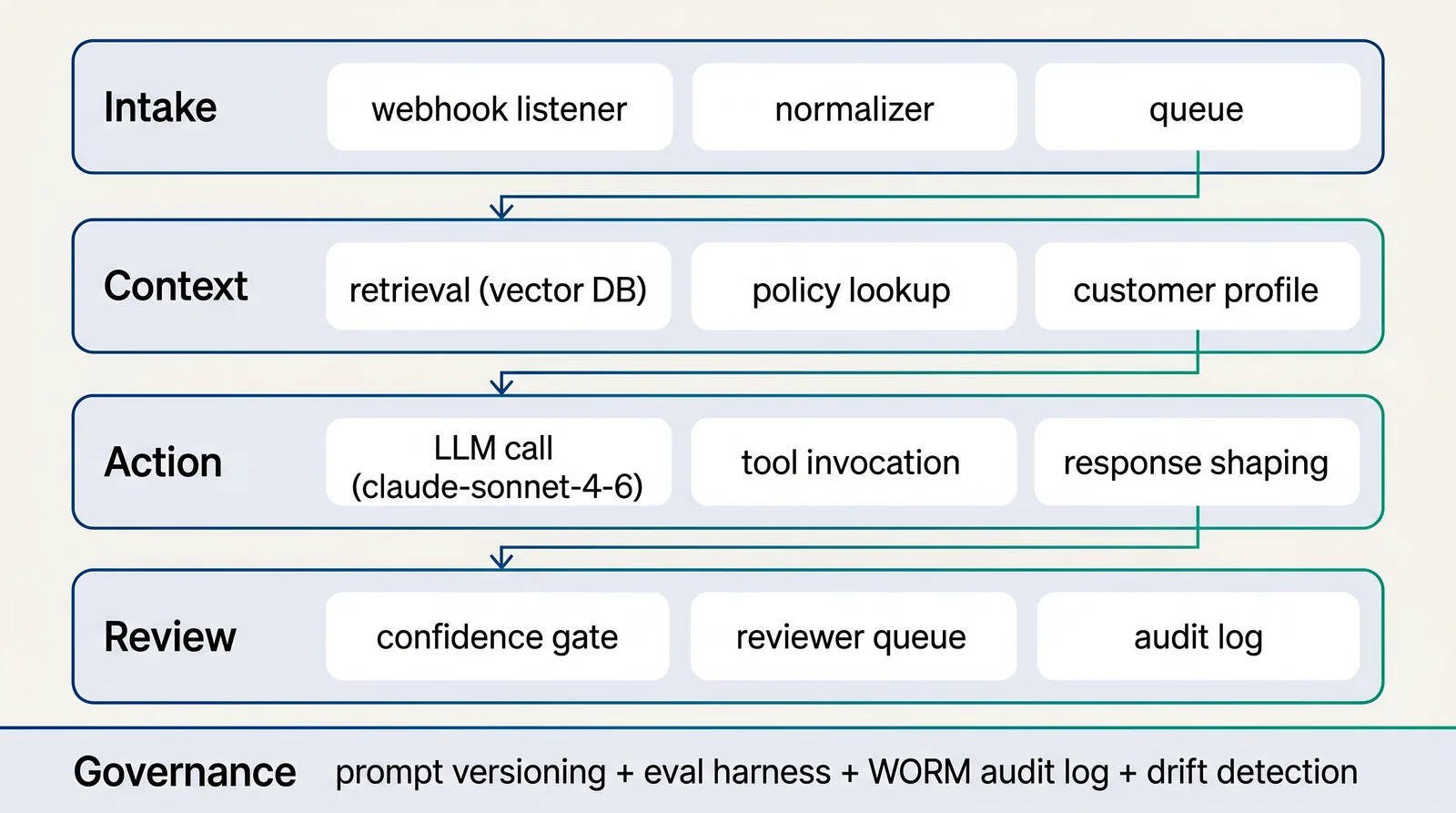
4-layer AI-native workflow for revenue & growth
The reference architecture treats prompts and retrieval as code: version-controlled, evaluated on every change, deployed through CI. That posture is what makes seo landing pages legible to engineering audit twelve months in.See the full architecture diagram for Revenue & Growth →
AI-native vs traditional approach
Side-by-side comparison of an AI-native engagement against the alternatives most travel agencies teams evaluate for seo landing pages: time to production, pricing model, governance posture, operator throughput, unit cost, exit path.
| Dimension | Traditional (in-house build or BPO) | AI-native engagement (us) |
|---|---|---|
| Lead time to live deployment | 6-12 months | 6-10 weeks (thin slice) |
| Engagement billing | Time-and-materials or annual contract | Phased fixed-price (Discovery → Build → opt Run) |
| Audit posture | Manual logs, periodic review | Versioned prompts, audit logs, reviewer queues, attestations |
| Per-operator capacity | 1.0× (baseline) | +50% |
| Per-case cost | Industry baseline | Sub-dollar marginal cost on routine envelope |
| Exit path | Knowledge transfer takes 6+ months | Documented exit at every phase; artefacts in your repo |
Manual itinerary research costs 90-180 min per quote; AI-native research compresses to 8-20 min with citation-grounded fare and inventory checks.
Engagement scope & pricing
SEO Landing Pages delivery is structured as Discovery → Build → opt-in Run, each priced and scoped independently. No multi-quarter retainer commitments.
Revenue engagement
Three commercial envelopes, three deliverables. The next phase is scoped against the evidence the prior phase produced.
Phase 1 · Discovery
$5k
2-week sprint
Phase 2 · Build
$15k–$22k
6-8 weeks
Phase 3 · Run
$2k–$3k / mo
optional, hourly bank also available
~$25k–$45k typical year 1 (60% take the run option for ~6 months)
Outbound, growth, or revenue-ops workflow, integration with your CRM, weekly operating review during Run.
Discovery contains its own value (the workflow map, the baseline, the SoW). You can stop after Discovery and still own the artefacts. If you proceed, Build is fixed-scope and fixed-price.
The 4-phase delivery model
Phase 1 · Weeks 1–2
Discovery
Discovery is short, intense, and decision-producing. By end of week 2, you have the workflow map, the baseline, the SoW, and the risk register. No code yet — the next phase is calibrated against this evidence.
Phase 2 · Weeks 2–4
Design
Design phase is where the irreversible architectural choices are made: layer boundaries, substitution interfaces, governance posture, evaluation methodology. We invest disproportionately here because corrections in Build are 10× more expensive.
Phase 3 · Weeks 4–8
Build
6-10 week sprint that ships the thin-slice production workflow on top of your existing systems. Eval harness gating every prompt change. Reviewer queue staffed. Audit log queryable. Dashboard live.
Phase 4 · Weeks 8+
Run
Optional Run phase, month-to-month, no lock-in. Weekly performance review against the Discovery baseline. Quarterly architecture retrospective. The cadence is documented; your team can absorb it any time.
Interactive ROI calculator
Estimate your AI-native ROI for seo landing pages
Reference inputs below are typical for travel agencies teams in the revenue cluster. Adjust them to match your situation.
Projected
Current monthly cost
$24,000
AI-native monthly cost
$7,920
Annual savings
$192,960
67% cost reduction · ~468 operator-hours freed / month
Governance and risk controls
Risk in travel agencies comes from three failure modes: the model is wrong, the source data is wrong, or the workflow allows the wrong action. We design for each mode separately — evaluation harness for model error, source curation and freshness for data error, allow-listed tool calls and approval queues for action error. Each has a defined owner and a measurable SLA.
How we report ROI
ROI on seo landing pages shows up in two timeframes for travel agencies: immediate (cycle time, throughput, error rate — visible within 30 days of Run) and structural (operating model maturity, knowledge capture, team capacity unlock — visible at 6-12 months). The first justifies the engagement; the second is what changes the business.
Selected portfolio
Real builds — seo landing pages in travel agencies and adjacent sectors
Below are engagements drawn from our active portfolio where the workflow rhymed with seo landing pages in travel agencies or in adjacent contexts. Scope and stack are accurate; client identities are withheld under engagement NDAs.
Q3 2025
On-demand regional aviation booking — flexible flight network across smaller cities
Regional aviation operator · DACH
Booking and operations stack for an on-demand regional aviation network connecting secondary cities. Customer-facing booking flow with dynamic availability, operator-side dispatch tools, route economics dashboards. Designed for a sustainable flight-network operating model rather than fixed-schedule airline patterns.
- Next.js + native-app companion
- Dynamic availability engine
- Operator dispatch console
Q1 2026
Premium marketing site for a specialist detailing workshop
Premium vehicle care specialist · DACH region
Marketing site for a premium vehicle detailing workshop: ceramic coating, paint protection film, detailing, smart repair. Luxury automotive visual direction, structured per-service catalog with proof points, German-market SEO foundation, appointment-oriented CTAs throughout the funnel.
- Next.js + custom design system
- Core Web Vitals first
- German-market SEO
Q3 2025
Specialist trades marketing site — roof, facade, renovation services
Construction trades specialist · France
Marketing site for a regional roofing and facade specialist: service architecture covering roof renovation, facade work, and installation services; quote-request workflow with regional catchment routing; SEO foundation built for local intent across nearby municipalities.
- Next.js + responsive
- Local SEO foundation
- Quote-request workflow
Client identities withheld under engagement NDAs. Sector, geography, and scope are accurate. Full case studies on request.
Common pitfall & mitigation
The failure mode we see most often on AI-native seo landing pages engagements in travel agencies contexts.
Volume without quality
Teams scale outbound 5× but reply rate collapses because the AI sends generic pitches
Per-prospect context retrieval (intent data + recent triggers) before any draft. Reviewer queue on first 500 sends to calibrate.
Designing for the consumer scale of this category
What separates a consumer-grade seo landing pages workflow from a B2B one in travel agencies is the asymmetry between routine and exceptional cases. The routine drives the unit economics; the exceptional drives the public perception. AI-native delivery lets you optimize both at once instead of trading them off.
On routine volume, the AI handles the work with consistent quality and sub-second turnaround. The throughput-per-operator improvement is what justifies the engagement in the CFO's spreadsheet. Concretely, for travel agencies, we typically see a 3-5x throughput lift on routine cases inside the first quarter of Run, with quality variance dropping by half. The operator team is not eliminated — it is redirected at the exceptional cases where its judgment compounds.
On exceptional cases, the architecture inverts: the AI's job is to surface the context, the policy clauses, the customer history, the prior similar cases — not to generate a confident answer. The operator's job is to apply judgment with the supporting evidence pre-assembled. The post-resolution review feeds the labelled test set so the next similar case is handled with deeper context. For travel agencies, this is what turns a one-off support frustration into a system improvement; for the operator, it is what turns reactive triage into deliberate craft.
The combined effect, visible in the dashboards by month three, is a workflow where routine work scales without degrading quality and exceptional work compounds operator knowledge instead of dissipating it. That dual outcome is the reason consumer-facing travel agencies teams adopt AI-native delivery on seo landing pages — not because the AI is impressive, but because the asymmetry between the two case types finally has a workflow shaped to it.
Week-by-week shape of the Build phase
The Build phase rhythm for seo landing pages in travel agencies is engineered for the bottleneck most teams hit at the end of week 2: ambition outrunning evidence. We engineer for the opposite — evidence first, ambition calibrated to it.
Week 1 produces the discovery report, the labelled test set, the integration plan, the risk register, the success metrics. Week 2 stands up the retrieval index, the intake classifier, the eval harness, the audit log. Week 3 wires the action layer with reviewer approval, runs the first three eval cycles, produces the first calibration report. Week 4 ships the thin slice to a narrow production audience (5-10% of routine cases), instruments the operator feedback loop, and runs the first weekly review.
By day 30, the dashboard is live, the system is processing real travel agencies cases, the operator team is engaging with the reviewer queue, the eval harness is gated on every change, and the next two weeks of Build are scoped from concrete evidence rather than initial assumptions. Days 31-45 widen the production envelope to 40-60% of routine cases. Days 46-60 absorb the remaining routine envelope and start handling the first tranche of exceptional cases. By the close of Build (day 60-70), the workflow is operating at its target envelope with the calibration discipline in place to handle drift, edge cases, and future model changes.
Week 1 — Discovery handover and labelled test set capture. We sit with the operator team running seo landing pages today, watch a working day end to end, and capture 200+ real cases as the labelled test set. By Friday we have the workflow map, the system inventory (GDS, CRM, and adjacent), the risk register, and the success metrics aligned with your KPI of indexed pages.
Week 2 — Architecture and integration scoping. We design the four-layer workflow (intake, context, action, review), confirm the retrieval shape, lock the prompt strategy direction, and produce the integration plan against GDS. The output is the Build statement of work with a fixed price and a named deliverable per phase.
Week 3-4 — Build sprint 1: retrieval and intake. We stand up the retrieval index against your approved sources, build the intake classifier, instrument the audit log, and run the first eval cycle against the labelled test set. The thin slice is functional but not production-deployed.
Week 5-6 — Build sprint 2: action and review. We ship the action layer, build the reviewer queue UI, calibrate the confidence thresholds against the labelled test set, and onboard the first reviewer cohort. By end of week 6 the workflow is processing low-stakes production traffic with full audit logging.
The rest of the Build phase widens the production envelope case-by-case based on the reviewer feedback loop. By the end of Build, seo landing pages for travel agencies is running on real traffic with the operating cadence already established.
A working example of this pattern
The recent build in our portfolio that maps cleanest to seo landing pages in travel agencies is summarised below. Identity withheld under engagement NDA; sector and stack are accurate.
On-demand regional aviation booking — flexible flight network across smaller cities. Booking and operations stack for an on-demand regional aviation network connecting secondary cities. Customer-facing booking flow with dynamic availability, operator-side dispatch tools, route economics dashboards. Designed for a sustainable flight-network operating model rather than fixed-schedule airline patterns. (Regional aviation operator · DACH, Q3 2025.)
What carries over is the operating discipline — the labelled test set as foundational artefact, the weekly evaluation cadence, the audit log architecture, the reviewer-queue UX. What we re-scope is the integration surface specific to travel agencies (GDS and the adjacent systems) and the prompt strategy tuned to the seo landing pages vernacular in your category.
For US buyers
US compliance scaffolding for seo landing pages in travel agencies (CCPA / CPRA, NIST AI RMF)
Travel Agencies engagements touching US clients on seo landing pages ship with the regulatory scaffolding your procurement, compliance, and legal teams expect. The framework that matters most for travel agencies is California Consumer Privacy Act / California Privacy Rights Act (CCPA / CPRA) — addressed below alongside the adjacent frames we encounter.
CCPA / CPRA
California Consumer Privacy Act / California Privacy Rights Act
Authority: California Privacy Protection Agency (CPPA)
- Scope
- California resident data rights (access, deletion, opt-out of sale/sharing), sensitive personal information, automated decision-making opt-out (proposed regs).
- How we ship inside it
- California-touching engagements ship with consumer-rights workflows: access request handling, deletion within 45 days, opt-out signals (GPC) honored at the retrieval layer. Automated-decision-making disclosures align with proposed CPPA regulations.
NIST AI RMF
NIST AI Risk Management Framework (AI 100-1)
Authority: U.S. National Institute of Standards and Technology
- Scope
- Voluntary framework: Govern, Map, Measure, Manage functions for AI system risk.
- How we ship inside it
- Every engagement maps to NIST AI RMF during Discovery. The control map produced becomes the artefact your internal audit and security teams use to defend the workflow.
For US companies
Start a US-friendly engagement
Discovery from $8,500–$12,000, Build from $35,000–$75,000, optional Run from $5k/mo. Fixed-price, milestone-billed, you own every artefact. Send a short brief and we reply within 5 business days. 11am–4pm ET overlap for live syncs.
USD pricing
Discovery $8,500–$12,000 · Build $35,000–$75,000
US-style commercial
MSA / SOW / mutual NDA standard. DPA with SCCs included.
Limited capacity
We onboard 3–5 new clients per quarter to protect delivery quality.
What the 2026 production data says
Gartner expects more than 40% of agentic AI projects to be cancelled before the end of 2027, citing escalating cost, unclear value, and weak risk controls. Each of those is decided at scoping, not in the build. For seo landing pages work in travel agencies, we price the projected production volume rather than the pilot volume — the two-to-three-times overrun that kills cutovers comes almost entirely from that gap.
Read the full breakdown of the pilot-to-production gap — the three failure modes, with the 2026 sources.
Build internally or work with us
Travel Agencies teams that build successfully in-house tend to have an existing ML platform, a labelled data culture, and a product manager dedicated to the workflow. If any of those is missing, the project tends to stall at proof-of-concept. We replace those three dependencies with a scoped engagement and a senior delivery team.
What to ask us before signing
- Ask for a 30/60/90-day plan with named deliverables, not a vague phase description.
- Ask how we handle the long tail of edge cases the operator team has never encoded — escalation, calibration, capture.
- Ask for the model and provider strategy — single-model, multi-model, fallback paths, cost forecasting.
- Ask how the reviewer queue UX is designed and whether your operator team can shape it during Build.
- Ask for references from travel agencies-adjacent engagements — sector, scope, and outcome dimensions.
Recommended first project
The first project we recommend for travel agencies on seo landing pages is rarely the one leadership names in the initial conversation. The named project is usually the most politically visible — which is also the riskiest place to ship a first AI-native workflow. We typically recommend the adjacent subflow with the cleanest baseline, the smallest blast radius, and the most repetitive operator work. That first project produces three artefacts that the visible project needs: a labelled test set the operator team has signed off on, a reference architecture against GDS, and a credibility track record with the internal stakeholders who will be asked to support the second engagement. By the time we propose the second workflow — the visible one — the organisational gravity is on our side.
Frequently asked questions
How do you automate seo landing pages in travel agencies with AI?+
We map the existing seo landing pages workflow inside travel agencies, identify the high-volume, high-structure tasks, and build an AI agent that handles those tasks while routing low-confidence cases to a human reviewer. The build connects to your GDS, CRM, booking engines, runs against a labelled test set, and ships behind a reviewer queue before it sees production traffic. We then operate it, measure indexed pages, impressions, qualified clicks, conversion rate, and internal link depth, and improve it weekly.
What does it cost to automate seo landing pages for travel agencies teams?+
~$25k–$45k typical year 1 (60% take the run option for ~6 months). The structure: $5k Discovery (2-week sprint) → $15k–$22k Build (6-8 weeks) → optional $2k–$3k / mo Run. Outbound, growth, or revenue-ops workflow, integration with your CRM, weekly operating review during Run.
What is the best AI agent for seo landing pages in travel agencies?+
Model selection on seo landing pages for travel agencies happens against five criteria: quality on your labelled test set, cost per inference at your projected volume, latency budget for the user-facing path, provider reliability over 12-18 months, contractual data-handling posture. We bring the comparative methodology from prior engagements and run it during Build; the winning model is the one that survives all five, not the one that wins the demo.
How long does it take to deploy AI seo landing pages for travel agencies?+
A thin-slice deployment in 2-week sprint after Discovery, with real travel agencies data and real reviewers. The full Build phase runs 6-8 weeks. By day 90, indexed pages, impressions, qualified clicks, conversion rate, and internal link depth is instrumented, the team has a baseline, and leadership has the data needed to decide on expansion into adjacent travel agencies workflows.
What do we own, and what do you own?+
What we ship as code lives in your repository under your IAM. The prompts, the evaluation harness, the integration code, the reviewer UI, the infrastructure-as-code — all in your Git, not in our SaaS. We bring the engineering, the operating discipline, and the cadence; you bring the data, the policy, and the operator team. The handover is documented from day one of Build, not deferred to the end.
Where does revenue lift actually come from on this engagement?+
Four channels. Throughput per operator (same team, more cases). Conversion lift on the long tail of cases that previously fell through. Cycle-time compression on the decision path. Measurement consistency — the dashboard finally reflects what the operation is actually doing, which feeds the next round of optimisation. All four roll up to indexed pages, impressions, qualified clicks, conversion rate, and internal link depth.
Do you train models on our data?+
No. We do not train any model on client data. Anthropic Zero-Data-Retention is enabled by default; OpenAI default-no-training is honoured. Prompts, retrieval indexes, audit logs, and integration data live in your cloud account under your IAM. At engagement end, every artefact transfers to your repository.
What if we want to exit the engagement?+
Discovery and Build are fixed-scope, so there is no mid-engagement exit cost. Run is month-to-month with 30-day notice. Every artefact (prompts, eval harness, integration code, dashboards, runbooks) is in your repository throughout the engagement, not behind our SaaS. There is no lock-in.
What does success look like 90 days after Build closes?+
indexed pages, impressions, qualified clicks, conversion rate, and internal link depth measurably improved against the Discovery baseline. Your team is operating the workflow with the cadence we shipped during Build. The audit log is queryable. The reviewer queue is calibrated. The next workflow scope is informed by real production evidence rather than initial assumptions.
What support is included after the engagement ends?+
Optional Run retainer covers weekly cadence, prompt refresh, retrieval index updates, and reviewer-queue calibration. Architecture-level questions and breaking-change support are billed hourly outside of Run. Most engagements transition Run in-house at month 6-12; we stay available for architecture decisions for 12 months at no extra charge.
How does this integrate with GDS and our existing stack?+
Discovery scopes the integration footprint explicitly. We integrate at the API layer; no replatforming required. The Build statement of work names exactly which systems are connected, which data flows are bidirectional, and what authentication patterns we use (SSO, service accounts, OAuth scopes). The integration code lives in your repository.
What does your team look like during an engagement?+
Discovery: 1 senior delivery lead + 1 PM, ~30 hours/week. Build: 1 senior delivery lead + 2-3 senior AI engineers, ~50-80 hours/week across the team. Run: 1 delivery owner + 1 engineer on weekly cadence. We do not use offshore staff augmentation. Every engineer touching your engagement is senior-level.
Sources we reference
The following sources inform the architecture, governance, and benchmarks we apply on travel agencies engagements. Cited here so you can verify and dig deeper.
- UN Tourism Digital Transformation
- Build for the Future: AI Maturity Survey — BCG
- Generative AI in the Enterprise — Deloitte AI Institute
- B2B Sales Pulse Survey — Gartner for Sales
- State of Sales Report — Salesforce Research
- Google Search Central: helpful, reliable, people-first content
- Google Search Central: URL structure best practices
High-intent reads
Start the engagement
Start a Travel Agencies engagement
Tell us about your workflow, the systems involved, and the KPI you want to move. We'll send a scoped statement of work within 5 business days.