Travel and Mobility · Customer Experience
Lift Airlines CSAT With AI-Native Customer Service Automation
An engagement page for airline executives, revenue leaders, operations teams, and customer experience owners considering AI-native customer service automation. We cover what we ship, how we operate it, what it costs, what controls travel with it, and how we report against the metrics your team already tracks.
Projects from $15k · Refundable 7 days · Kickoff within 5 days
Early access: we work with a small first cohort. Engagements are scoped, priced, and shipped end-to-end by our team — not referred to third parties.
In one sentence
AI-native customer service automation for airlines — Fixed-price phases that take customer service automation from a Discovery baseline to a production thin slice on real airlines traffic, with the operating cadence handed over to your team by the end of Build. Expected delta on first contact resolution: −75%.
Key facts
- Industry
- Airlines
- Use case
- Customer Service Automation
- Intent cluster
- Customer Experience
- Primary KPI
- first contact resolution, support cost per case, CSAT, and backlog age
- Top benchmark
- Support cost per case (fully loaded): $8.40 → $2.10 (−75%)
- Systems integrated
- PSS, GDS, CRM
- Buyer
- airline executives, revenue leaders, operations teams, and customer experience owners
- Risk lens
- customer trust, operational continuity, safety governance, and regulatory obligations
- Engagement timeline
- Discovery 3 weeks → Build 8 weeks → Run continuous (regulated industry)
- Team size
- 2 senior delivery + 1 part-time reviewer trainer
- Discovery price
- $5k · 2-week sprint
- Build price
- $18k–$25k · 6-9 weeks
Primary outcome
reduce support volume while improving response quality
What we ship
AI service desk, escalation paths, knowledge workflows, and quality dashboards
KPIs we report on
first contact resolution, support cost per case, CSAT, and backlog age
Why Airlines teams hire us for this
What separates AI-native customer service automation from "AI features added on top" is operating discipline. The pattern that works in airlines is the same one that works for any high-stakes operational system: instrument the baseline, ship a thin slice to production, govern explicitly, then expand. We run every engagement against that pattern.
Forrester customer-centricity research finds that consistent quality matters more than peak quality in airlines service. AI-native automation excels at consistency — it is poor at the surprising edge case. That tradeoff is the heart of our design.
Industry context: Airlines run on hyper-volatile demand (load factor swings 12-18 pts per quarter), tight margins (3-5% net), and safety-grade audit requirements. AI-native delivery must respect IATA Resolution 753 baggage tracking, IROPS handling protocols, and DOT consumer protection rules.
Benchmarks we hit
Reference benchmarks from production deployments of customer service automation in airlines-comparable contexts. Sources noted per row. Your actuals are measured against the baseline captured in Discovery.
| Metric | Industry baseline | AI-native typical | Delta |
|---|---|---|---|
Support cost per case (fully loaded) Includes AI tokens, agent time, QA review, infra overhead | $8.40 | $2.10 | −75% |
CSAT (post-interaction) Lift requires escalation paths kept obvious and fast | 4.1 / 5 | 4.4 / 5 | +0.3 |
Agent attrition / quarter Agents handle higher-judgment cases; AI absorbs the repetitive volume that drove burnout | 11% | 5% | −55% |
Benchmarks are reference values from comparable engagements and authoritative sector benchmarks. Your engagement's baseline is captured during Discovery and actuals are reported weekly during Run against that baseline.
How we operate the workflow
Airlines buyers often ask whether they can keep their existing tooling stack. The answer is almost always yes — we build the AI-native operating layer on top of PSS and the surrounding systems, not as a replacement. The integration surface is scoped in Discovery and capped in the Build statement of work, so the engagement does not turn into a re-platforming.
What we build inside the workflow
The single most common mistake we see airlines teams make when Building customer service automation is over-investing in prompt quality and under-investing in evaluation infrastructure. We invert that ratio: prompts are iterated weekly against a fixed labelled test set, and the labelled test set is treated as the most valuable artefact of the engagement. Without it, every change is a guess.
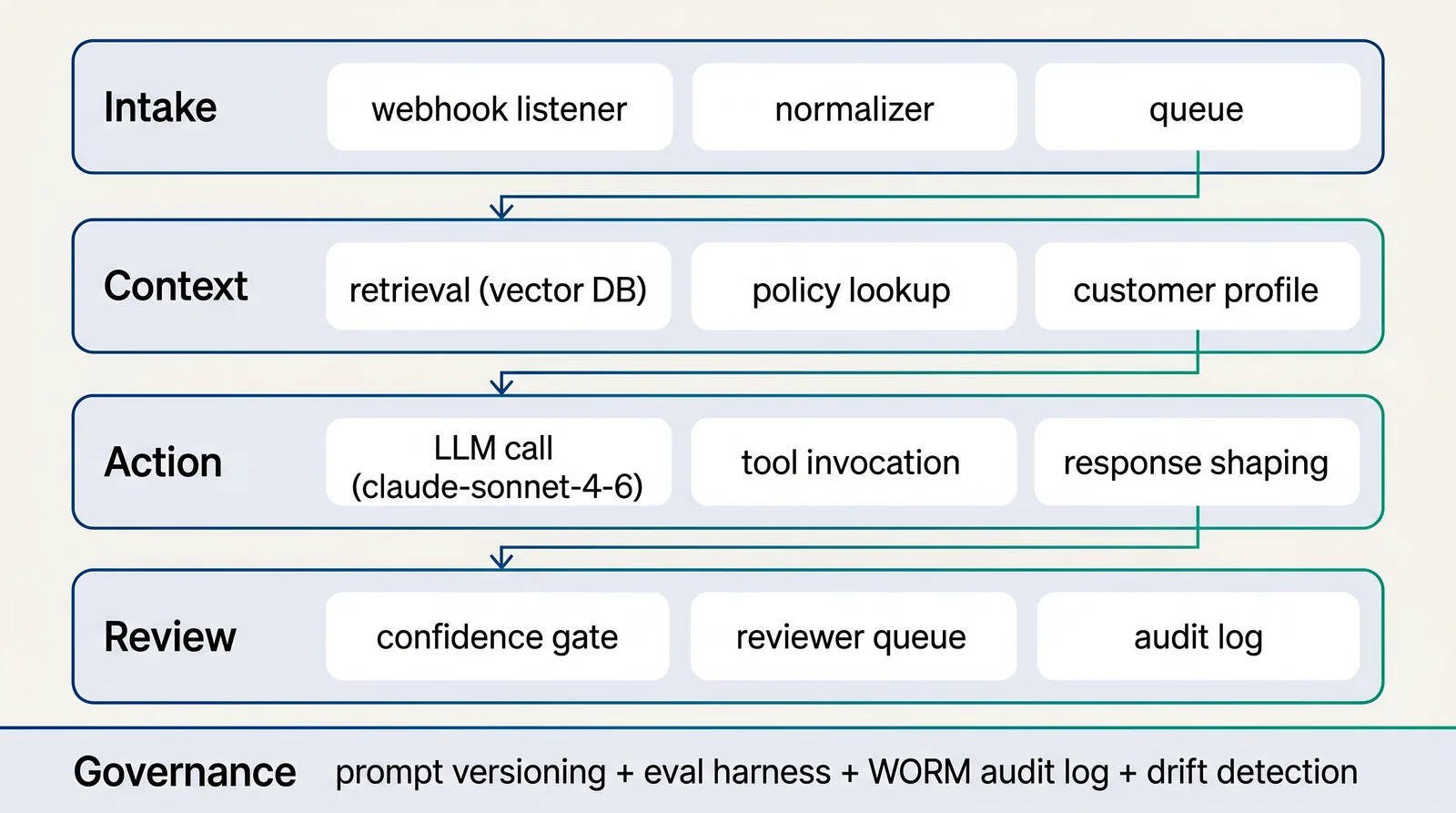
Reference architecture
4-layer AI-native workflow for customer experience
Intake → context → action → review. The loop is closed: every reviewer decision feeds the next iteration of the prompt and the retrieval index. Without the closed loop, accuracy degrades silently over months.See the full architecture diagram for Customer Experience →
AI-native vs traditional approach
The honest comparison for airline executives, revenue leaders, operations teams, and customer experience owners on customer service automation: where AI-native delivery genuinely wins, where it is comparable, and where the traditional approach still makes sense.
| Dimension | Traditional (in-house build or BPO) | AI-native engagement (us) |
|---|---|---|
| Time-to-first-traffic | Multi-quarter program | 8-week thin-slice ship target |
| Commercial structure | Monthly retainer with FTE assumptions | Discovery, Build, Run priced independently |
| Control surface | Manual audit cycles | Versioned artefacts, signed audit log, named owners per control |
| Throughput-per-FTE | 1.0× (baseline) | +0.3 |
| Unit economics | Unchanged from baseline | 60-80% lower on routine cases |
| Termination clause | Multi-quarter notice; documentation gaps | Month-to-month Run; handover plan in Build SoW |
Traditional BPO costs $14-22 per booking touch; AI-native delivery brings it to $3-6 with reviewer-gated approval for IRROPS and refund cases.
Engagement scope & pricing
Airlines engagements run as fixed-scope phases with named deliverables, not as hourly retainers. Each phase is independently committable.
CX engagement
Phased delivery, separate billing. Commit only to what you can defend against the prior phase's output.
Phase 1 · Discovery
$5k
2-week sprint
Phase 2 · Build
$18k–$25k
6-9 weeks
Phase 3 · Run
$2k–$3k / mo
optional, hourly bank also available
~$28k–$48k typical year 1 (60% take the run option for ~6 months)
Customer journey design, escalation handling, tone calibration, and CX KPI reporting.
Two-week Discovery, then your decision. Build is fixed-price against the Discovery output. Run, if you opt in, is month-to-month with a documented exit path.
The 4-phase delivery model
Phase 1 · Weeks 1–2
Discovery
Workflow mapping, integration scoping, baseline capture, risk register, labelled-test-set seed. The output is the Build SoW with a fixed price and named deliverables.
Phase 2 · Weeks 2–4
Design
We translate the Discovery findings into an architecture: which data sources, which prompts, which review queues, which controls, which dashboards. The Build phase ships against this design.
Phase 3 · Weeks 4–8
Build
End of Build deliverables: the production workflow, the operating runbook, the eval pipeline as code, the reviewer interface, the audit log architecture, the dashboard with KPI tracking. All six are inspectable.
Phase 4 · Weeks 8+
Run
Run is where AI accuracy stops being a one-time evaluation result and becomes a sustained operating metric. We run the weekly cadence; your team takes ownership progressively over the first quarter.
Interactive ROI calculator
Estimate your AI-native ROI for customer service automation
Reference inputs below are typical for airlines teams in the customer experience cluster. Adjust them to match your situation.
Projected
Current monthly cost
$42,000
AI-native monthly cost
$13,000
Annual savings
$348,000
69% cost reduction · ~920 operator-hours freed / month
Governance and risk controls
Most "AI governance" frameworks airlines teams encounter are slide decks. Ours is a runtime: every inference call passes through guardrails (input filters, output validators, schema enforcement), every action is logged with the prompt and model version that produced it, every reviewer decision is captured. The framework documents what the runtime already enforces.
How we report ROI
Compounding is the under-rated ROI driver on customer service automation. Week 1 of Run delivers the obvious gain — model handles the routine. By month 3, the prompt library, source corpus, and reviewer playbook are tuned to your specific airlines workflow. By month 6, the gap between your workflow and a generic AI agent is what makes the system hard to replace, internally or externally.
Selected portfolio
Real builds — customer service automation in airlines and adjacent sectors
Below are engagements drawn from our active portfolio where the workflow rhymed with customer service automation in airlines or in adjacent contexts. Scope and stack are accurate; client identities are withheld under engagement NDAs.
Q3 2025
On-demand regional aviation booking — flexible flight network across smaller cities
Regional aviation operator · DACH
Booking and operations stack for an on-demand regional aviation network connecting secondary cities. Customer-facing booking flow with dynamic availability, operator-side dispatch tools, route economics dashboards. Designed for a sustainable flight-network operating model rather than fixed-schedule airline patterns.
- Next.js + native-app companion
- Dynamic availability engine
- Operator dispatch console
Q1 2026
AI-powered interior design platform — generative room concepts for the MEA market
AI interior design SaaS · MEA region
Vertical AI SaaS for interior design in the Middle East: image-conditioned generation tuned for local taste profiles, room-by-room concept workflow, project export for designers and clients. Built with a market-specific dataset and an evaluation loop on regional aesthetic baselines.
- Next.js + image generation pipeline
- Regional taste-profile tuning
- Designer + client export flows
Q3 2025
Property marketplace — buy, rent, list across apartments, villas, commercial
Regional real-estate marketplace · GCC region
National real-estate marketplace covering apartments, villas, and commercial property: listing management for agencies and owners, search and filter optimised for local buyer intent, SEO foundation built for long-tail property queries, lead capture per listing with routing to the listing agent.
- Next.js + dynamic SEO routes
- Listing CMS
- Lead routing engine
Client identities withheld under engagement NDAs. Sector, geography, and scope are accurate. Full case studies on request.
Common pitfall & mitigation
The failure mode we see most often on AI-native customer service automation engagements in airlines contexts.
Compliance gap on sensitive intents
Refund / data deletion / cancellation handled autonomously without proper authorization
Allow-list of intents that can be handled autonomously; deny-list for sensitive intents routes to humans
Physical-world constraints on the digital workflow
Airlines workflows are different because the data is only ever a partial picture of the operation. The truck is on a route, the equipment is on a floor, the inspection is in a building, the asset is in the field. Customer Service Automation in this context has to reconcile what the systems show with what is actually happening physically — a constraint a pure-digital workflow does not face.
We address that constraint at three layers. At the data layer, we treat the system of record (PSS, the ERP, the field-service platform) as one source among several rather than ground truth. Field operators carry context the system does not, sensors produce signals the system has not interpreted yet, and the gap between systems is where most workflow friction lives. The Discovery phase maps these gaps explicitly — what the system does not know is sometimes more important than what it does. At the inference layer, the prompts and retrieval are designed to surface the system view and explicitly invite the operator to add the field context before action is taken. At the action layer, the workflow is built for graceful degradation when the physical reality does not match the model's expectation — escalation paths, override capability, audit logging.
The practical outcome for airlines teams is a workflow that respects the field. Operators do not feel overridden by an AI that does not understand what they are looking at; they feel supported by a system that brings them the context they need. That distinction sounds soft — it is not. The operations leaders who adopt AI workflows successfully in airlines are the ones whose field teams stop sandbagging the system because the system finally stopped sandbagging them. The labelled test set we capture during Discovery is, in many airlines engagements, more about edge cases the field sees than about model outputs the analyst measures.
The hardest design question in airlines customer service automation engagements is where to draw the boundary between the digital system and the physical operation. Cross that boundary too far in either direction and the workflow breaks: too digital and field operators ignore it, too physical and the analytics layer cannot tell what is happening at scale.
We draw the boundary at the decision interface. The AI-native workflow ingests sensor data, system records, operator notes, customer signals, and external context. It surfaces the relevant subset to the decision-maker — usually an operator with physical-world context — with the supporting evidence pre-assembled. The operator's decision is captured, executed in the system of record (PSS or adjacent), and logged for the next iteration of calibration. The system does not pretend to know things it does not know; the operator does not have to relay things the system already has.
The architecture choice that follows is data-locality. For airlines, the data that matters lives in three places: the central system of record, the field-edge devices, and the operator's head. The first two are connectable; the third is captured through the reviewer interface and the operator notes layer, which we treat as a first-class data source rather than a free-text afterthought. By month six of Run, the operator notes have become a structured corpus that the retrieval layer queries — your field team's accumulated craft, finally legible to the analytics layer.
The risk we explicitly engineer against in airlines is the workflow that optimizes the dashboard at the expense of the field. We see this failure mode often in vendor-led AI deployments: the metrics look great, the operators are silently working around the system, the operation degrades. The instrumentation we ship reports both — central metrics and field-feedback signals — so leadership can detect the gap if it opens.
Most failure modes in airlines customer service automation workflows trace back to the same architectural mistake: treating the central system of record as authoritative when the field reality has moved on. We design against that mistake explicitly. The system of record is one input; the operator's observation is another; the sensor or external signal is a third. The workflow reconciles them with a documented precedence rule per case class, and the reconciliation event is logged in a way that can be audited later.
What this looks like in practice for airlines on customer service automation: the operator sees a single decision interface that surfaces the three views, flags conflicts, and asks for the override or escalation that breaks the tie. The audit log captures the inputs, the decision, the reasoning, the operator. Six months later, if a regulator, an auditor, or an internal reviewer asks how a particular case was handled, the answer is queryable in one step.
How we ship the thin slice on this workflow
For airlines engagements on customer service automation, the first 30 days are not about building features — they are about producing the labelled test set that will govern every subsequent decision. The test set is the most valuable artefact of the engagement, because it is what makes "did this change make the workflow better?" a measurable question instead of an opinion.
We spend week 1 on test-set capture. The operator team picks 200-400 representative cases spanning routine, exceptional, ambiguous, and adversarial. Each case has the expected outcome, the expected reasoning, and the source citations a reviewer would want to see. The test set is reviewed for coverage gaps, signed off by the engagement sponsor, and version-controlled alongside the prompts.
From week 2, every prompt change, retrieval-index update, and threshold calibration is gated by the eval harness running against this test set. Improvements that beat the incumbent across enough metric slices get promoted; changes that look impressive on one slice but regress on another are flagged for review. By the end of Build, the test set has grown to 600-1000 cases, the workflow has been through 15-25 eval cycles, and airlines leadership has empirical evidence that the system performs on their data, not on a vendor's demo.
This is the practice most airlines AI projects skip because it looks like overhead in the first three weeks. It is the practice that determines whether the workflow survives the third quarter of Run, which is why we treat it as the foundation of Build rather than an afterthought.
If you have ever shipped a non-trivial production system you know the first 30 days are make-or-break. For customer service automation in airlines, the make-or-break decisions are: what does the labelled test set look like, what is in scope for the integration against PSS, where does the automation boundary sit, and how is the reviewer queue UX going to feel to your operator team. We answer all four in the first two weeks.
Labelled test set: 200 cases minimum by end of week 2, signed off by the engagement sponsor, covering routine, exceptional, ambiguous, and adversarial. Integration scope: documented and bounded by end of week 1, with the data-access plan reviewed by your engineering team. Automation boundary: drawn deliberately in week 2 — full automation lane, drafted-with-review lane, reserved-to-human lane — with confidence thresholds calibrated against the test set. Reviewer UX: prototyped in week 2 with two of your senior operators in the loop, iterated through week 3.
From day 30, the Build sprint shifts to widening the envelope. The decisions made in the first month are the ones that shape the next 12 months of operating the workflow — which is why we resist the temptation to skip ahead to the model layer before the test set and the reviewer UX have been earned.
Pattern reference from a prior engagement
The engagement that most closely rhymes with customer service automation in airlines is summarised below. Identity withheld under engagement NDA; sector and stack are accurate.
On-demand regional aviation booking — flexible flight network across smaller cities. Booking and operations stack for an on-demand regional aviation network connecting secondary cities. Customer-facing booking flow with dynamic availability, operator-side dispatch tools, route economics dashboards. Designed for a sustainable flight-network operating model rather than fixed-schedule airline patterns. (Regional aviation operator · DACH, Q3 2025.)
The architectural choices that worked there translate to airlines customer service automation with two adjustments: the data-source mix shifts to match your operating systems (PSS, GDS, and adjacent), and the reviewer SLAs adjust to your team's operating cadence. The four-layer pattern (intake, context, action, review), the evaluation discipline, and the audit posture are portable.
For US buyers
US compliance scaffolding for customer service automation in airlines (CCPA / CPRA, NIST AI RMF)
Airlines engagements touching US clients on customer service automation ship with the regulatory scaffolding your procurement, compliance, and legal teams expect. The framework that matters most for airlines is California Consumer Privacy Act / California Privacy Rights Act (CCPA / CPRA) — addressed below alongside the adjacent frames we encounter.
CCPA / CPRA
California Consumer Privacy Act / California Privacy Rights Act
Authority: California Privacy Protection Agency (CPPA)
- Scope
- California resident data rights (access, deletion, opt-out of sale/sharing), sensitive personal information, automated decision-making opt-out (proposed regs).
- How we ship inside it
- California-touching engagements ship with consumer-rights workflows: access request handling, deletion within 45 days, opt-out signals (GPC) honored at the retrieval layer. Automated-decision-making disclosures align with proposed CPPA regulations.
NIST AI RMF
NIST AI Risk Management Framework (AI 100-1)
Authority: U.S. National Institute of Standards and Technology
- Scope
- Voluntary framework: Govern, Map, Measure, Manage functions for AI system risk.
- How we ship inside it
- Every engagement maps to NIST AI RMF during Discovery. The control map produced becomes the artefact your internal audit and security teams use to defend the workflow.
For US companies
Start a US-friendly engagement
Discovery from $8,500–$12,000, Build from $35,000–$75,000, optional Run from $5k/mo. Fixed-price, milestone-billed, you own every artefact. Send a short brief and we reply within 5 business days. 11am–4pm ET overlap for live syncs.
USD pricing
Discovery $8,500–$12,000 · Build $35,000–$75,000
US-style commercial
MSA / SOW / mutual NDA standard. DPA with SCCs included.
Limited capacity
We onboard 3–5 new clients per quarter to protect delivery quality.
What the 2026 production data says
MIT's State of AI in Business work found that 95% of generative AI pilots produced no measurable P&L impact. That statistic is usually read as a verdict on the technology; it is closer to a verdict on scoping. In airlines, a customer service automation pilot that was never attached to an owned metric cannot show impact, however well it performs. We require the metric and its owner before the engagement starts.
Read the full breakdown of the pilot-to-production gap — the three failure modes, with the 2026 sources.
Build internally or work with us
The build-vs-buy decision in airlines usually comes down to four constraints: do you have AI engineering capacity, do you have ops capacity to govern it, do you have time-to-value pressure, and do you have a reference architecture to copy. We bring all four to an engagement. If you have two or fewer, working with us is faster and cheaper than building.
What to ask us before signing
- Ask for the labelled test set methodology — how many cases, what the coverage gaps are, who signs them off.
- Ask where the prompt library and retrieval index will live (your cloud or ours) and what happens to them at the end of Run.
- Ask how we calibrate confidence thresholds and how often they are revisited against the airlines reality.
- Ask for the audit log architecture — what is logged, how long it is retained, who can query it.
- Ask how a senior operator on your team becomes the first reviewer and what onboarding we ship to support them.
Recommended first project
If you can pick only one wedge, pick the customer service automation subflow that is currently absorbing the most senior-operator time on cases that are mostly routine but require context the system does not surface today. That subflow has the highest immediate ROI and the cleanest path to a labelled test set. We have shipped this pattern across enough airlines engagements to know which subflows compound and which stall. The Discovery sprint identifies the wedge concretely. The Build phase ships it as a thin slice within 6-8 weeks. The Run phase compounds value as the labelled test set grows, the prompt library tunes to your category, and the reviewer team calibrates against real traffic. The 90-day milestone is a defensible empirical track record on which to scope the next engagement.
Frequently asked questions
How do you automate customer service automation in airlines with AI?+
For airlines, the build is biased toward operational durability over demo-grade polish. We instrument every case end-to-end (intake → context → action → review), gate every prompt change behind an evaluation harness, and integrate against PSS + GDS. The workflow goes to production in 6-10 weeks and operates against first contact resolution, support cost per case, CSAT, and backlog age.
What does it cost to automate customer service automation for airlines teams?+
Phased pricing — you commit to one phase at a time. Discovery is $5k for 2-week sprint. Build, scoped from Discovery, runs $18k–$25k over 6-9 weeks. Run is opt-in at $2k–$3k / mo per optional, hourly bank also available. ~$28k–$48k typical year 1 (60% take the run option for ~6 months)
What is the best AI agent for customer service automation in airlines?+
The model is rarely the most consequential choice on customer service automation in airlines. What matters more: the retrieval shape against your approved sources, the confidence-threshold calibration against the labelled test set, the reviewer queue UX, and the audit log architecture. We benchmark frontier models (Claude, GPT-4-class, Gemini) against your data and select for the accuracy/cost/latency profile that fits your operational reality — not a generic leaderboard.
How long does it take to deploy AI customer service automation for airlines?+
Production traffic on customer service automation for airlines typically starts at week 6-8 of Build, after the labelled test set, the eval harness, the reviewer queue, and the audit log are all in place. The first quarter of Run is paired operation — your team takes the dashboard, we stay on the architecture decisions. By the end of the first Run quarter, your team is operating the workflow with the cadence we ship as part of Build.
What do we own, and what do you own?+
The ownership boundary is documented in the Build statement of work. Our side: workflow architecture, prompt library, retrieval shape, evaluation harness, reviewer-queue design, audit log architecture, weekly operating cadence. Your side: data access, source curation by your subject-matter experts, policy interpretation, exception approval, final commercial decisions. Every artefact is yours at the end of Run.
What does the customer actually see vs. what the AI does?+
The customer sees a coherent experience with consistent tone, clear escalation paths to humans when warranted, and explainability for any consequential output. Internally, the workflow distinguishes high-confidence routine cases (automated) from lower-confidence cases (drafted with reviewer approval) from policy edges (reserved to human). The transparency layer is a design choice, not a model property.
Do you train models on our data?+
No. We do not train any model on client data. Anthropic Zero-Data-Retention is enabled by default; OpenAI default-no-training is honoured. Prompts, retrieval indexes, audit logs, and integration data live in your cloud account under your IAM. At engagement end, every artefact transfers to your repository.
What if we want to exit the engagement?+
Discovery and Build are fixed-scope, so there is no mid-engagement exit cost. Run is month-to-month with 30-day notice. Every artefact (prompts, eval harness, integration code, dashboards, runbooks) is in your repository throughout the engagement, not behind our SaaS. There is no lock-in.
What does success look like 90 days after Build closes?+
first contact resolution, support cost per case, CSAT, and backlog age measurably improved against the Discovery baseline. Your team is operating the workflow with the cadence we shipped during Build. The audit log is queryable. The reviewer queue is calibrated. The next workflow scope is informed by real production evidence rather than initial assumptions.
What support is included after the engagement ends?+
Optional Run retainer covers weekly cadence, prompt refresh, retrieval index updates, and reviewer-queue calibration. Architecture-level questions and breaking-change support are billed hourly outside of Run. Most engagements transition Run in-house at month 6-12; we stay available for architecture decisions for 12 months at no extra charge.
How does this integrate with PSS and our existing stack?+
Discovery scopes the integration footprint explicitly. We integrate at the API layer; no replatforming required. The Build statement of work names exactly which systems are connected, which data flows are bidirectional, and what authentication patterns we use (SSO, service accounts, OAuth scopes). The integration code lives in your repository.
What does your team look like during an engagement?+
Discovery: 1 senior delivery lead + 1 PM, ~30 hours/week. Build: 1 senior delivery lead + 2-3 senior AI engineers, ~50-80 hours/week across the team. Run: 1 delivery owner + 1 engineer on weekly cadence. We do not use offshore staff augmentation. Every engineer touching your engagement is senior-level.
Sources we reference
The following sources inform the architecture, governance, and benchmarks we apply on airlines engagements. Cited here so you can verify and dig deeper.
- IATA Digital Transformation
- Hype Cycle for Artificial Intelligence — Gartner
- MIT Sloan Management Review — AI & Business Strategy — MIT Sloan
- State of the Connected Customer — Salesforce Research
- Customer Service & AI — Zendesk CX Trends
- ICAO Innovation — International Civil Aviation Organization
- Google Search Central: helpful, reliable, people-first content
- Google Search Central: URL structure best practices
High-intent reads
Start the engagement
Start a Airlines engagement
Tell us about your workflow, the systems involved, and the KPI you want to move. We'll send a scoped statement of work within 5 business days.