Professional Services · Revenue & Growth
Automate Content Marketing in Consulting with AI
consultancies, transformation offices, strategy teams, and boutique advisory firms usually arrive here with two questions: what does AI-native content marketing actually ship, and what does it cost. Both are answered below, alongside the operating posture and the governance frame.
Projects from $15k · Refundable 7 days · Kickoff within 5 days
Early access: we work with a small first cohort. Engagements are scoped, priced, and shipped end-to-end by our team — not referred to third parties.
In one sentence
AI-native content marketing for consulting — From Discovery baseline to production traffic in 8-12 weeks, with the operating model — eval harness, reviewer UI, audit log, calibration cadence — handed over as part of Build, not deferred to Run. Expected delta on organic pipeline: −77%.
Key facts
- Industry
- Consulting
- Use case
- Content Marketing
- Intent cluster
- Revenue & Growth
- Primary KPI
- organic pipeline, publication cadence, content refresh rate, and assisted conversions
- Top benchmark
- Cost per qualified meeting: $420 → $95 (−77%)
- Systems integrated
- knowledge bases, CRM, project management
- Buyer
- consultancies, transformation offices, strategy teams, and boutique advisory firms
- Risk lens
- client confidentiality, weak analysis, over-automation, IP handling, and recommendation quality
- Engagement timeline
- Discovery 2.5 weeks → Build 7 weeks → Run continuous
- Team size
- 2 senior delivery (1 architect + 1 implementer)
- Discovery price
- $5k · 2-week sprint
- Build price
- $15k–$22k · 6-8 weeks
Primary outcome
publish better expert content at a higher cadence
What we ship
editorial operating system, briefing templates, review workflows, and distribution calendar
KPIs we report on
organic pipeline, publication cadence, content refresh rate, and assisted conversions
Why Consulting teams hire us for this
What separates AI-native content marketing from "AI features added on top" is operating discipline. The pattern that works in consulting is the same one that works for any high-stakes operational system: instrument the baseline, ship a thin slice to production, govern explicitly, then expand. We run every engagement against that pattern.
Recent industry benchmarks (Gartner, Salesforce Research) show consulting revenue teams spend 60-70% of their week on non-selling activities. AI-native delivery targets that non-selling block first.
Industry context: Mid-market and enterprise operators face the same fundamental tradeoff: AI must compress operational cycle time while remaining auditable and integrable with existing systems of record.
Benchmarks we hit
Reference benchmarks from production deployments of content marketing in consulting-comparable contexts. Sources noted per row. Your actuals are measured against the baseline captured in Discovery.
| Metric | Industry baseline | AI-native typical | Delta |
|---|---|---|---|
Cost per qualified meeting Includes AI infra cost, SDR time, and overhead allocation | $420 | $95 | −77% |
Lead-to-meeting cycle time Median across Salesforce-reporting B2B teams; AI-native compression validated on first thin-slice deployment | 11.4 days | 2.8 days | −75% |
Outbound reply rate Industry baseline from Gartner B2B Sales Pulse; AI-native lift from per-prospect context injection | 1.2% | 4.1% | +3.4× |
Benchmarks are reference values from comparable engagements and authoritative sector benchmarks. Your engagement's baseline is captured during Discovery and actuals are reported weekly during Run against that baseline.
How we operate the workflow
Three commitments anchor how we run content marketing in production for consulting: every output is grounded in an approved source, every action is logged with the prompt and model version that produced it, every reviewer decision feeds the next iteration. Drop any one of the three and the workflow degrades within weeks — we have seen it happen, so we ship all three from week one.
What we build inside the workflow
Concretely for consulting, we integrate with knowledge bases and CRM, build the retrieval and reasoning steps for content marketing, and instrument organic pipeline, publication cadence, content refresh rate, and assisted conversions. The Build deliverable is editorial operating system, briefing templates, review workflows, and distribution calendar, paired with a runbook your team can operate without us.
Reference architecture
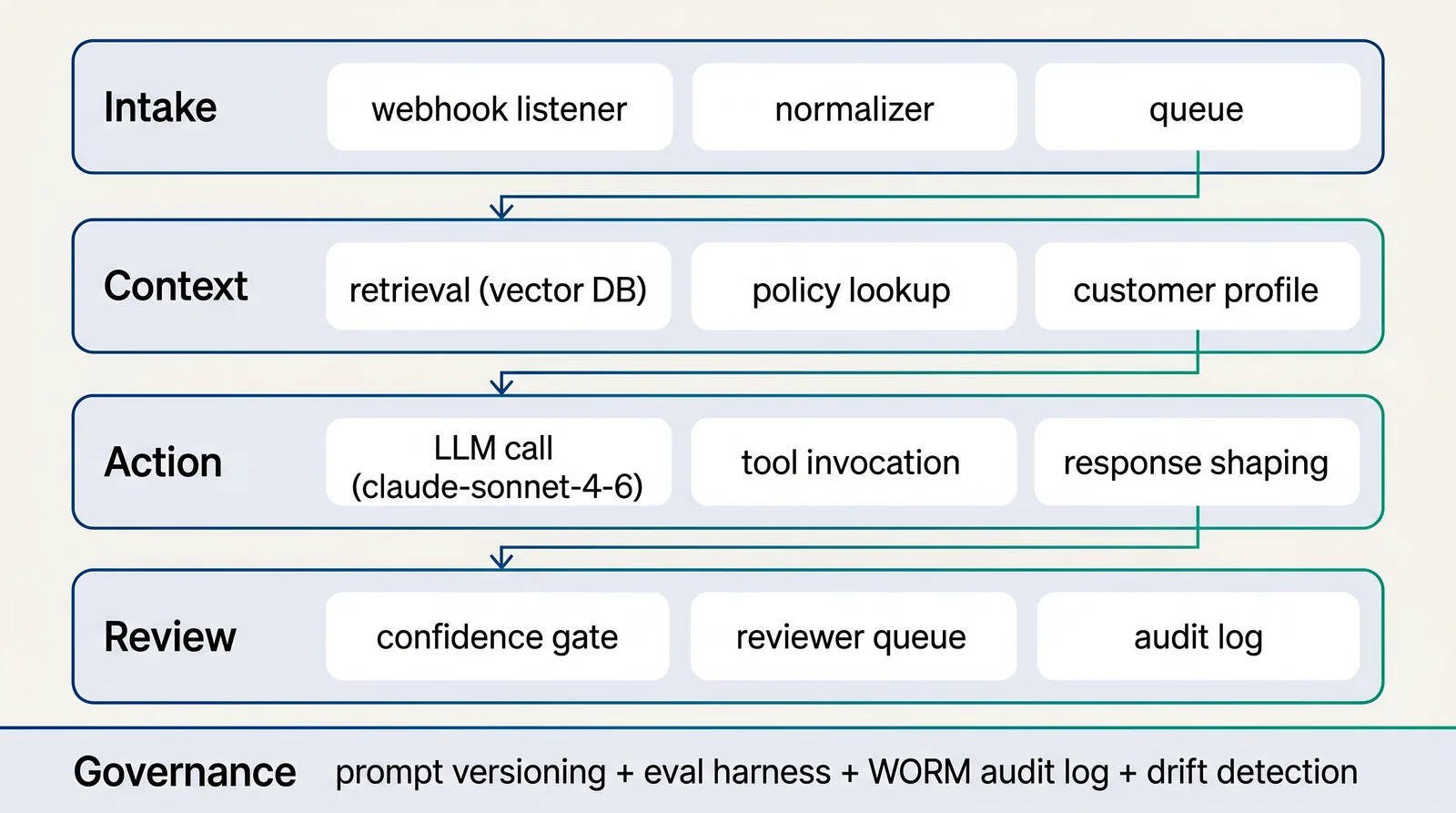
4-layer AI-native workflow for revenue & growth
Four layers, in the order data flows through them: intake (classify and tag), context (retrieve approved sources), action (draft, route, decide), review (humans on low-confidence and high-impact cases). Each layer is independently observable.See the full architecture diagram for Revenue & Growth →
AI-native vs traditional approach
How a scoped AI-native engagement compares to the alternatives for content marketing in consulting: in-house build, BPO retainer, generic SaaS subscription, traditional consulting engagement.
| Dimension | Traditional (in-house build or BPO) | AI-native engagement (us) |
|---|---|---|
| Lead time to live deployment | 6-12 months | 6-10 weeks (thin slice) |
| Engagement billing | Time-and-materials or annual contract | Phased fixed-price (Discovery → Build → opt Run) |
| Audit posture | Manual logs, periodic review | Versioned prompts, audit logs, reviewer queues, attestations |
| Per-operator capacity | 1.0× (baseline) | −75% |
| Per-case cost | Industry baseline | Sub-dollar marginal cost on routine envelope |
| Exit path | Knowledge transfer takes 6+ months | Documented exit at every phase; artefacts in your repo |
Traditional process automation projects cost $80-200k+ with 6-12 month payback; AI-native engagements deliver thin-slice production in 6-8 weeks with measurable baseline-vs-actuals reporting.
Engagement scope & pricing
We run this as a fixed-scope engagement with a clear commercial envelope, not an open-ended retainer.
Revenue engagement
Three phases, billed separately. You commit one phase at a time.
Phase 1 · Discovery
$5k
2-week sprint
Phase 2 · Build
$15k–$22k
6-8 weeks
Phase 3 · Run
$2k–$3k / mo
optional, hourly bank also available
~$25k–$45k typical year 1 (60% take the run option for ~6 months)
Outbound, growth, or revenue-ops workflow, integration with your CRM, weekly operating review during Run.
Start with Discovery; nothing more is required to begin. Build is scoped from the Discovery output. Run, if it happens, is month-to-month with no lock-in.
The 4-phase delivery model
Phase 1 · Weeks 1–2
Discovery
Workflow mapping, integration scoping, baseline capture, risk register, labelled-test-set seed. The output is the Build SoW with a fixed price and named deliverables.
Phase 2 · Weeks 2–4
Design
Design phase is where the irreversible architectural choices are made: layer boundaries, substitution interfaces, governance posture, evaluation methodology. We invest disproportionately here because corrections in Build are 10× more expensive.
Phase 3 · Weeks 4–8
Build
We ship a production thin slice on real data, with versioned prompts, evaluation harness, and human review.
Phase 4 · Weeks 8+
Run
Monthly month-to-month Run cadence: Monday metric review, Wednesday prompt and retrieval refresh, Friday calibration audit. The cadence is the deliverable; the prompts are the artefacts that change between cadence cycles.
Interactive ROI calculator
Estimate your AI-native ROI for content marketing
Reference inputs below are typical for consulting teams in the revenue cluster. Adjust them to match your situation.
Projected
Current monthly cost
$24,000
AI-native monthly cost
$7,920
Annual savings
$192,960
67% cost reduction · ~468 operator-hours freed / month
Governance and risk controls
Most "AI governance" frameworks consulting teams encounter are slide decks. Ours is a runtime: every inference call passes through guardrails (input filters, output validators, schema enforcement), every action is logged with the prompt and model version that produced it, every reviewer decision is captured. The framework documents what the runtime already enforces.
How we report ROI
Compounding is the under-rated ROI driver on content marketing. Week 1 of Run delivers the obvious gain — model handles the routine. By month 3, the prompt library, source corpus, and reviewer playbook are tuned to your specific consulting workflow. By month 6, the gap between your workflow and a generic AI agent is what makes the system hard to replace, internally or externally.
Selected portfolio
Real builds — content marketing in consulting and adjacent sectors
Below are engagements drawn from our active portfolio where the workflow rhymed with content marketing in consulting or in adjacent contexts. Scope and stack are accurate; client identities are withheld under engagement NDAs.
Q2 2026
Digital brand refresh + integrated recruitment platform for an IT consulting firm
Enterprise IT consulting boutique · Europe
Repositioning + redesign for a pure-staffing IT consulting house serving CIO buyers. Editorial architecture tightened around three expertise pillars (IT & SAP, cloud, cybersecurity), premium art direction, conversion-oriented UX, marketing-team-owned Sanity CMS, and an integrated recruitment funnel for senior consultant sourcing.
- Next.js + Framer Motion
- Sanity CMS (marketing-owned)
- Recruitment funnel
Q1 2026
Premium bilingual corporate site + internal CRM
Multi-vertical consulting group · Europe
Corporate marketing site with animated bento-grid editorial, bilingual content architecture, and an internal CRM behind the scenes for lead handling. Designed to project a premium positioning aligned with enterprise buyers while keeping marketing-team ownership of the content layer.
- Next.js + animated bento grids
- Bilingual content layer
- Internal CRM integration
Q1 2026
AI pricing system for startup founders — 9-step foundation + personalised AI brain
Founder-led pricing-strategy AI SaaS · DACH
First AI-powered pricing platform for startup founders. Structured 9-step pricing-foundation flow (product, customers, competition, costs, boundaries, model, strategy), personalised AI brain that learns from each business over time, two subscription tiers with money-back guarantee. Built end-to-end including billing, AI orchestration, and onboarding.
- Next.js + TypeScript
- Multi-LLM orchestration
- Subscription billing
Client identities withheld under engagement NDAs. Sector, geography, and scope are accurate. Full case studies on request.
Common pitfall & mitigation
The failure mode we see most often on AI-native content marketing engagements in consulting contexts.
Attribution loss
AI-generated touches blur the funnel; nobody knows what really worked
UTM convention + touch-level logging from day 1; weekly cohort analysis in the Run review
Building inside an organisation that builds for a living
Consulting teams have an unusual buyer profile for AI-native content marketing: the buyer is technical, the team already ships software, and the bar for what counts as production is high. The engagement model we run with consulting customers reflects that. We do not sell a black box; we ship code, prompts, and infrastructure-as-code that your engineering team can read, audit, fork, and extend.
The Build phase produces an artefact your engineers can inspect line-for-line. The prompt repository is version-controlled in your Git, not in our SaaS. The retrieval index lives in your cloud account, not ours. The evaluation harness is a CI pipeline you can extend. The reviewer UI is a React app in your codebase. The infrastructure-as-code is in your Terraform. We hand over a working workflow, not a vendor lock-in. The commercial advantage for us is that this transparency turns consulting engagements into long Run partnerships rather than short Build-and-leave engagements — your engineers find the value, your engineers extend it, and the next workflow we build together starts with shared context instead of cold scoping.
Where our engagement compounds value for consulting on content marketing is in the operational discipline around the model layer that engineering teams typically have not encoded yet: prompt versioning with evaluation gates, retrieval freshness with citation tracking, reviewer queues with calibration loops, model swapping with regression suites. Your team has shipped plenty of code; what we bring is the operating model for AI-native code specifically.
The consulting engagement model for content marketing is built around a hard constraint: your engineers will read every line of code we ship, and the line they would not have written themselves is the line that becomes the conversation. We design for that conversation from day one.
The prompt layer is documented at the rationale level, not just the syntax level — why this structure, why this retrieval shape, why this confidence threshold. The evaluation harness is structured as a test suite your team would write if they had three months to think about it. The reviewer UI is a React app with explicit state management, not a black box. The deployment pipeline is your existing CI, with our additions as standard GitHub Actions or equivalent. The artefacts we ship are the artefacts a senior engineer at your team would have shipped, with the prompts and evaluation discipline as the differentiator.
What we bring that your team would have spent six months reinventing is the operational discipline around the model layer. Prompt versioning that survives team turnover. Retrieval freshness that survives data-source schema drift. Reviewer queues that survive scale. Model swapping that survives provider outages. We have shipped the pattern enough times to know which pieces fail under real production load, which pieces look good in a slide deck and break in week three, and which pieces compound value over a year of operation. That experience is the engagement, not the code.
The concrete first-30-day delivery plan
Week 1 — Discovery handover and labelled test set capture. We sit with the operator team running content marketing today, watch a working day end to end, and capture 200+ real cases as the labelled test set. By Friday we have the workflow map, the system inventory (knowledge bases, CRM, and adjacent), the risk register, and the success metrics aligned with your KPI of organic pipeline.
Week 2 — Architecture and integration scoping. We design the four-layer workflow (intake, context, action, review), confirm the retrieval shape, lock the prompt strategy direction, and produce the integration plan against knowledge bases. The output is the Build statement of work with a fixed price and a named deliverable per phase.
Week 3-4 — Build sprint 1: retrieval and intake. We stand up the retrieval index against your approved sources, build the intake classifier, instrument the audit log, and run the first eval cycle against the labelled test set. The thin slice is functional but not production-deployed.
Week 5-6 — Build sprint 2: action and review. We ship the action layer, build the reviewer queue UI, calibrate the confidence thresholds against the labelled test set, and onboard the first reviewer cohort. By end of week 6 the workflow is processing low-stakes production traffic with full audit logging.
The rest of the Build phase widens the production envelope case-by-case based on the reviewer feedback loop. By the end of Build, content marketing for consulting is running on real traffic with the operating cadence already established.
The Build phase rhythm for content marketing in consulting is engineered for the bottleneck most teams hit at the end of week 2: ambition outrunning evidence. We engineer for the opposite — evidence first, ambition calibrated to it.
Week 1 produces the discovery report, the labelled test set, the integration plan, the risk register, the success metrics. Week 2 stands up the retrieval index, the intake classifier, the eval harness, the audit log. Week 3 wires the action layer with reviewer approval, runs the first three eval cycles, produces the first calibration report. Week 4 ships the thin slice to a narrow production audience (5-10% of routine cases), instruments the operator feedback loop, and runs the first weekly review.
By day 30, the dashboard is live, the system is processing real consulting cases, the operator team is engaging with the reviewer queue, the eval harness is gated on every change, and the next two weeks of Build are scoped from concrete evidence rather than initial assumptions. Days 31-45 widen the production envelope to 40-60% of routine cases. Days 46-60 absorb the remaining routine envelope and start handling the first tranche of exceptional cases. By the close of Build (day 60-70), the workflow is operating at its target envelope with the calibration discipline in place to handle drift, edge cases, and future model changes.
Closest precedent in our portfolio
The closest pattern reference we ship for content marketing in consulting is summarised below. Identity withheld under engagement NDA; sector and stack are accurate.
Premium bilingual corporate site + internal CRM. Corporate marketing site with animated bento-grid editorial, bilingual content architecture, and an internal CRM behind the scenes for lead handling. Designed to project a premium positioning aligned with enterprise buyers while keeping marketing-team ownership of the content layer. (Multi-vertical consulting group · Europe, Q1 2026.)
The architectural choices that worked there translate to consulting content marketing with two adjustments: the data-source mix shifts to match your operating systems (knowledge bases, CRM, and adjacent), and the reviewer SLAs adjust to your team's operating cadence. The four-layer pattern (intake, context, action, review), the evaluation discipline, and the audit posture are portable.
For US buyers
US compliance scaffolding for content marketing in consulting (NIST AI RMF)
Consulting engagements touching US clients on content marketing ship with the regulatory scaffolding your procurement, compliance, and legal teams expect. The framework that matters most for consulting is NIST AI Risk Management Framework (AI 100-1) (NIST AI RMF) — addressed below alongside the adjacent frames we encounter.
NIST AI RMF
NIST AI Risk Management Framework (AI 100-1)
Authority: U.S. National Institute of Standards and Technology
- Scope
- Voluntary framework: Govern, Map, Measure, Manage functions for AI system risk.
- How we ship inside it
- Every engagement maps to NIST AI RMF during Discovery. The control map produced becomes the artefact your internal audit and security teams use to defend the workflow.
For US companies
Start a US-friendly engagement
Discovery from $8,500–$12,000, Build from $35,000–$75,000, optional Run from $5k/mo. Fixed-price, milestone-billed, you own every artefact. Send a short brief and we reply within 5 business days. 11am–4pm ET overlap for live syncs.
USD pricing
Discovery $8,500–$12,000 · Build $35,000–$75,000
US-style commercial
MSA / SOW / mutual NDA standard. DPA with SCCs included.
Limited capacity
We onboard 3–5 new clients per quarter to protect delivery quality.
What the 2026 production data says
Vendors are moving from seat-based to usage-based pricing as agentic workloads grow, which pushes inference cost from a footnote to the centre of the business case. For content marketing in consulting, that means the run cost belongs in the proposal, not in a later invoice. Our engagements state it before signature, and our cost calculator is public so you can check the arithmetic yourself.
Read the full breakdown of the pilot-to-production gap — the three failure modes, with the 2026 sources.
Build internally or work with us
The opportunity cost of building first in consulting is often invisible: 6-9 months spent hiring, tooling, and converging on a reference architecture is 6-9 months of competitors shipping. The engagement model we propose front-loads the reference architecture and the senior delivery team, then transitions the operation to your team once the pattern is proven.
What to ask us before signing
- Ask for a 30/60/90-day plan with named deliverables, not a vague phase description.
- Ask how we handle the long tail of edge cases the operator team has never encoded — escalation, calibration, capture.
- Ask for the model and provider strategy — single-model, multi-model, fallback paths, cost forecasting.
- Ask how the reviewer queue UX is designed and whether your operator team can shape it during Build.
- Ask for references from consulting-adjacent engagements — sector, scope, and outcome dimensions.
Recommended first project
Pick the content marketing flow that has three properties: high enough weekly volume to produce a labelled test set quickly, structured enough to evaluate, and reversible if a decision is wrong. That is the wedge that ships fast, proves adoption, and earns the credibility to extend into the harder cases. The first 30 days are spent on the labelled test set, the integration to knowledge bases, and the thin-slice workflow. The next 60 days are spent operating the thin slice on real consulting traffic, widening the automation envelope week by week. By day 90 you have an empirical track record, not a vendor's projection, and the next workflow can be scoped against that evidence.
Frequently asked questions
How do you automate content marketing in consulting with AI?+
We map the existing content marketing workflow inside consulting, identify the high-volume, high-structure tasks, and build an AI agent that handles those tasks while routing low-confidence cases to a human reviewer. The build connects to your knowledge bases, CRM, project management, runs against a labelled test set, and ships behind a reviewer queue before it sees production traffic. We then operate it, measure organic pipeline, publication cadence, content refresh rate, and assisted conversions, and improve it weekly.
What does it cost to automate content marketing for consulting teams?+
~$25k–$45k typical year 1 (60% take the run option for ~6 months). The structure: $5k Discovery (2-week sprint) → $15k–$22k Build (6-8 weeks) → optional $2k–$3k / mo Run. Outbound, growth, or revenue-ops workflow, integration with your CRM, weekly operating review during Run.
What is the best AI agent for content marketing in consulting?+
Model selection on content marketing for consulting happens against five criteria: quality on your labelled test set, cost per inference at your projected volume, latency budget for the user-facing path, provider reliability over 12-18 months, contractual data-handling posture. We bring the comparative methodology from prior engagements and run it during Build; the winning model is the one that survives all five, not the one that wins the demo.
How long does it take to deploy AI content marketing for consulting?+
A thin-slice deployment in 2-week sprint after Discovery, with real consulting data and real reviewers. The full Build phase runs 6-8 weeks. By day 90, organic pipeline, publication cadence, content refresh rate, and assisted conversions is instrumented, the team has a baseline, and leadership has the data needed to decide on expansion into adjacent consulting workflows.
What do we own, and what do you own?+
What we ship as code lives in your repository under your IAM. The prompts, the evaluation harness, the integration code, the reviewer UI, the infrastructure-as-code — all in your Git, not in our SaaS. We bring the engineering, the operating discipline, and the cadence; you bring the data, the policy, and the operator team. The handover is documented from day one of Build, not deferred to the end.
What's the revenue ROI shape for content marketing in consulting?+
organic pipeline, publication cadence, content refresh rate, and assisted conversions is the bridge metric to utilization, delivery margin, proposal win rate, research cycle time, and client satisfaction. The first 30 days are negative (engagement cost vs. limited production volume); month 3 typically hits break-even; months 4-12 are strongly positive as the labelled test set grows and the prompt library tunes to your category.
Do you train models on our data?+
No. We do not train any model on client data. Anthropic Zero-Data-Retention is enabled by default; OpenAI default-no-training is honoured. Prompts, retrieval indexes, audit logs, and integration data live in your cloud account under your IAM. At engagement end, every artefact transfers to your repository.
What if we want to exit the engagement?+
Discovery and Build are fixed-scope, so there is no mid-engagement exit cost. Run is month-to-month with 30-day notice. Every artefact (prompts, eval harness, integration code, dashboards, runbooks) is in your repository throughout the engagement, not behind our SaaS. There is no lock-in.
What does success look like 90 days after Build closes?+
organic pipeline, publication cadence, content refresh rate, and assisted conversions measurably improved against the Discovery baseline. Your team is operating the workflow with the cadence we shipped during Build. The audit log is queryable. The reviewer queue is calibrated. The next workflow scope is informed by real production evidence rather than initial assumptions.
What support is included after the engagement ends?+
Optional Run retainer covers weekly cadence, prompt refresh, retrieval index updates, and reviewer-queue calibration. Architecture-level questions and breaking-change support are billed hourly outside of Run. Most engagements transition Run in-house at month 6-12; we stay available for architecture decisions for 12 months at no extra charge.
How does this integrate with knowledge bases and our existing stack?+
Discovery scopes the integration footprint explicitly. We integrate at the API layer; no replatforming required. The Build statement of work names exactly which systems are connected, which data flows are bidirectional, and what authentication patterns we use (SSO, service accounts, OAuth scopes). The integration code lives in your repository.
What does your team look like during an engagement?+
Discovery: 1 senior delivery lead + 1 PM, ~30 hours/week. Build: 1 senior delivery lead + 2-3 senior AI engineers, ~50-80 hours/week across the team. Run: 1 delivery owner + 1 engineer on weekly cadence. We do not use offshore staff augmentation. Every engineer touching your engagement is senior-level.
Sources we reference
The following sources inform the architecture, governance, and benchmarks we apply on consulting engagements. Cited here so you can verify and dig deeper.
- OECD AI Policy Observatory
- AI Index Report — Stanford HAI
- The State of AI — McKinsey & Company
- B2B Sales Pulse Survey — Gartner for Sales
- State of Sales Report — Salesforce Research
- Google Search Central: helpful, reliable, people-first content
- Google Search Central: URL structure best practices
High-intent reads
Start the engagement
Start a Consulting engagement
Tell us about your workflow, the systems involved, and the KPI you want to move. We'll send a scoped statement of work within 5 business days.