Healthcare · Risk & Compliance
Pass Your Next Biotechnology Audit with AI-Native Quality Assurance
A scoped engagement page for biotech founders, clinical operations teams, business development leaders, and scientific program managers evaluating quality assurance. We cover deliverables, timeline, pricing, controls, and the reporting cadence we run during the Build and optional Run phases.
Projects from $15k · Refundable 7 days · Kickoff within 5 days
Early access: we work with a small first cohort. Engagements are scoped, priced, and shipped end-to-end by our team — not referred to third parties.
In one sentence
AI-native quality assurance for biotechnology — Fixed-price phases that take quality assurance from a Discovery baseline to a production thin slice on real biotechnology traffic, with the operating cadence handed over to your team by the end of Build. Expected delta on defect rate: −87%.
Key facts
- Industry
- Biotechnology
- Use case
- Quality Assurance
- Intent cluster
- Risk & Compliance
- Primary KPI
- defect rate, review cycle time, rework, and audit findings
- Top benchmark
- Review backlog clearance: 14 days → 1.8 days (−87%)
- Systems integrated
- ELN, LIMS, clinical trial systems
- Buyer
- biotech founders, clinical operations teams, business development leaders, and scientific program managers
- Risk lens
- scientific validity, IP protection, trial documentation, privacy, and investor communication accuracy
- Engagement timeline
- Discovery 3 weeks → Build 8 weeks → Run continuous (regulated industry)
- Team size
- 2 senior delivery + 1 part-time reviewer trainer
- Discovery price
- $8k · 2-3 week sprint
- Build price
- $30k–$40k · 8-12 weeks
Primary outcome
detect quality issues earlier and standardize review
What we ship
quality monitoring assistant, inspection workflows, defect taxonomy, and corrective action summaries
KPIs we report on
defect rate, review cycle time, rework, and audit findings
Why Biotechnology teams hire us for this
For biotechnology leadership, the appetite for quality assurance automation lives in a narrow band: too cautious and the volume keeps growing while operator costs compound; too aggressive and one bad public failure resets the entire program. AI-native delivery is calibrated for the middle — confident automation on the routine, deliberate review on the unusual, full human ownership on the policy edge.
Biotechnology compliance teams routinely report that reviewing AI-generated outputs is faster than reviewing human-generated outputs — as long as the AI system surfaces the supporting evidence at the same time. That is a design choice, not a model capability.
Industry context: Mid-market and enterprise operators face the same fundamental tradeoff: AI must compress operational cycle time while remaining auditable and integrable with existing systems of record.
Benchmarks we hit
Reference benchmarks from production deployments of quality assurance in biotechnology-comparable contexts. Sources noted per row. Your actuals are measured against the baseline captured in Discovery.
| Metric | Industry baseline | AI-native typical | Delta |
|---|---|---|---|
Review backlog clearance False-positive triage automated; reviewers see only the cases that need them | 14 days | 1.8 days | −87% |
False-positive rate (initial alerts) Lift from grounded context + multi-step reasoning before alert escalation | 78% | 31% | −60% |
Reviewer throughput per FTE AI pre-assembles evidence; reviewer makes the policy decision in <2 min average | 1.0× | 3.1× | +210% |
Benchmarks are reference values from comparable engagements and authoritative sector benchmarks. Your engagement's baseline is captured during Discovery and actuals are reported weekly during Run against that baseline.
How we operate the workflow
We do not hand over a prompt library and walk away. The Run phase is where the value compounds: weekly performance review, prompt refresh against new edge cases, retrieval index updates, escalation pattern analysis. After 6 months of Run, the workflow looks meaningfully different from day-1 deployment — and Biotechnology leadership has the data to prove the improvement.
What we build inside the workflow
The single most common mistake we see biotechnology teams make when Building quality assurance is over-investing in prompt quality and under-investing in evaluation infrastructure. We invert that ratio: prompts are iterated weekly against a fixed labelled test set, and the labelled test set is treated as the most valuable artefact of the engagement. Without it, every change is a guess.
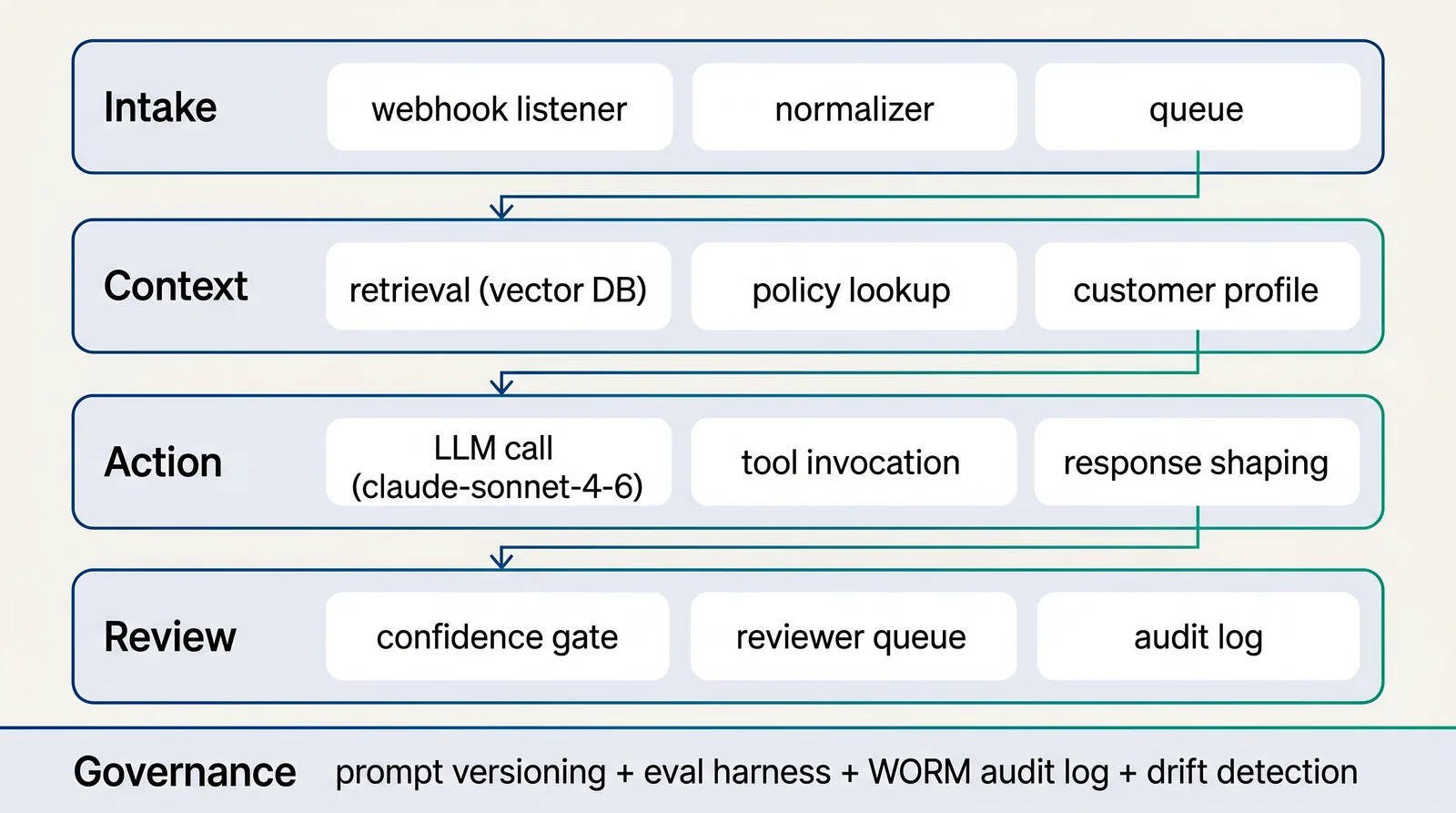
Reference architecture
4-layer AI-native workflow for risk & compliance
Intake → context → action → review. The loop is closed: every reviewer decision feeds the next iteration of the prompt and the retrieval index. Without the closed loop, accuracy degrades silently over months.See the full architecture diagram for Risk & Compliance →
AI-native vs traditional approach
Biotechnology teams considering quality assurance typically weigh four paths: in-house build with new hires, BPO contract, generic AI SaaS, or AI-native engagement. The table below compares the trade-offs.
| Dimension | Traditional (in-house build or BPO) | AI-native engagement (us) |
|---|---|---|
| Time-to-first-traffic | Multi-quarter program | 8-week thin-slice ship target |
| Commercial structure | Monthly retainer with FTE assumptions | Discovery, Build, Run priced independently |
| Control surface | Manual audit cycles | Versioned artefacts, signed audit log, named owners per control |
| Throughput-per-FTE | 1.0× (baseline) | −60% |
| Unit economics | Unchanged from baseline | 60-80% lower on routine cases |
| Termination clause | Multi-quarter notice; documentation gaps | Month-to-month Run; handover plan in Build SoW |
Traditional process automation projects cost $80-200k+ with 6-12 month payback; AI-native engagements deliver thin-slice production in 6-8 weeks with measurable baseline-vs-actuals reporting.
Engagement scope & pricing
Phased and fixed-price by default. You commit one phase at a time, with a defined deliverable per phase.
Governed engagement
Discovery → Build → Run, each phase committable on its own. No bundling, no annual minimum.
Phase 1 · Discovery
$8k
2-3 week sprint
Phase 2 · Build
$30k–$40k
8-12 weeks
Phase 3 · Run
$4k–$6k / mo
optional, quarterly attestations available
~$52k–$90k typical year 1 (~80% take the run option, regulated workflows need ongoing controls)
Controls, audit logs, reviewer queues, versioned prompts, and quarterly risk attestations.
Two-week Discovery, then your decision. Build is fixed-price against the Discovery output. Run, if you opt in, is month-to-month with a documented exit path.
The 4-phase delivery model
Phase 1 · Weeks 1–2
Discovery
Two weeks of structured discovery: workflow walk-through, system inventory, decision-owner mapping, baseline KPI capture, risk register. Output: a fixed-scope statement of work for Build.
Phase 2 · Weeks 2–4
Design
Design phase is where the irreversible architectural choices are made: layer boundaries, substitution interfaces, governance posture, evaluation methodology. We invest disproportionately here because corrections in Build are 10× more expensive.
Phase 3 · Weeks 4–8
Build
Build is paced by the evaluation harness: every prompt change must beat the incumbent on the labelled test set across enough metric slices to be promoted. The harness is what makes Build defensible.
Phase 4 · Weeks 8+
Run
Optional Run phase, month-to-month, no lock-in. Weekly performance review against the Discovery baseline. Quarterly architecture retrospective. The cadence is documented; your team can absorb it any time.
Interactive ROI calculator
Estimate your AI-native ROI for quality assurance
Reference inputs below are typical for biotechnology teams in the risk compliance cluster. Adjust them to match your situation.
Projected
Current monthly cost
$57,000
AI-native monthly cost
$20,070
Annual savings
$443,160
65% cost reduction · ~656 operator-hours freed / month
Governance and risk controls
scientific validity, IP protection, trial documentation, privacy, and investor communication accuracy. Those concerns are addressed by architecture, not by policy documents. We ship a control map alongside the workflow — what data sources are approved, what model versions are deployed, what reviewer queues exist, what escalation paths trigger, what attestation cadence we run. The map is on the same dashboard as the workflow metrics, not in a shared drive nobody reads.
How we report ROI
For biotechnology CFOs evaluating quality assurance engagements, the cleanest ROI framing is unit economics: cost per case before vs after, throughput per FTE before vs after, error rate before vs after. We instrument all three from the Discovery baseline and report against them weekly. No abstract "productivity gain" claims; concrete dollars and minutes.
Selected portfolio
Real builds — quality assurance in biotechnology and adjacent sectors
Below are engagements drawn from our active portfolio where the workflow rhymed with quality assurance in biotechnology or in adjacent contexts. Scope and stack are accurate; client identities are withheld under engagement NDAs.
Q3 2025
Radiology workflow application — case handling and reporting
Medical imaging operator · Europe
Application supporting radiology workflow: case intake, structured reporting, document handling, and quality-assurance loop. Designed for regulated medical-imaging context with audit trail and role-based access.
- Web app + secure storage
- Structured reporting
- Audit-trail compliance
Q2 2026
Authenticated remote voting platform — AGM resolutions, audit trail, EN/AR bilingual
Mid-market property operator · GCC region
Purpose-built e-voting system: per-unit cryptographic authentication, AGM resolution console for admins, real-time tally, full per-vote audit log. Federated identity with the OA management platform so owners use one login. Bilingual EN/AR from day one.
- Next.js + tRPC
- Per-unit auth + audit trail
- Bilingual EN/AR (next-intl)
Q1 2026
AI-powered interior design platform — generative room concepts for the MEA market
AI interior design SaaS · MEA region
Vertical AI SaaS for interior design in the Middle East: image-conditioned generation tuned for local taste profiles, room-by-room concept workflow, project export for designers and clients. Built with a market-specific dataset and an evaluation loop on regional aesthetic baselines.
- Next.js + image generation pipeline
- Regional taste-profile tuning
- Designer + client export flows
Client identities withheld under engagement NDAs. Sector, geography, and scope are accurate. Full case studies on request.
Common pitfall & mitigation
The failure mode we see most often on AI-native quality assurance engagements in biotechnology contexts.
Regulator surprise at first attestation
Audit trail is incomplete; reviewer left a 3-week gap in week 4
Audit log designed as primary artifact (not log-as-afterthought); weekly attestation rehearsal
Defensible delivery in a regulated environment
Biotechnology sits inside a regulatory perimeter that an AI-native workflow has to inhabit, not bolt onto afterwards. For quality assurance, the perimeter includes: data residency rules for the source corpus, model-output traceability for any decision affecting a customer, replayability for the regulator's audit window, and named human accountability for every category of decision. We capture each of those requirements during Discovery, before any code is written, and the Build statement of work names which control implements which requirement. The output is an architecture where compliance is not a phase — it is a layer that lives in the same dashboard as the operating metrics.
The specific controls we ship for biotechnology engagements track the published expectations of the relevant supervisory bodies. The model registry records every prompt and model version that touched a decision, with an immutable hash. The retrieval index documents source provenance, freshness, and approval status per document. The reviewer queue captures the human owner, the timestamp, and the rationale for every escalation. The attestation pack — exportable on demand — bundles the above for any 30/60/90-day window the regulator chooses. This is the same shape that internal audit teams in biotechnology have been refining for a decade; we replicate it inside the AI-native operating layer instead of duplicating it in a separate evidence binder.
Where we depart from a traditional risk-and-controls program is in cadence. The classic posture treats compliance as an annual or quarterly attestation; the AI-native posture treats it as a weekly heartbeat. Every Monday during Run we sample low-confidence decisions, calibrate thresholds, and produce a drift report. Every quarter we run a red-team exercise on the most consequential flows. The compliance officer joining one of those Monday reviews sees the same dashboard the operators see, with attestation-ready evidence one click away. That continuity is what auditors recognize as a controlled environment, and it is what lets biotechnology leadership defend the workflow when the next supervisory examination arrives.
Internal audit teams in biotechnology are increasingly comfortable with AI in workflows, provided three conditions hold. The system is documented (model card, prompt repository, retrieval source list, threshold rationale). The decisions are traceable (audit log of inputs, outputs, model version, reviewer disposition). The controls are testable (the auditor can pull a random sample of cases and verify the workflow operated as documented). We engineer for all three from week one of Build because the alternative — retrofitting them into a working AI system — costs 4-6x as much and produces an inferior result.
From kickoff to thin-slice production
For biotechnology engagements on quality assurance, the first 30 days are not about building features — they are about producing the labelled test set that will govern every subsequent decision. The test set is the most valuable artefact of the engagement, because it is what makes "did this change make the workflow better?" a measurable question instead of an opinion.
We spend week 1 on test-set capture. The operator team picks 200-400 representative cases spanning routine, exceptional, ambiguous, and adversarial. Each case has the expected outcome, the expected reasoning, and the source citations a reviewer would want to see. The test set is reviewed for coverage gaps, signed off by the engagement sponsor, and version-controlled alongside the prompts.
From week 2, every prompt change, retrieval-index update, and threshold calibration is gated by the eval harness running against this test set. Improvements that beat the incumbent across enough metric slices get promoted; changes that look impressive on one slice but regress on another are flagged for review. By the end of Build, the test set has grown to 600-1000 cases, the workflow has been through 15-25 eval cycles, and biotechnology leadership has empirical evidence that the system performs on their data, not on a vendor's demo.
This is the practice most biotechnology AI projects skip because it looks like overhead in the first three weeks. It is the practice that determines whether the workflow survives the third quarter of Run, which is why we treat it as the foundation of Build rather than an afterthought.
A comparable engagement we have shipped
The engagement that most closely rhymes with quality assurance in biotechnology is summarised below. Identity withheld under engagement NDA; sector and stack are accurate.
Radiology workflow application — case handling and reporting. Application supporting radiology workflow: case intake, structured reporting, document handling, and quality-assurance loop. Designed for regulated medical-imaging context with audit trail and role-based access. (Medical imaging operator · Europe, Q3 2025.)
What carries over is the operating discipline — the labelled test set as foundational artefact, the weekly evaluation cadence, the audit log architecture, the reviewer-queue UX. What we re-scope is the integration surface specific to biotechnology (ELN and the adjacent systems) and the prompt strategy tuned to the quality assurance vernacular in your category.
For US buyers
US compliance scaffolding for quality assurance in biotechnology (FDA 21 CFR Part 11, NIST AI RMF)
Biotechnology engagements touching US clients on quality assurance ship with the regulatory scaffolding your procurement, compliance, and legal teams expect. The framework that matters most for biotechnology is Electronic Records and Electronic Signatures (FDA 21 CFR Part 11) — addressed below alongside the adjacent frames we encounter.
FDA 21 CFR Part 11
Electronic Records and Electronic Signatures
Authority: U.S. Food and Drug Administration
- Scope
- Validation of electronic records in GxP environments, audit trails, electronic signatures, system access controls.
- How we ship inside it
- Pharma and medical-device engagements include 21 CFR Part 11 system validation documentation: design qualification (DQ), installation qualification (IQ), operational qualification (OQ), performance qualification (PQ). Audit trails are tamper-evident and signature-bound.
NIST AI RMF
NIST AI Risk Management Framework (AI 100-1)
Authority: U.S. National Institute of Standards and Technology
- Scope
- Voluntary framework: Govern, Map, Measure, Manage functions for AI system risk.
- How we ship inside it
- Every engagement maps to NIST AI RMF during Discovery. The control map produced becomes the artefact your internal audit and security teams use to defend the workflow.
For US companies
Start a US-friendly engagement
Discovery from $8,500–$12,000, Build from $35,000–$75,000, optional Run from $5k/mo. Fixed-price, milestone-billed, you own every artefact. Send a short brief and we reply within 5 business days. 11am–4pm ET overlap for live syncs.
USD pricing
Discovery $8,500–$12,000 · Build $35,000–$75,000
US-style commercial
MSA / SOW / mutual NDA standard. DPA with SCCs included.
Limited capacity
We onboard 3–5 new clients per quarter to protect delivery quality.
What the 2026 production data says
The failure mode that costs the most in biotechnology is not an agent that crashes — it is one that answers a small share of quality assurance cases wrong without raising an alert, for weeks, in front of customers. Most 2026 pilots ship with uptime monitoring and no output monitoring. We treat the eval harness as build scope, not polish, which is why we publish ours rather than describe it.
Read the full breakdown of the pilot-to-production gap — the three failure modes, with the 2026 sources.
Build internally or work with us
For biotechnology CTOs already running an ML platform, the value we bring is not engineering — it is the operating model and the productized governance stack. We have shipped enough variations of this workflow to know what fails in production, what reviewer queues look like at scale, and what evaluation cadence actually catches drift. Reusable knowledge, not reusable code.
What to ask us before signing
- Ask for the labelled test set methodology — how many cases, what the coverage gaps are, who signs them off.
- Ask where the prompt library and retrieval index will live (your cloud or ours) and what happens to them at the end of Run.
- Ask how we calibrate confidence thresholds and how often they are revisited against the biotechnology reality.
- Ask for the audit log architecture — what is logged, how long it is retained, who can query it.
- Ask how a senior operator on your team becomes the first reviewer and what onboarding we ship to support them.
Recommended first project
If you can pick only one wedge, pick the quality assurance subflow that is currently absorbing the most senior-operator time on cases that are mostly routine but require context the system does not surface today. That subflow has the highest immediate ROI and the cleanest path to a labelled test set. We have shipped this pattern across enough biotechnology engagements to know which subflows compound and which stall. The Discovery sprint identifies the wedge concretely. The Build phase ships it as a thin slice within 6-8 weeks. The Run phase compounds value as the labelled test set grows, the prompt library tunes to your category, and the reviewer team calibrates against real traffic. The 90-day milestone is a defensible empirical track record on which to scope the next engagement.
Frequently asked questions
How do you automate quality assurance in biotechnology with AI?+
For biotechnology, the build is biased toward operational durability over demo-grade polish. We instrument every case end-to-end (intake → context → action → review), gate every prompt change behind an evaluation harness, and integrate against ELN + LIMS. The workflow goes to production in 6-10 weeks and operates against defect rate, review cycle time, rework, and audit findings.
What does it cost to automate quality assurance for biotechnology teams?+
Phased pricing — you commit to one phase at a time. Discovery is $8k for 2-3 week sprint. Build, scoped from Discovery, runs $30k–$40k over 8-12 weeks. Run is opt-in at $4k–$6k / mo per optional, quarterly attestations available. ~$52k–$90k typical year 1 (~80% take the run option, regulated workflows need ongoing controls)
What is the best AI agent for quality assurance in biotechnology?+
The model is rarely the most consequential choice on quality assurance in biotechnology. What matters more: the retrieval shape against your approved sources, the confidence-threshold calibration against the labelled test set, the reviewer queue UX, and the audit log architecture. We benchmark frontier models (Claude, GPT-4-class, Gemini) against your data and select for the accuracy/cost/latency profile that fits your operational reality — not a generic leaderboard.
How long does it take to deploy AI quality assurance for biotechnology?+
Production traffic on quality assurance for biotechnology typically starts at week 6-8 of Build, after the labelled test set, the eval harness, the reviewer queue, and the audit log are all in place. The first quarter of Run is paired operation — your team takes the dashboard, we stay on the architecture decisions. By the end of the first Run quarter, your team is operating the workflow with the cadence we ship as part of Build.
What do we own, and what do you own?+
The ownership boundary is documented in the Build statement of work. Our side: workflow architecture, prompt library, retrieval shape, evaluation harness, reviewer-queue design, audit log architecture, weekly operating cadence. Your side: data access, source curation by your subject-matter experts, policy interpretation, exception approval, final commercial decisions. Every artefact is yours at the end of Run.
How do you keep quality assurance defensible to supervisors and internal audit?+
Three properties wired into the architecture: explainability (every decision ships with supporting evidence), replayability (every inference call is reconstructible from the audit log), segregation of duties (lanes for full automation, drafted-with-review, reserved-to-human are documented and instrumented). Together they answer the three questions internal audit and supervisors ask about quality assurance in biotechnology.
Do you train models on our data?+
No. We do not train any model on client data. Anthropic Zero-Data-Retention is enabled by default; OpenAI default-no-training is honoured. Prompts, retrieval indexes, audit logs, and integration data live in your cloud account under your IAM. At engagement end, every artefact transfers to your repository.
What if we want to exit the engagement?+
Discovery and Build are fixed-scope, so there is no mid-engagement exit cost. Run is month-to-month with 30-day notice. Every artefact (prompts, eval harness, integration code, dashboards, runbooks) is in your repository throughout the engagement, not behind our SaaS. There is no lock-in.
What does success look like 90 days after Build closes?+
defect rate, review cycle time, rework, and audit findings measurably improved against the Discovery baseline. Your team is operating the workflow with the cadence we shipped during Build. The audit log is queryable. The reviewer queue is calibrated. The next workflow scope is informed by real production evidence rather than initial assumptions.
What support is included after the engagement ends?+
Optional Run retainer covers weekly cadence, prompt refresh, retrieval index updates, and reviewer-queue calibration. Architecture-level questions and breaking-change support are billed hourly outside of Run. Most engagements transition Run in-house at month 6-12; we stay available for architecture decisions for 12 months at no extra charge.
How does this integrate with ELN and our existing stack?+
Discovery scopes the integration footprint explicitly. We integrate at the API layer; no replatforming required. The Build statement of work names exactly which systems are connected, which data flows are bidirectional, and what authentication patterns we use (SSO, service accounts, OAuth scopes). The integration code lives in your repository.
What does your team look like during an engagement?+
Discovery: 1 senior delivery lead + 1 PM, ~30 hours/week. Build: 1 senior delivery lead + 2-3 senior AI engineers, ~50-80 hours/week across the team. Run: 1 delivery owner + 1 engineer on weekly cadence. We do not use offshore staff augmentation. Every engineer touching your engagement is senior-level.
Sources we reference
The following sources inform the architecture, governance, and benchmarks we apply on biotechnology engagements. Cited here so you can verify and dig deeper.
- NIH Artificial Intelligence
- Hype Cycle for Artificial Intelligence — Gartner
- MIT Sloan Management Review — AI & Business Strategy — MIT Sloan
- Model Risk Management Handbook — Federal Reserve (SR 11-7)
- Principles for the Sound Management of AI Risks — BIS Financial Stability Institute
- Google Search Central: helpful, reliable, people-first content
- Google Search Central: URL structure best practices
Concepts on this page:
AI governance·NIST AI RMF·Audit log·Grounding·Guardrails·Model cardFull glossary →High-intent reads
Start the engagement
Start a Biotechnology engagement
Tell us about your workflow, the systems involved, and the KPI you want to move. We'll send a scoped statement of work within 5 business days.